No, Thank You, Uncle
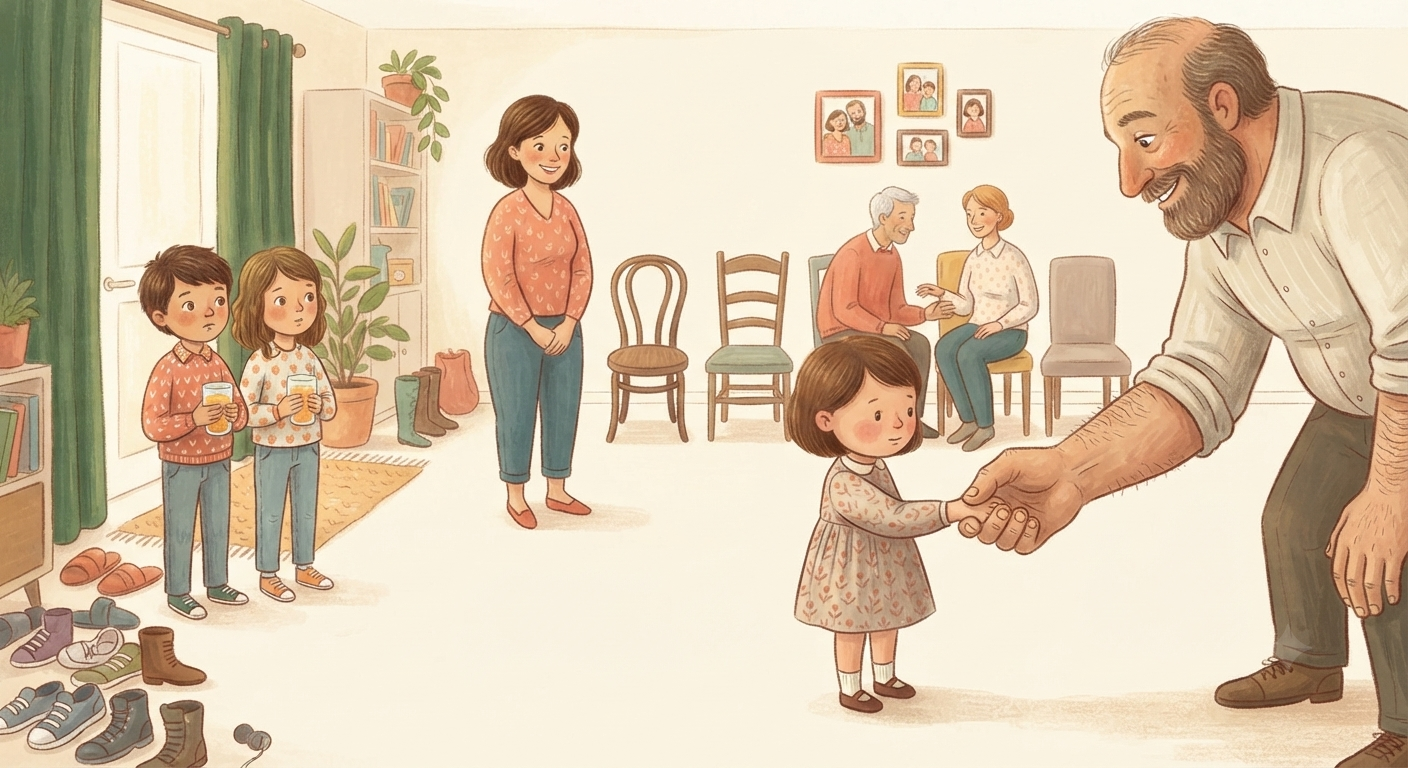
On Sunday the chairs came in from three different houses.
Papa carried two down from upstairs. Nani wiped them with a cloth. By eleven o’clock there were chairs all along the wall, and shoes in a heap at the door. The good glasses were down from the top cupboard — the ones with gold rings round them.
Ira was under the table.
From under the table, the world was legs. Papa’s legs, going fast. Nani’s legs, going slowly. The leg of the table with the chip out of it. That one was her favourite, because you could put one finger in the chip.
She counted the shoes at the door. Fourteen. Then sixteen. Then a very big pair of brown sandals came in, and it was eighteen.
“Where is she?” said a big voice. “Where is my Ira?”
Uncle Prakash came twice a year. He had a laugh you could hear from the stairs. He always brought a paper bag of orange sweets. And he always, always wanted a hug.
Ma’s hand came under the table and found Ira’s shoulder. Her thumb went round in a small circle. Once. Twice.
Ira came out. But she came out slowly. Her feet went one small step, and then one smaller step, and then they stopped altogether behind Ma’s leg.
Uncle Prakash bent down. He put his arms out wide, the way he always did. Like a gate opening.
“Come, come,” he said. “Big hug for uncle.”
The whole room was looking. Nani was looking. Both cousins were looking, with their orange squash halfway to their mouths. Somebody’s phone was already up.
Ira held on to Ma’s sleeve with two hands and did not come out.
“Arre,” said Uncle Prakash. “So shy!”
“Go, beta,” said somebody near the window. “Just one hug.”
Ira put her face into the cloth of Ma’s kurta. It smelled of ironing.
And Ma put a hand on Ira’s head and said, “She’ll shake hands.”
That was all. She did not say sorry. She did not say Ira was tired, or shy, or being difficult. She said it the way you say the time, and then she waited.
Nobody said anything. In the kitchen the pressure cooker went off, one long whistle, and Nani went to see about it.
Uncle Prakash’s arms came down. His face did a small thing — a little bump, like when you find the last laddoo is gone. Then he took his big hand out of his pocket and held it out flat.
“Shake hands, then,” he said.
Ira looked at the hand. It was very wide. There was a gold ring on one finger and a small white scar near the thumb. It was the kind of hand that could pick up a whole watermelon.
She let go of Ma’s sleeve. She walked three steps out into the middle of the floor, past all the chairs. And she put her hand into Uncle Prakash’s hand.
Then she put her other hand in too. One hand did not seem like enough for a hand that big.
They shook. Up, down. Up, down. Very slowly, and very seriously, like two people who had just agreed about something important.
“Hah!” said Uncle Prakash. “Businesswoman.”
He laughed his stairs laugh. The cousins laughed, and their orange squash still had not moved. Somebody took a photo anyway.
Later, when the plates were going round, he gave her the paper bag of orange sweets. Ira took it with both hands.
“Thank you, uncle,” she said.
And she sat down next to him, on the chair from upstairs, and ate two.
Talk About It
- Ira didn't want a hug. Uncle Prakash did want one. Was either of them being naughty?
- Ma said one small sentence and then stopped talking. What do you think would have happened if she hadn't said anything at all?
- If somebody wants a hug and you don't want to give one, what else could you do? Let's think of two things you could try.
Did this story land tonight?
One tap helps us write better ones. No login, nothing shared publicly.
Thank you — this genuinely helps. 🌙