Not Even My Friend
Let’s be honest about Pranav first, because the story doesn’t work otherwise.
Pranav was annoying. Not tragic. Not secretly wonderful. Annoying, in known and documented ways. He corrected teachers on pronunciation — and was right, which made it worse. He announced his own marks. He had opinions on your tiffin, your handwriting, your bowling action, and he delivered them like a boy providing a public service. In four years of the same class, Zain had exchanged maybe two hundred sentences with him and enjoyed roughly none. When groups were assigned, nobody fought over Pranav.
This matters. In stories, the kid who gets picked on is usually someone the hero secretly likes. Real life is less tidy. Real life asks a harder question: what do you owe the annoying kid?
The picking-on had grown worse that term, and it centred on Kunal’s group. Zain’s group. The group he ate lunch with. Their jokes were genuinely funny, and being in their orbit made school feel like a place where he had a seat. It had started as roasting — the ordinary rough joking of Class 7. But somewhere it had crossed the line everyone can feel and nobody can define. The jokes stopped being about what Pranav said and started being about Pranav. His walk. His voice. The fact of him. The group had found the oldest game there is, the one where the target’s reaction is the entertainment. And Pranav, who understood everything except people, kept supplying reactions.
Zain’s role, for months, was the one most people play: the laugher. Never the author. Just the audience the authors needed. He had his excuses ready. I never start it. He does bring it on himself. It’s not that serious.
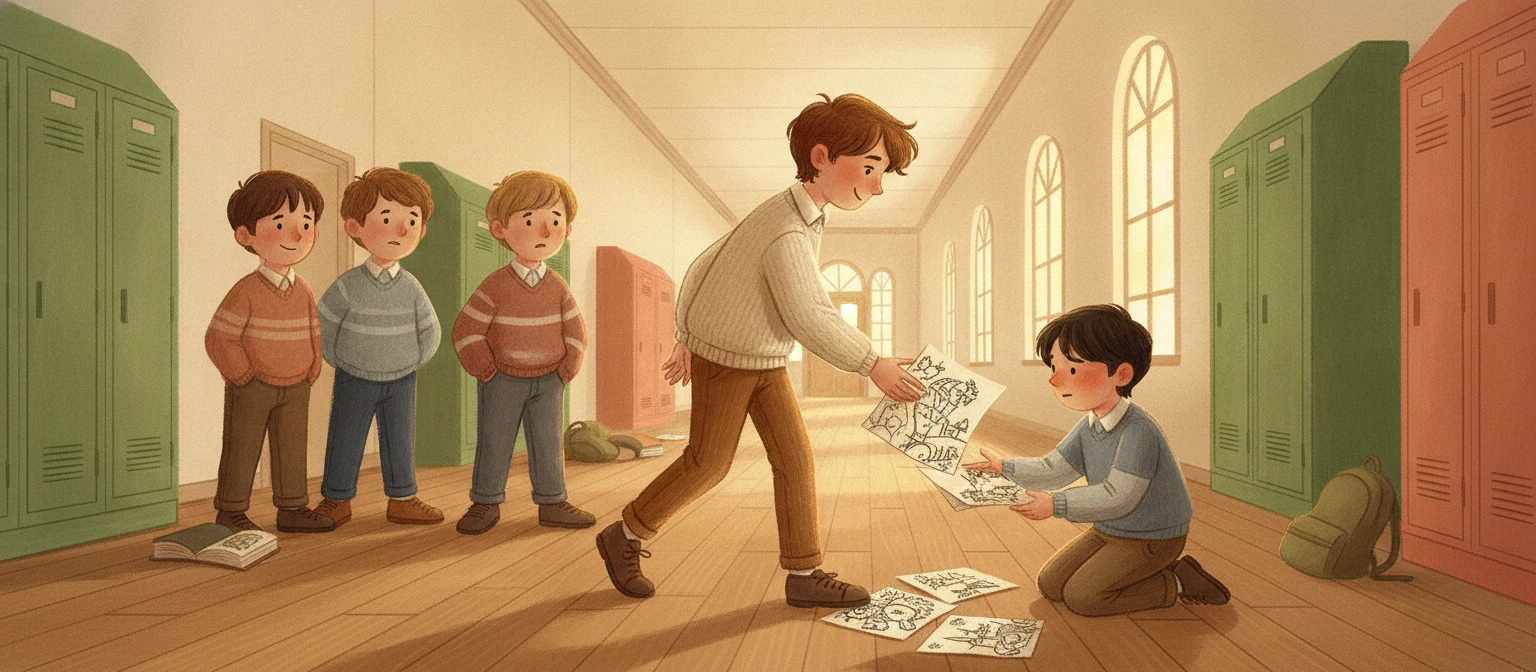
The corridor thing happened on a Tuesday after maths. Pranav was carrying his drawings folder — a thing he’d recently, unwisely, shown around. Pages of patient, detailed pen-work. Cities and machines. Startlingly good, and the one thing about himself he never boasted about. He’d seemed almost shy about it. Kunal hooked the folder out of his hands in passing — a smooth, casual move, done a hundred times with pencil boxes and caps. Except this time the clasp gave. Thirty pages of pen-work went across the corridor floor. A passing herd of Class 6 walked over them before anyone could move. Kunal’s group was laughing. And then someone stepped on a drawing of a city on purpose, dragging a shoe-print across it, for the reaction.
The reaction came, but not the funny kind. Pranav went down on his knees on the corridor floor, gathering pages without a word. His hands were shaking. And his face had stopped being a target’s face. It was just a face. Eleven years old, on the floor, at the feet of an audience.
Zain thought about it later, and what moved him wasn’t kindness, exactly. It was seeing clearly. For one sickening moment, he saw the scene without the group’s laughter as its soundtrack. Just as it was. A kid on the floor. Shoe-prints on the one good thing he had.
Zain stepped out of the audience, knelt, and started picking up pages.
The corridor’s temperature changed instantly — he felt it on his back. He handed Pranav a stack. He straightened the trodden city-drawing as much as it could be straightened. He heard his own voice, steadier than his pulse: “This one’s ripped at the corner. The rest are okay.” Then he turned to Kunal — and this was the part that cost, because Kunal’s face was already asking whose side are you on — and said, “Not funny, yaar. It stopped being funny weeks ago. Look at it.”
Look at it. That was the whole speech. It would have lost him a debate competition. But he had said it out loud, in the open, with his name attached. The group heard it. The corridor heard it. And the daily game — which ran, like all such games, on everyone laughing — suddenly had someone who wasn’t.
Now the honest part, because this story refuses to lie to you.
It cost. Kunal froze him out for two weeks. Lunches went awkward. The group chat went quiet in his corner. Someone tried out “Pranav’s bodyguard” as a nickname for a few days, to see if it would stick. That fortnight was lonely in the particular way of social punishment. At least twice, Zain lay awake wondering whether one annoying kid’s folder had been worth his whole seat at the table.
And: the game genuinely broke. Not because Zain was popular enough to end it. Because the game needed everyone laughing, and once one insider had said look at it out loud, others found their own versions. The quiet ones got less quiet. A teacher finally heard about the folder from three directions at once. By November, the game had simply stopped.
And Pranav? Still annoying. That’s the ending this story insists on. A month later, mid-thank-you, he corrected Zain’s pronunciation of “colonel.” Insufferable. They did not become best friends. They became nothing special — nodding terms, occasional partners in maths. One boy who now showed his drawings again. And another who had learned the sentence he would carry for the rest of his life, the one his grandfather confirmed that winter with a nod like a stamp:
You don’t have to like someone for it to be wrong. Liking is a preference. Wrong is wrong on its own.
The seat at Kunal’s table came back, by the way. Mostly. Eventually. Changed. Zain took it, changed too: an audience member who now knew exactly what audiences are for, and what they can refuse to be.
Talk About It
- Would it have been easier for Zain if Pranav had been his friend? Why do you think standing up for someone you don't like is the harder, and maybe truer, version?
- Zain paid a real price with his group. Do you think he'd say it was worth it? Would you?
- 'You don't have to like someone for it to be wrong' — where else does that idea apply, outside school?
Did this story land tonight?
One tap helps us write better ones. No login, nothing shared publicly.
Thank you — this genuinely helps. 🌙