The Question Nobody Asked
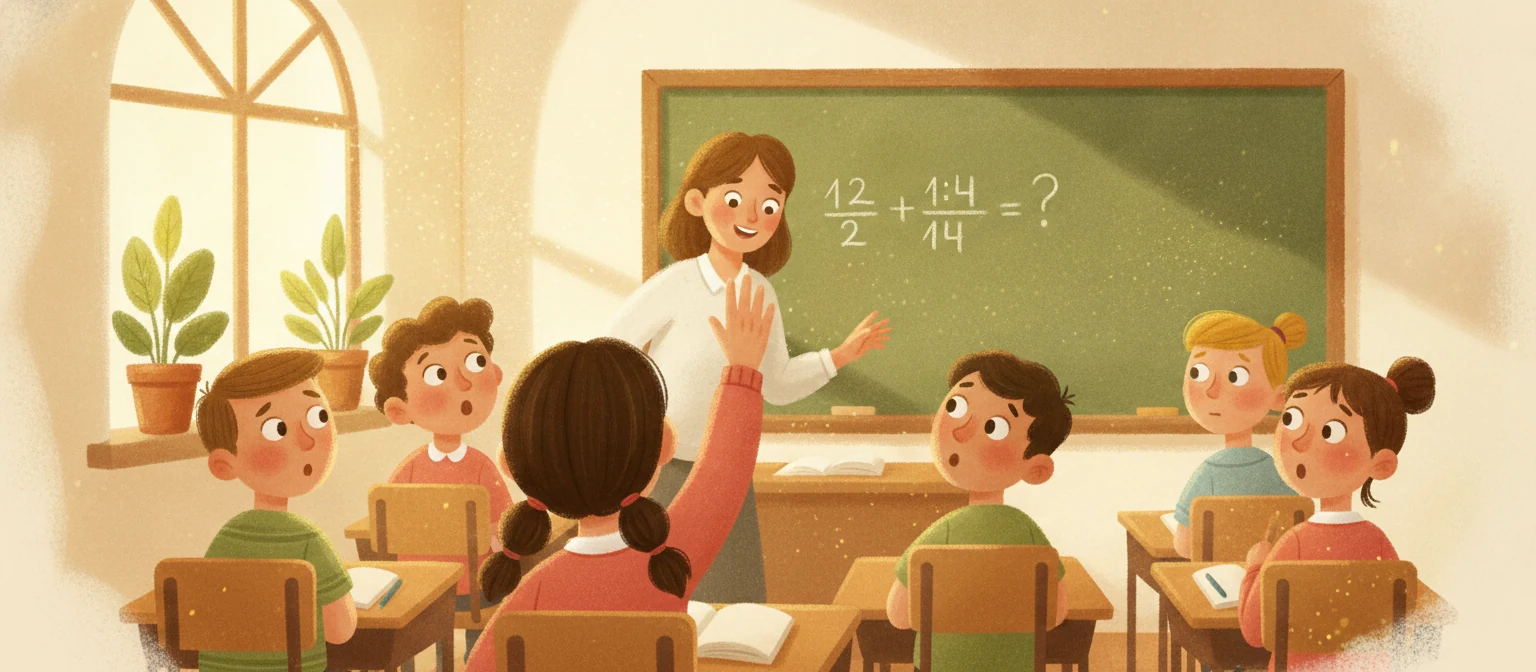
The trouble started on the day fractions arrived in class 4B.
Miss Rose drew a circle on the board, cut it into pieces like a roti, and said things — reasonable-sounding things — about halves and quarters, and numerators living upstairs and denominators living downstairs. Then she drew a second circle and did something with it that Meera did not follow.
Meera waited for it to make sense the way you wait for a bus. It didn’t come.
She looked around, ready to exchange a what-on-earth face with somebody. And this was the moment the real trouble began — because the whole of 4B was nodding.
Rehan was nodding. Divya was nodding slowly, like a wise little owl. Even Arjun, who once wore his shirt inside out for a full day without noticing, was nodding.
Everyone understood. Everyone except her.
“Any questions?” said Miss Rose.
Meera’s hand wanted to go up. It had a whole question ready: can you please do the second circle again, slowly. The hand stayed exactly where it was. Because if everyone else understood, then the question wouldn’t sound like a question. It would sound like an announcement: Meera is the only one. Meera is slow. Her hand suddenly weighed a hundred kilos. The moment passed. The lesson moved on. And Meera moved on with it, nodding along like everyone else — a passenger on a bus going somewhere she didn’t know.
Here is the thing about not understanding: it doesn’t stay the same size. Fractions came back the next day wearing new clothes. The day after that, they brought friends. Each lesson stood on yesterday’s lesson — and yesterday’s lesson, for Meera, was fog. By Thursday she wasn’t one question behind. She was a whole family of questions behind. And the first one — the small, easy, original one — was buried under all its children.
At dinner, her grandfather noticed her pushing rice around the plate and extracted the whole story in the way of grandfathers, without seeming to ask anything at all.
“Ah,” he said. “The nodding class. I sat in one of those for thirty years — they let adults in too, you know. Meetings are full of nodders.” He tore a roti in half, held up a piece. “Let me tell you the secret I learned too late. In every nodding room, the bravest sentence in the language is four words long: I don’t understand yet. And I’ll tell you the stranger secret. The moment one person says it — watch the room.”
“Watch it do what?”
“Just watch it.”
Friday. Fractions, round four. Miss Rose did the mysterious thing with the circles again, and said, “Any questions?”
Meera’s hand weighed a hundred kilos. She put it up anyway — wobbly, half-height, but up — and the room went quiet, every face turning, exactly as she’d feared.
“I don’t understand the second circle,” she said. Her voice came out small but it came out. “Can you do it again? Slowly?”
Two things happened.
The first: Miss Rose smiled — not the polite smile, the real one. “Thank you, Meera. That’s exactly what this class needed.” She went back to the board and did the whole thing again, slowly, a different way, with a mango instead of a roti. Somewhere in the middle of the mango, the fog in Meera’s head thinned. The thing underneath it turned out to be not that hard, just as her grandfather had promised. It had only needed asking for.
The second thing was the one her grandfather had told her to watch.
Around the room, quietly, the class exhaled. Rehan’s pencil, which had been hovering over nothing, started actually writing. Divya whispered, “I didn’t get it either.” Arjun said “OHHHH” out loud, to nobody — the sound of three days of fog lifting at once. Half of 4B, it turned out, had been nodding the same empty nod. Each one certain they were the only one. All of them waiting, some for days, for somebody to spend four brave words on their behalf.
Miss Rose said fractions went better in 4B after that, and she was right. But the bigger change was quieter than fractions. The class had learned what Meera’s hundred-kilo hand had bought them. The nodding had been a costume — and one wobbly hand had shown everyone that half the class was wearing the same one.
Meera still keeps a private rule from that Friday, and her grandfather says it will hold for life:
When the question feels heaviest — that’s how you know how many other people are carrying it too.
Talk About It
- Why did Meera's hand feel so heavy? What was she actually afraid would happen?
- What happened in the class right after she asked? Why do you think half the class exhaled?
- Is there something you've pretended to understand? What would asking actually cost?
Did this story land tonight?
One tap helps us write better ones. No login, nothing shared publicly.
Thank you — this genuinely helps. 🌙