The Deep End
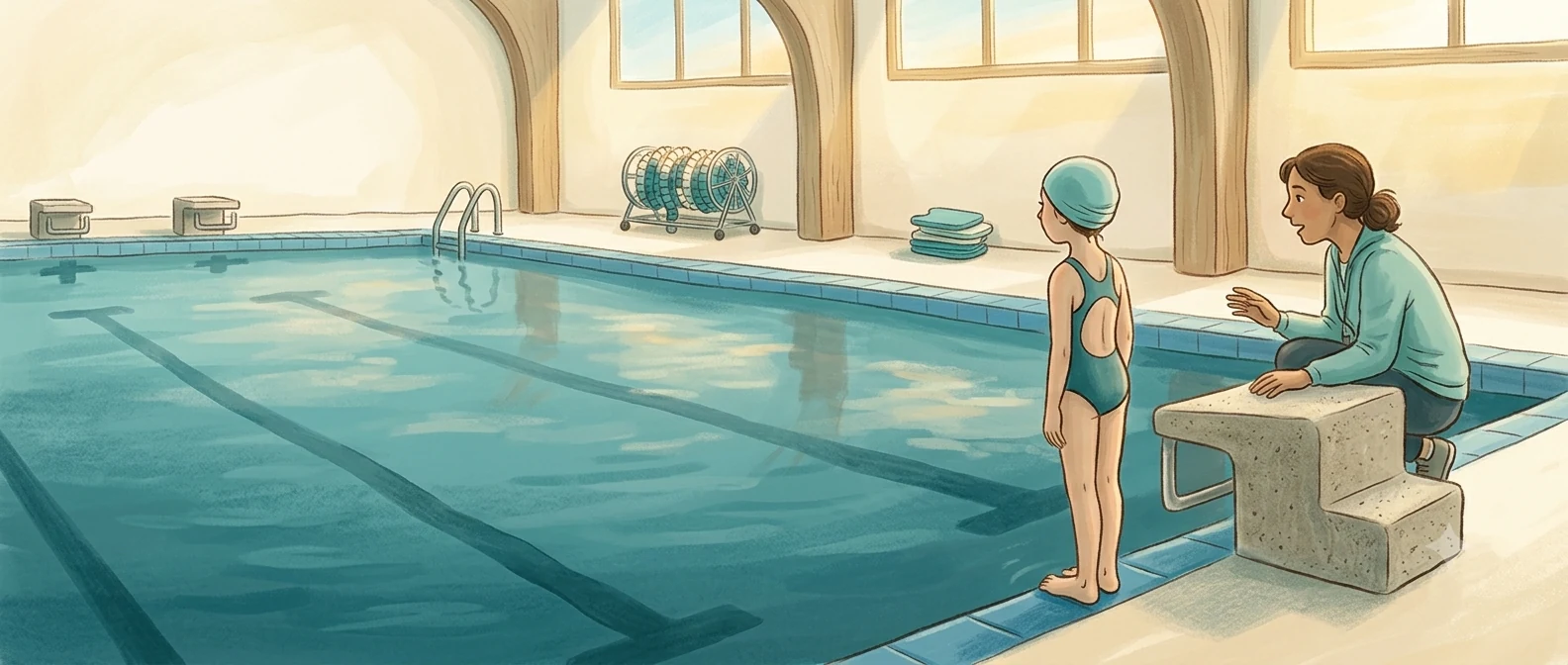
There were two swimming pools at Sunrise Aquatic Centre, and as far as anyone knew, Riya Menon owned both of them.
The training pool — four feet deep, end to end — was where the batch did laps. In the training pool, Riya was untouchable. Fastest freestyle in the under-13s. Cleanest turns. Coach Nair used her stroke as the demonstration stroke. When the others raced her, they were really racing for second.
The main pool was the one with the deep end. Twelve feet, under the far blocks. In fourteen months of training, Riya had never once swum in it. She had managed this with a rotation of excuses so smooth it deserved separate marks. Ear trouble. A convenient cramp. A forgotten cap. Twice, a strategically upset stomach.
Because here was the thing she had told no one, and had organised her entire swimming life around not telling: the moment Riya couldn’t feel the bottom under her, something in her chest closed like a fist.
It made no sense, and she knew it made no sense. That was the worst part. She could swim. Her body did not know the difference between four feet and twelve. Her stroke was her stroke. But her mind knew, the second the floor tilted away into deep blue nothing. Her breath went shallow. Her arms forgot their training. She had learned this at age nine, in one bad flailing minute that she’d passed off as a joke. And she had decided, apparently, that she would rather build a fourteen-month fortress of excuses than ever feel it again.
The fortress fell on a Tuesday. Coach Nair posted the list for the inter-club meet. Riya’s name was at the top. The meet was at Nehru Pool.
Nehru Pool had no shallow lanes.
She thought about the stomach excuse. She thought about the ear. She lay awake doing what she privately called the accounting — the running tally of what the secret cost per week, in planning and dodging and almost getting caught. Somewhere after midnight, the accounting produced a result she hadn’t expected. The fear of the deep end was only the second heaviest thing she carried. The heaviest was the hiding.
Everyone thought she was the bravest swimmer in the batch. Every single day, she got up and performed that person. You can be terrified of one end of a pool, it turns out, and exhausted by the whole thing.
On Wednesday she came to training forty minutes early, when it was just Coach Nair and the cleaning nets. She stood at the edge of the main pool, at the deep end, toes curled over the tiles, heart going like a fast set. And she said the eleven words she’d been rehearsing since midnight — out loud, to an adult, for the first time:
“I’m scared of deep water. I’ve been hiding it from you.”
Coach Nair did not laugh. He did not say but you’re my best swimmer, which she had dreaded. And he did not say there’s nothing to be scared of, which would have been worse — because there she was, scared, and that sentence would have told her the thing didn’t exist.
He looked at the water. “Fourteen months,” he said, doing his own accounting. “The ear infections. The cramp at districts.” He shook his head slowly. Not angry. Something closer to respect for the sheer effort. “You know what I coach, Riya? I don’t coach fearless. Fearless drowns, eventually, somewhere, showing off. I coach scared-and-swimming. That I can work with. But only if I know.”
What followed was not a montage, and Riya wanted it remembered that way. It was three weeks of small, specific, unglamorous work. Treading water at the rope where deep began — one hand on the rope, then one finger, then hovering. Learning that the fist in her chest loosened if she breathed out longer than she breathed in. Floating on her back over the deep — “the water doesn’t check the depth before holding you up,” Coach said, “that part’s just physics” — while her mind screamed for the first four days, and merely muttered by the sixth. Swimming one width. Then one length. Always with Coach walking the pool edge beside her. Until the morning he silently didn’t.
At the meet, on the blocks at Nehru Pool, Riya looked down twelve feet of blue and felt the fist form in her chest, right on schedule.
There you are, she thought. Fine. Come along, then.
She didn’t win. Third, in the end, two body-lengths behind a tall girl from Pune. It did not matter even slightly. Or rather, it mattered in a completely different currency. She had raced a whole length of water with nothing under her feet. Scared at the start, scared at the turn, less scared at the wall. And every metre of it had been out in the open — her name announced, no fortress anywhere.
Her batch cheered like she’d taken gold. They didn’t know the half of it.
Coach Nair knew. At the bus, he handed her the participation sheet to sign and said, not quite looking at her, in the tone he used for stroke corrections:
“Bravest swimmer in the batch. Now it’s even true.”
Talk About It
- Riya could swim perfectly well. What was she actually afraid of — the water, or something else?
- Which took more courage: the swimming, or the sentence she said to Coach? Why?
- Is there something you're good at 'in the shallow end' — where it feels safe — that you've been avoiding taking deeper?
Did this story land tonight?
One tap helps us write better ones. No login, nothing shared publicly.
Thank you — this genuinely helps. 🌙