One Seat Over
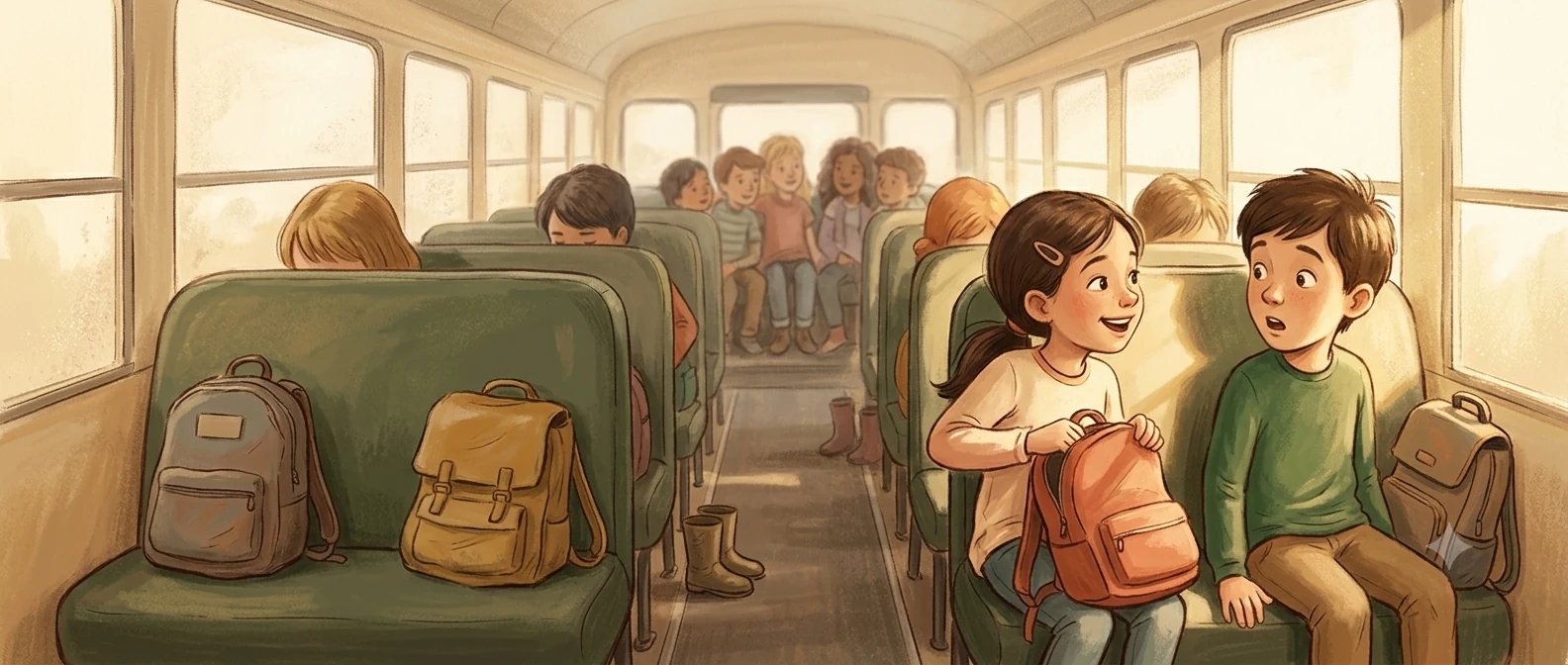
The joke wasn’t even good. Diya thought about that a lot afterwards. At her desk, on the stairs, lying in bed. How it wasn’t even a good joke.
She always sat on the left side of the bus, because the left side got the trees. She counted yellow cars out of habit, the way other people counted sheep, and was currently on eleven for the week.
Sameer had a stammer. It showed up mostly on hard consonants, and mostly when he was put on the spot. The front half of the bus did homework and traded stickers. The back half belonged to six boys, a broken window catch that rattled all the way to school, and the smell of yesterday’s dust. They had turned putting Sameer on the spot into a daily programme. That morning Ansh leaned over the seat back and asked him the time. He held up a bare wrist as he said it, with no watch on it at all. Sameer looked at the empty wrist, then answered anyway. “It’s—” He hit the wall on “t-t-ten.” Ansh echoed it back — t-t-ten, t-t-thanks — and the back bench laughed.
And Diya, two seats up with her bag on her knees and her thumb in her book, facing forward, had laughed too. Not loudly. A small breath of a laugh, the kind that leaks out before you have decided anything.
Sameer hadn’t seen her do it. That should have made it fine, and somehow it made it worse. She heard the little laugh leave her. She heard it join the bigger laughter behind her. Then she turned her face to the window. Rainwater sat in the potholes like broken mirrors. A barber was shaving someone under the big shady tree by the crossing, the same someone as most mornings. Three dogs slept outside the bakery in exactly the same spot, curled the same way, as if they had agreed on it the night before. She watched all of it go past, all the way to the school gate, and did not say one word to anybody.
She thought about it through two classes and a games period, the way you keep touching a mouth ulcer with your tongue.
At lunch she sat on the low wall by the canteen with her tiffin shut on her knees and made herself do the honest count. The jokes happened every single morning. Everyone on the bus knew. Every morning, when it started, heads turned back to books. Earphones went in. Windows suddenly became fascinating. No teacher had ever set foot on that bus. Sameer had started sitting alone in the second row. Bag on the seat beside him like a wall. Headphones in. Water bottle wedged against the window. She had watched him build that wall over weeks, one morning at a time.
And she had told herself, on all those mornings, the thing everyone on the bus told themselves: I’m not doing anything wrong. I’m not the one saying it.
Which was true.
It had stopped being enough at about half past seven that morning.
The next morning Diya came up the bus steps, held the rail, walked past her usual seat, and stopped at the second row.
“That seat taken?”
Sameer looked up at her with flat disbelief — checked behind her, actually turned and checked, for the trick, for the audience. There wasn’t one. He moved the bag.
She sat down.
Her heart was going like she had run for the bus. Ridiculous. It was a seat, with a split in the green plastic and somebody’s initials scratched into the foam underneath.
They didn’t talk much that first day. He was redoing a maths problem from yesterday, pencil sharpened down to a needle, eraser worn to the size and colour of an exhausted pink raisin. He lined it up against the edge of the notebook without seeming to notice he was doing it. The bus hit the pothole outside the petrol pump, the one it hit every single morning. Every bag on the floor jumped an inch and landed again. She said the teacher’s method was longer than it needed to be. He turned the notebook round on his knee and showed her his own method. It was, annoyingly, shorter.
The back bench noticed. Of course they noticed.
“New f-f-friend, Diya?”
And here was the moment, with the whole bus listening behind its dusty windows and its schoolbags. The fan had chopped the warm air into slow, sleepy circles the night before. She had lain awake, rehearsing the same three sentences over and over, under her breath.
“His maths is better than yours, Ansh.” She turned back around. “So’s his company.”
It wasn’t lightning. Nobody clapped. The back bench sniggered and went back to whatever they had been doing. Diya’s ears burned for three stops, and she sat looking at the seat in front of her, at a sticker somebody had half scraped off.
Beside her, Sameer turned a page in his notebook.
“That was terrible,” he said, not looking up from the page.
“I know,” said Diya, to the window.
“Really bad.”
“I said I know.”
The jokes did not stop that day. She sat in the second row the next morning, and the one after, with her bag on the floor between her shoes.
On Thursday Ansh tried the time thing again over the seat back. Sameer got stuck on the same letter. Diya said the time herself, flatly, without turning round, and went back to her book. Somebody at the back coughed. The bus went over the speed bump by the gate. Nobody laughed.
He did not try it on Friday.
He tried again the week after, and worse. That lunchtime Diya knocked on the staff room door, tiffin still in her hand. She told Miss D’Souza the whole thing. Every morning of it, and the names. Miss D’Souza put down her cup and got a pen.
Ansh’s group got called in on Monday, one at a time, out of the maths lesson. For a fortnight the back bench talked about football and the price of the canteen samosa and nothing else.
Then, in the last week of term, the driver leaned on the horn for five full seconds at a cow. The cow did not move. He leaned on it for five more at nothing at all.
Sameer waited until it stopped.
“He’s not,” he said, “a very p-p-patient man.”
He let the pause sit exactly as long as he wanted it to sit. Two rows laughed, Ansh loudest of all of them, and Sameer sat back against the window and let it happen.
She never told him about her own small laugh, that first morning. Maybe she should have.
She got on the bus the next day, held the rail, walked past her old seat, and sat down in the second row.
Talk About It
- Diya wasn't the one making the jokes. Why do you think she still felt so bad?
- Moving one seat over seems small. What did it actually change for Sameer?
- What's one thing you could actually say or do if someone was being laughed at in front of you? Let's think of the exact words.
Did this story land tonight?
One tap helps us write better ones. No login, nothing shared publicly.
Thank you — this genuinely helps. 🌙