He Was First
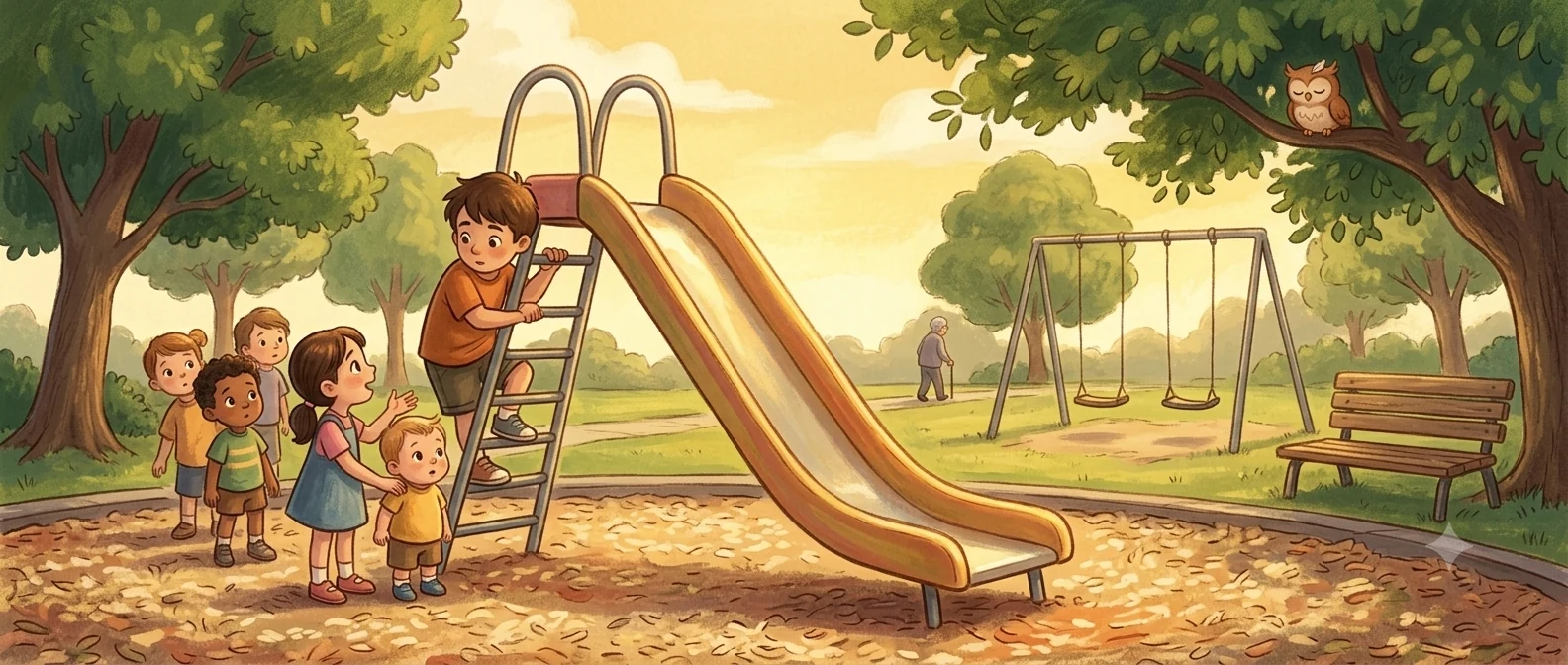
The best thing in the park was the big red slide, and everyone knew the rule of the slide, because it was the oldest rule in the world:
The line is the line.
You waited your turn. Even when the waiting felt like forever. That was the deal, and even the pigeons seemed to know it.
But that afternoon, a bigger boy was breaking the rule — and he was breaking it, every single time, on the smallest kid in the line.
Little Golu was maybe three, with shorts too big for him, and he waited his turn the careful way small kids do, holding the ladder rail with both hands. And every time he reached the front, the bigger boy came loping over, said “move it, small fry,” and stepped right in over his head.
The first time, everyone in the line saw it and said nothing.
The second time, everyone saw it and said nothing. Anya, three places back, watched Golu shuffle to the side and go quietly to the back of the line, and something in her chest felt hot and squeezed, like a squeezed lemon.
She looked around for a grown-up. The uncles and aunties were all on the far benches, deep in their phones and their talk. The line was just kids. And the kids were all doing what she was doing — looking at their feet, thinking, he’s bigger than me. Someone should say something. Someone else.
The third time the big boy loped over, little Golu was at the front again, both hands on the rail, and he didn’t even argue anymore. He just started to move aside — as if being pushed out was the rule now, his own special rule.
That was the part Anya couldn’t watch.
Her legs walked her out of the line before her brain finished voting. Her heart was going dhak-dhak-dhak, and when the words came out, they came out wobbly — not loud, not fierce, just wobbly and clear enough:
“He was first.”
The big boy turned. He was a whole head taller. “What?”
“He was first.” Anya put her hand on the ladder rail, next to Golu’s small ones, and stayed put. “The line is the line. He’s been first three times and you keep taking it. It’s his turn.”
Now — here is a true thing about push-in boys. They are counting on the quiet. When the quiet breaks, even a little, even in one wobbly voice, everything changes — because suddenly the line behind Anya wasn’t looking at its feet anymore. Two other kids said, “yeah, he was first.” Then a third one said it. The line had found its voice down the whole ladder. The big boy was big enough to push past one small kid, but not big enough to argue with a whole line and its oldest rule. He muttered “whatever” and slouched off toward the swings.
Golu looked up at Anya with his mouth open.
“Go on,” said Anya, whose heart was still going dhak-dhak, but slower now, and warmer. “Your turn.”
He went up the ladder like a rocket. He came down the big red slide with his arms up and his too-big shorts flapping, making the exact sound of a person getting his turn back. And then, being three, he ran straight to the back of the line to wait all over again.
Anya went back to her own place in line. Her legs were still a little shaky. Funny thing, though — she felt taller than the slide.
And when she told Ma about it on the walk home — the pushing, the wobbly words, all of it — Ma stopped walking. She crouched down to Anya’s height and said the thing Anya kept forever:
“Three small words, and you gave them to somebody smaller than you. That’s not small, Anya. That’s the biggest thing anyone did in that park today.”
Talk About It
- Anya's voice went wobbly when she spoke. Can something be brave AND wobbly at the same time?
- What three words did Anya say? Could you say them?
- If a big kid is being unfair, who are the grown-ups you could tell?
Did this story land tonight?
One tap helps us write better ones. No login, nothing shared publicly.
Thank you — this genuinely helps. 🌙