Not Your Weather
It started with the glasses.
Aarav got them in July. Black frames, a little thick, in a hard blue case that clicked when it shut. He liked them. For four days he liked them.
Then Dev called him binoculars on the school ground, in front of the whole cricket group, with the bat still in his hands. Everybody laughed. Dev was the kind of boy who went wherever the laughing was.
By August it was not one joke any more.
It was binoculars every morning. It was the chair pulled back half a second before he sat down, so that he went to the floor with his bag still on his shoulder. It was his water bottle going hand to hand over his head, all the way down the row, while everybody grinned and said it was only a joke.
Four boys laughing. One boy not laughing.
In September he dropped a catch. The ball came down out of a white sky, and his hands were in the right place, and it went straight through them. All that week Dev’s group did it again in slow motion in the corridor by the notice board. Hands open. Ball falling. Every time he walked past.
Aarav told nobody.
He had his reasons, and from the inside they looked solid. If he told his parents there would be phone calls and a meeting, and Dev would find out he had told. If he told a teacher, that was snitching. Under those two sat a third one he never said out loud, not even inside his own head, not properly. Maybe it was him. The glasses. The dropped catch. The way his voice went thin when somebody looked at him too long.
So he carried it.
From Sunday evening onwards, school sat in his stomach like a stone. He stopped leaving his bag by the door and started keeping it under his bed. He read the same page of the same book four times at his desk and could not have told you one word of it. Every Monday at about half past six, a headache arrived.
And his mother began giving him a certain long look across the table at dinner. The kind that goes on a little after you have finished answering.
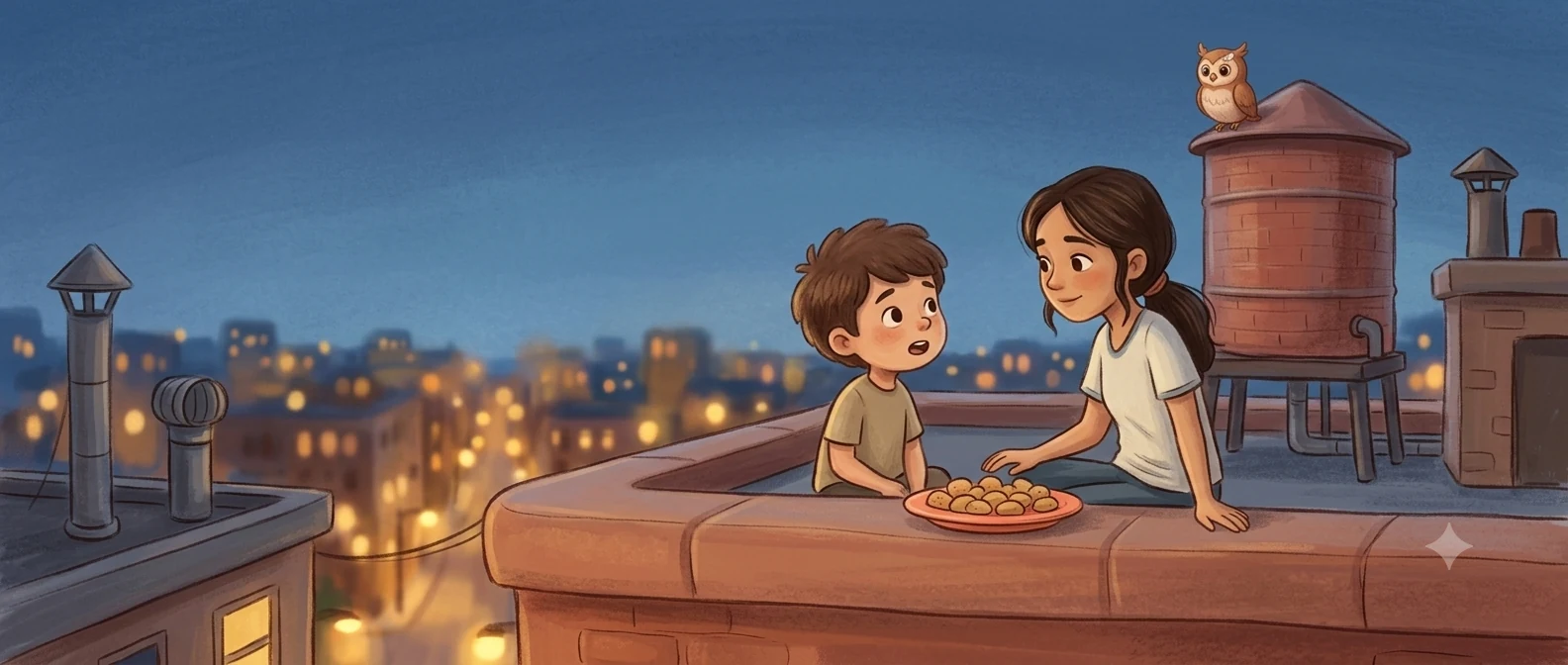
Teena Didi came home for Diwali. She was seventeen, she was his mother’s sister’s daughter, and she was not a parent.
They were up on the roof at dusk, sitting on the low wall with their backs against the water tank. Between them was a steel plate of chakli, crisp brown spirals still warm from the pan, that his mother had fried that afternoon. Below them the city was going dim, window by window. Somebody two houses down was trying to start a scooter and failing.
“So,” said Teena Didi, looking straight ahead. “Who is making school bad for you?”
“What? Nobody—”
“Aarav.” She took a chakli off the plate. “I had one too. Mine was called Sneha. Class eight, and half of class nine.” She said it the way you say the day of the week. “So. Who is yours?”
It came out of him like water out of a tipped bucket. The glasses. The bottle going over his head. The ball through his hands. His voice went thin twice and he had to start the sentence again. Teena Didi ate chakli and watched the city and did not once say oh no.
When he stopped, she was quiet for a while.
“Mine started with a haircut,” she said. “Not glasses. A haircut.”
Aarav looked over at her.
“When it rains,” she said, “is that your fault?”
”…No.”
“No. It comes out of the sky.” She broke a chakli in half and held out one piece until he took it. “That is Dev. It is his weather. Not yours.”
Aarav held his half and did not eat it.
The scooter two houses down caught at last, and went away down the road, and the sound of it went with it. The streetlights came on one after another, all the way to the corner shop.
“I stood under it for ten months,” Teena Didi said. “Told nobody. Not Ma. Not you people.”
“Did it stop?”
“No.” She put her chin on her knees. “It stopped in July. Somebody else told. A girl I hardly knew, whose desk was behind mine.”
She let that sit there between them, next to the plate.
“Tomorrow,” she said. “You and me. We tell your mother.”
Aarav’s stomach did the Monday thing, on a Sunday.
“She’ll—”
“Yes. She will. For about four minutes.” Teena Didi stood up and brushed the crumbs off her knees. “After that, it stops being your job.”
They told her the next morning at the kitchen table, before school, with his bag on the chair and the milk still on the stove.
Teena Didi started it, and then went quiet at exactly the right moment, so that Aarav had to finish it himself. He got as far as the water bottle going over his head. Then he could not get any further.
His mother did not shout.
That was the part he had not got ready for. She put down the cup of tea she had been holding for ten minutes without drinking, and it made a small sound on the saucer. She reached across the table and turned his chin until he was looking at her.
“Since July,” she said. It was not a question.
“Yes.”
“July.” She said it again, to herself, quietly. Then she looked past him at the window for a while and did not say anything at all. Aarav looked at her hands. She had folded them together on the tablecloth, very tightly.
Then she got up, took his lunchbox off the counter, and put it into his hands.
“Get your bag,” she said. “You’ll be late.”
That was all of it. Four minutes, near enough, exactly as she had said. And when he stood up, it felt like somebody had lifted a school bag off his back that he had been wearing so long he had stopped noticing it.
His mother went in to the school office on Thursday morning. Aarav did not have to be there.
Nothing exploded. There was no assembly. A week later Dev and two of the others were moved to another section, and the notice on the board called it evening out the class numbers. Dev never said sorry. Aarav stopped waiting for it somewhere around December, without noticing the day he stopped.
There was a boy in B section called Nikhil. He had seen the water bottle game once, from the gate, and he had not laughed.
One day in November he came and sat down on the steps by the water cooler, where Aarav ate his lunch. He put his own lunchbox down on the step, took the lid off, and said that the new spin bowler everybody was shouting about was overrated.
Aarav put down his roti.
“He turns it both ways,” he said.
“With that arm? Anybody can turn it both ways.”
“Not without changing his hand. You cannot see which way it is going.”
“That is not skill,” said Nikhil, with his mouth full. “That is luck.”
The bell went before they had finished. They had not finished the next day either. After that it was most days on that step. Two lunchboxes, one packet of biscuits between them, and somebody’s bowling to disagree about, which they never once settled.
By January the blue case lived at the bottom of his bag, and the glasses were just his face.
Some Mondays the stone still turned up in his stomach. It came out of pure habit, the way an uncle turns up without telephoning first. It would sit there through the whole of assembly, look about, find there was nothing left for it to do, and be gone before the lunch bell.
Then, in February, a new boy joined in the middle of term.
Small. Nervous. An accent the corridor turned round to listen to. The new boy sat on the far bench at lunch, on his own, with his lunch still shut on his knees. On his third day Aarav looked up from the steps and saw two of Dev’s old crowd drifting across the ground towards him.
The new boy had gone very still. He was looking down at his shoes.
Aarav picked up his lunchbox. He walked over. He sat down next to him.
“Hi. I’m Aarav,” he said. “Come and sit with us.”
Talk About It
- Aarav thought telling someone would make things worse, and that it meant he could not handle it himself. What actually happened when he told?
- Teena Didi said that Dev was weather. What do you think she meant — and whose weather was it?
- Who are your people — the ones you could tell anything to? Let's name them.
Did this story land tonight?
One tap helps us write better ones. No login, nothing shared publicly.
Thank you — this genuinely helps. 🌙