The Lion Cub Who Couldn't Roar
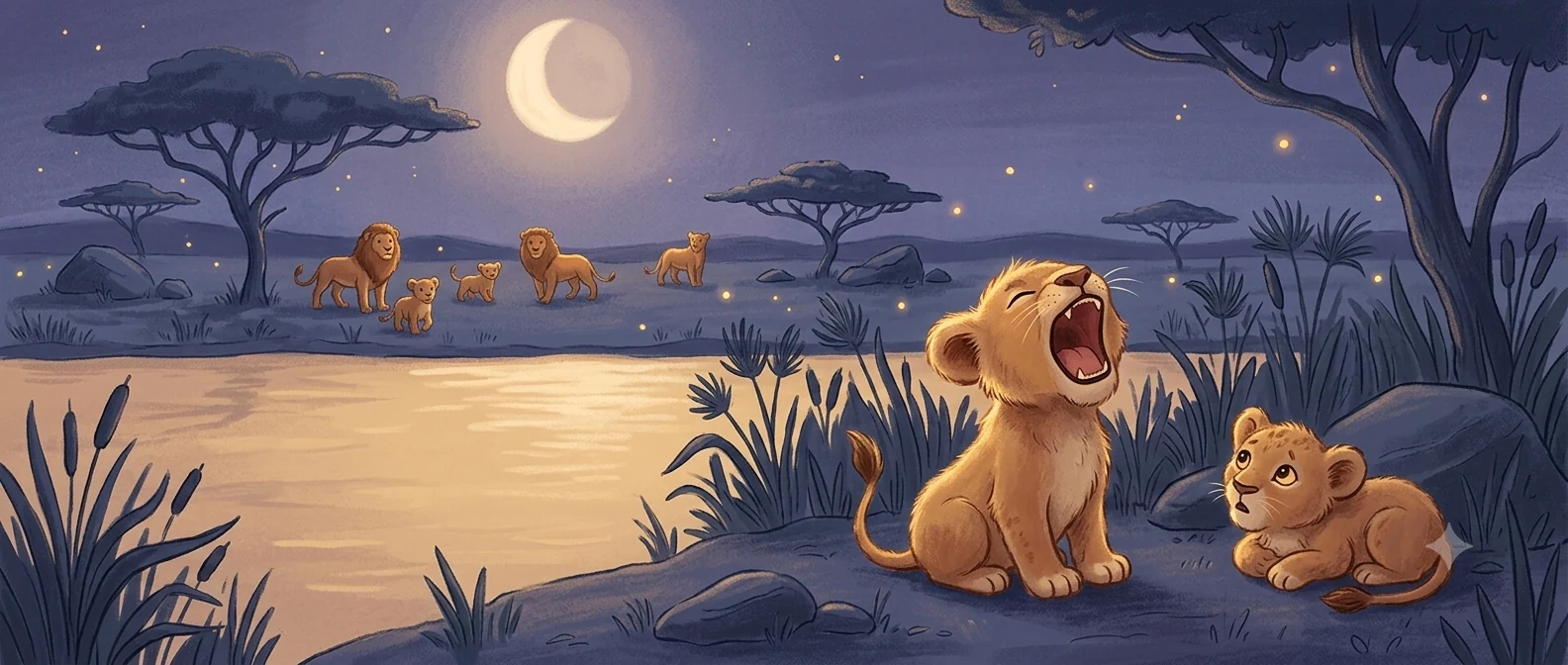
In the golden country where the grass grows taller than a cub’s ears, the lions held a Gathering every year, and at every Gathering, the year’s cubs gave their first roar.
It was tradition. The pride formed a great circle at sunset. One by one, each cub stepped into the middle, planted their paws, and roared as well as a small lion can — which is not very well, but that wasn’t the point. The point was the stepping in and the trying, and the enormous cheer that followed.
Sher had been practising all season. In the mornings he roared at the river. In the evenings he roared at his own shadow. His sister, who was a year older and had roared at her own Gathering like a rockslide, gave him tips. “From the belly,” she said. “Not the throat. The throat squeaks.”
The night of the Gathering came. The circle formed. The cubs went one by one — a growl here, a rumble there, one surprisingly good bellow that made all the aunts nod.
Then it was Sher’s turn.
He stepped into the middle. He planted his paws. He found his belly, just like he’d practised, took the biggest breath of his life, opened his mouth—
—and squeaked.
Not a small roar. Not a rough growl. A squeak — high, tiny, ridiculous, the sound a hinge makes, the sound a mouse would be embarrassed by. It hung in the silence over the whole listening pride.
Somebody’s cousin laughed. Only one laugh, quickly hushed, but one is enough.
Sher didn’t wait for the kind words he could see the aunts preparing. He turned and walked out of the circle, past the cubs who had roared, and lay down alone by the river in the dark. He stayed there a long time, thinking the kind of thoughts that visit after a squeak: Everyone saw. I practised all season and it made no difference. Maybe I’m just not a roaring kind of lion.
The river went on saying nothing, the way rivers do.
And then, much later, through the dark, Sher heard something that made his ears stand straight up.
His little sister’s voice — his littlest sister, barely walking — mewing, faint and frightened, from downstream. Far from the pride. Near the reeds, where the ground goes soft and the crocodiles wait for exactly this.
Sher was on his feet before he had finished hearing it. He ran along the bank, and there she was. Tiny in the moonlight, wobbling on the mud at the very edge of the black water. And something long and quiet was beginning to move in the reeds beyond her.
There was no time to fetch anyone. There was no time to think about bellies or throats or circles of watching lions.
Sher planted his paws between his sister and the reeds, and he made a sound.
It was not a perfect roar. It cracked in the middle. It scraped at the edges, and it ended in something like a squeak. And it was also, everyone agreed afterward, unmistakably and absolutely a ROAR. Loud enough to freeze the reeds. Loud enough to reach the pride on the hill and turn every head. Loud enough that his mother arrived to find the long quiet shape retreating into deep water — and one small cub standing over his sister, his legs shaking.
They walked back together, his sister riding on their mother’s back, Sher’s legs still not quite his own.
“That was a fine roar,” said his mother.
“It cracked,” said Sher. “And the end squeaked.”
“Mm,” said his mother. “They mostly do, the real ones.”
At the next Gathering, when the new cubs stepped trembling into the circle, they say Sher cheered loudest of all — especially, and on purpose, for the ones who squeaked.
Talk About It
- How do you think Sher felt walking away from the Gathering? Have you ever felt like that?
- Why do you think the real roar came when it did?
- What's the difference between failing at something and being a failure?
Did this story land tonight?
One tap helps us write better ones. No login, nothing shared publicly.
Thank you — this genuinely helps. 🌙