Lights Out at Camp
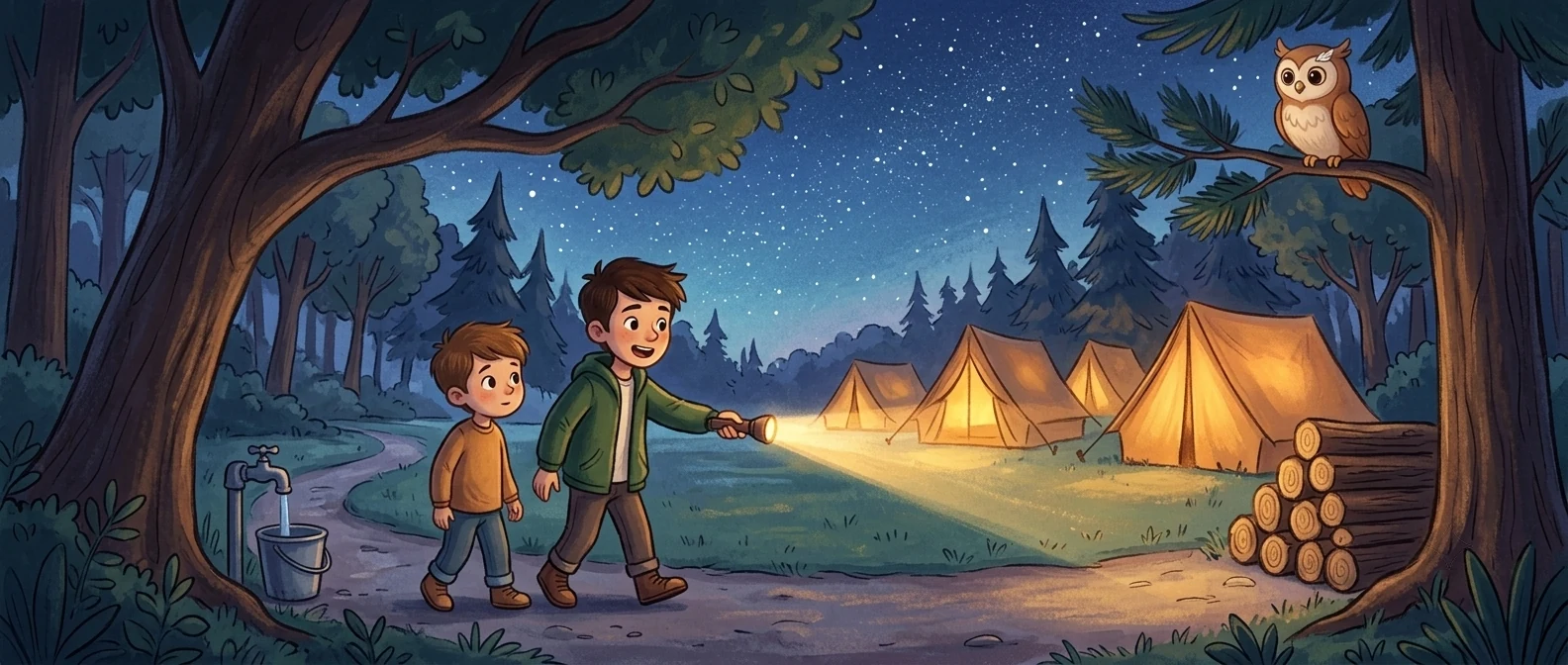
By age eleven, Dhruv had a system, and the system had never failed.
The system had one goal: no human being must ever learn that Dhruv Malhotra — cricket team, second-highest in maths, officially Fears Nothing — could not sleep in full darkness. At home it was managed invisibly. Door open two inches. Bathroom light on down the hall. A “habit” nobody examined. At his cousins’ place: claim the mattress near the window, where the streetlight came in. Sleepovers were harder. He had once faked a stomachache at 10 p.m. to get collected early, rather than lie all night in the sealed black of Kabir’s bedroom, listening to his own heart.
He wasn’t proud of the system. But the alternative — the tent group finding out — was unthinkable. Everyone knew fear of the dark had an expiry age, and everyone knew he was past it. The fear itself he could live with. Being seen having it was the monster.
Then the Class 6 notice board announced: Three-day nature camp, Panhala. Tents of four. Lights out 9:30.
Tents. Plural kids, singular darkness. No hall light, no streetlamp, no window — canvas dark, forest dark, the real original dark that his whole system existed to avoid. Dhruv considered the stomachache gambit for a full week, but three days was beyond even his repertoire.
The first night, he lay rigid in the sealed black of Tent 3 while the other three boys dropped off with insulting ease. He ran the old checks — every rustle assigned a species, every shadow audited twice — until sometime past midnight, when exhaustion finally won.
The second night, the teachers posted the duty roster, and there it was: Water-tap escort, 9:00 pm — Dhruv M. (Class 6) with Ayaan T. (Class 4). Older kids walked younger ones to the far tap before lights out. With torches. Through the trees.
Ayaan turned out to be a small, solemn boy who made it four steps past the last tent before his breathing changed. Dhruv knew that breathing from the inside — knew it the way you know your own handwriting — and glanced down to find the kid stopped dead, staring into the treeline, hand strangling his torch.
“There’s something there,” Ayaan whispered.
And Dhruv — an eleven-year-old veteran of a thousand solo midnight audits — heard himself begin to teach.
“Where? Show me with the light. Rule one: never stare at a dark shape and guess. Point the torch. Dark plus guessing is how you build monsters; light plus looking is how you take them apart.” The beam found it: the woodpile. “See? Logs. Now you do the next one.”
They went down the path like that. Ayaan swept the torch. Dhruv narrated. That’s the generator shed. That clicking is a nightjar — it does that. That smell is wet pine; it gets stronger at night because everything does. And the strangest thing was happening in Dhruv’s own chest. Running the checks out loud, for someone else, the fear had nowhere to sit. The dark hadn’t changed. But he wasn’t in the audience anymore. He was the guide. And the guide’s torch hand, he noticed with something like awe, was perfectly steady.
At the tap, filling bottles under the enormous spill of stars, Ayaan said, matter-of-fact, the way small kids drop depth charges: “I’m always scared at night. My brother says I’ll grow out of it.” A pause. “Did you grow out of it?”
The system said: lie. Said it automatically, said it in the voice of five years of open doors and window mattresses.
“No,” said Dhruv. Out loud. Under the stars. To a nine-year-old. First time ever. The word didn’t fall over. Nothing happened at all — except that it was suddenly much easier to breathe, at night, on a hill, in a forest. “No, I didn’t grow out of it. I got good at it instead. There’s a difference. You just watched the difference.”
Back in Tent 3, in the sealed black, something emboldened him — the audit voice still warm in his throat — and he ran the experiment he’d never dared: “Oi. Anyone else hate how dark it gets in here, or just me?”
Silence. Then Veer, from the left: “The first night I basically didn’t sleep.”
Then Kabir — Kabir, of the sealed bedroom: “I keep my earphones in with nothing playing. It helps somehow.”
Then Rohit: “My mama still keeps the passage light on for me. Don’t say anything.”
Four for four. The tent sat with its own discovery in the dark. Then someone snorted. Then all of them were laughing — the specific, unrepeatable 11 p.m. laughter of four boys who had just set down the same secret at the same time, each having carried it for years, each certain he was the only one.
They left the tent flap tied open a hand’s width after that, “for air.” Stars came in through the gap. Nobody officially needed them there.
Nobody officially didn’t, either.
Talk About It
- Dhruv spent more energy hiding the fear than feeling it. What does keeping a secret like that actually cost per day?
- Why did helping Ayaan change something that years of 'just get over it' hadn't?
- The tent poll at the end — did it surprise you? Why do we each assume we're the only one?
Did this story land tonight?
One tap helps us write better ones. No login, nothing shared publicly.
Thank you — this genuinely helps. 🌙