The Wrong Note
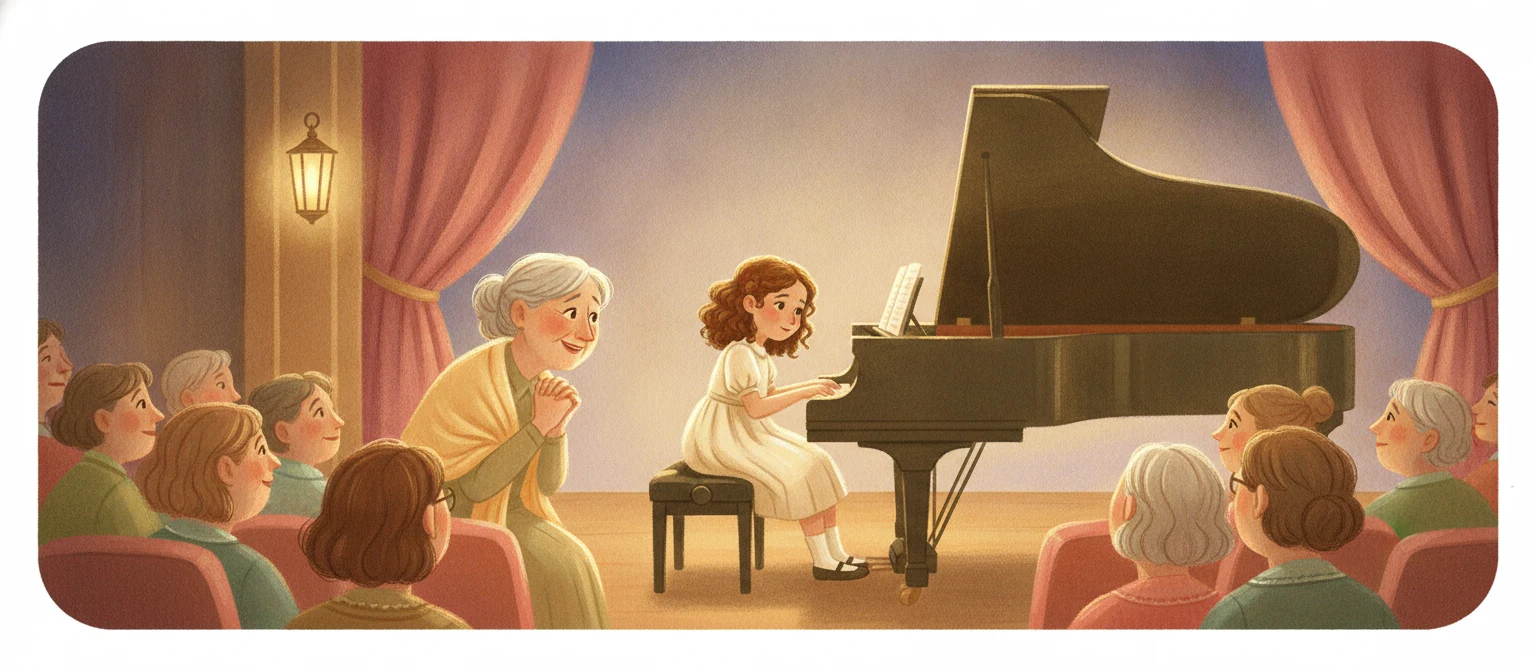
Anna had played “The River Song” perfectly forty-one times.
She knew, because she’d kept count in the back of her music book: forty-one clean run-throughs on the upright piano at home. By recital week her fingers were so sure of the piece that she could play it while talking, while yawning, practically while asleep. Miss Rivera said it was ready. Anna said it was ready.
Nobody mentioned that the piece had only ever been played in an empty room.
The recital hall, on the night, held about a hundred people — parents, grandparents, a forest of phones held up to record. Anna sat in the second row in her stiff new shoes, watched four kids play before her, clapped, and felt her hands going cold in a way that was new information entirely.
Then her name. The walk to the piano took nine hours and also no time at all.
She began well. The first page of “The River Song” flowed out the way it had forty-one times before. She could hear, distantly, that it sounded good in the big room. Better than at home — the notes blooming in all that space. Somewhere in there came a thought, a tiny, fatal, innocent thought:
It’s going well. Don’t mess up.
And her hands — her sure, forty-one-times hands — heard the thought, and looked down, so to speak, like a tightrope walker glancing at the drop.
Halfway down the second page, between one bar and the next, the piece simply… vanished. Not a wrong note — nothing so small. Her fingers stopped, and the music in her head went white, the way a light goes out. Silence in the hall. Real silence, the enormous kind, with a hundred people inside it and every phone still recording.
One second. Three. Five. Anna sat staring at the keys, which had turned into seventy-two strangers. Her whole face filled with heat. She was living inside the exact thing every kid fears from the second row.
Here is what nobody had told her, and what she learned right there, alone on the bench: the freeze isn’t the test. The next ten seconds are.
She had two doors. Door one: get up, small nod, walk off — the hall would clap kindly, the kind clapping that follows you around afterward. It was open. It was so open.
And then she caught sight of Miss Rivera in the front row. Miss Rivera was not doing a worried face. She had one hand resting flat on her own knee, calm as Sunday — and she mouthed four words, the same four she said in every lesson when a passage collapsed:
Start where you love.
Not from the top — from the part you love. Anna loved the third page. The rolling left-hand part, the bit that actually sounded like a river. She’d loved it since the first week.
She took a breath she could hear. Set her hands. And began again — not where she’d fallen, but where she loved — and the river came back under her fingers, hesitant for two bars, then true. She played the third page better than she’d ever played it at home. She played it like someone with something to say. And when the last chord settled into the hall, there was a beat of quiet —
— and the applause that came was not the kind clapping. It was the real kind, the loud kind, the kind with a couple of parents standing up in it, and it went on longer for Anna than for anyone that night. She knew why, even at nine. It wasn’t for the piece.
It was for the coming back.
“Everyone freezes,” Miss Rivera told her afterward, at the biscuits table. “Everyone, eventually — I froze in a cathedral once, mid-wedding. The audience forgets the freeze, Anna, I promise you. What they take home is what you did next. You gave them the good ending. That’s the whole job — of recitals, and of most things.”
Forty-two, Anna wrote in the back of her music book that night. Then, after a moment, she crossed it out and wrote the truer number:
One.
The first one that counted.
Talk About It
- Anna had played the piece perfectly at home a hundred times. What was different on the stage?
- Miss Rivera said the audience remembers 'the coming back' more than the mistake. Why do you think that's true?
- Have you ever had to keep going in front of people after something went wrong? What helped?
Did this story land tonight?
One tap helps us write better ones. No login, nothing shared publicly.
Thank you — this genuinely helps. 🌙