The Boy Who Was Nice on Wednesdays
Mihir had the good colour pencils.
Thirty-six of them, in a flat tin with a picture of a mountain on the lid. Every one of them still sharp, because he sharpened them at home on Sundays, over the bin, with the shavings falling into an old newspaper. There were four different greens. There was a gold one, and the gold one worked.
Drawing class was on Wednesdays.
Rohan never brought his own pencils. Every Wednesday he sat down next to Mihir, and every Wednesday Mihir slid the tin into the middle of the desk without being asked.
And every Wednesday, Rohan was the funniest boy in the whole of Class 4.
He drew Mr Nayak’s moustache on absolutely everything, in plain pencil, quick as anything. On a fish. On a bus. On the corner of his own worksheet, next to his name. It was the same three lines every time, and it was funny every time. He kept the gold one for last, for the sun in the corner of the page, and used it until the tip went flat against the paper. He let Mihir choose what they were both drawing.
On Wednesdays, the forty minutes of drawing class went by so fast it felt like 10.
Every other day, something in Rohan changed the moment the bell rang.
Thursday, Friday, Monday, Tuesday — every ordinary day — Rohan was out through the gate first. He went off down the road with his own bag bouncing on his back, fast, the way you walk when you are already late for something. He did not stop to talk. He did not look over at the post where Mihir usually waited.
Mihir did not understand it. On Wednesdays, Rohan forgot the time completely. On every other day, he could not get away fast enough, as if the gate had a clock ticking behind it that only he could hear.
It went on like that for a whole term.
In November there was a school trip, and everybody had to write down who they wanted to sit with on the bus. Mihir wrote Rohan’s name.
Rohan sat with Dev.
Mihir sat by the window on his own, with his bag on his knees, and watched the fields and the electric poles and the parked trucks go by. It stung, a little, the way it always stung when Rohan chose somebody else.
At the lunch stop, everybody opened their tiffins on a sheet spread under a tree. Dev had not brought one. He sat with his hands in his lap, looking at the grass, saying he was not hungry, which nobody believed.
Rohan opened his own tiffin and split the rice and the potatoes clean down the middle with the back of a spoon. He slid half across to Dev without a word. Dev took it without a word too, the way you take something you have taken before.
“Dev’s mother’s away this week,” Rohan said quietly, when he caught Mihir looking. “I knew, so I packed extra.”
Mihir did not say anything back. He just understood, all at once, why the seat next to Rohan had gone to Dev that day.
On Monday, Mihir came home from school to find the house full of guests — his aunts, his cousins, shoes lined up three deep by the door. His mother caught him before he had even changed out of his uniform.
“Run to the mart,” she said, pressing coins into his hand. “Sugar, and a packet of tea. Quickly.”
Mihir was not usually sent on errands. He walked to the mart still in his school clothes, turning the coins over in his pocket, thinking about nothing much at all.
Then he saw who was behind the counter.
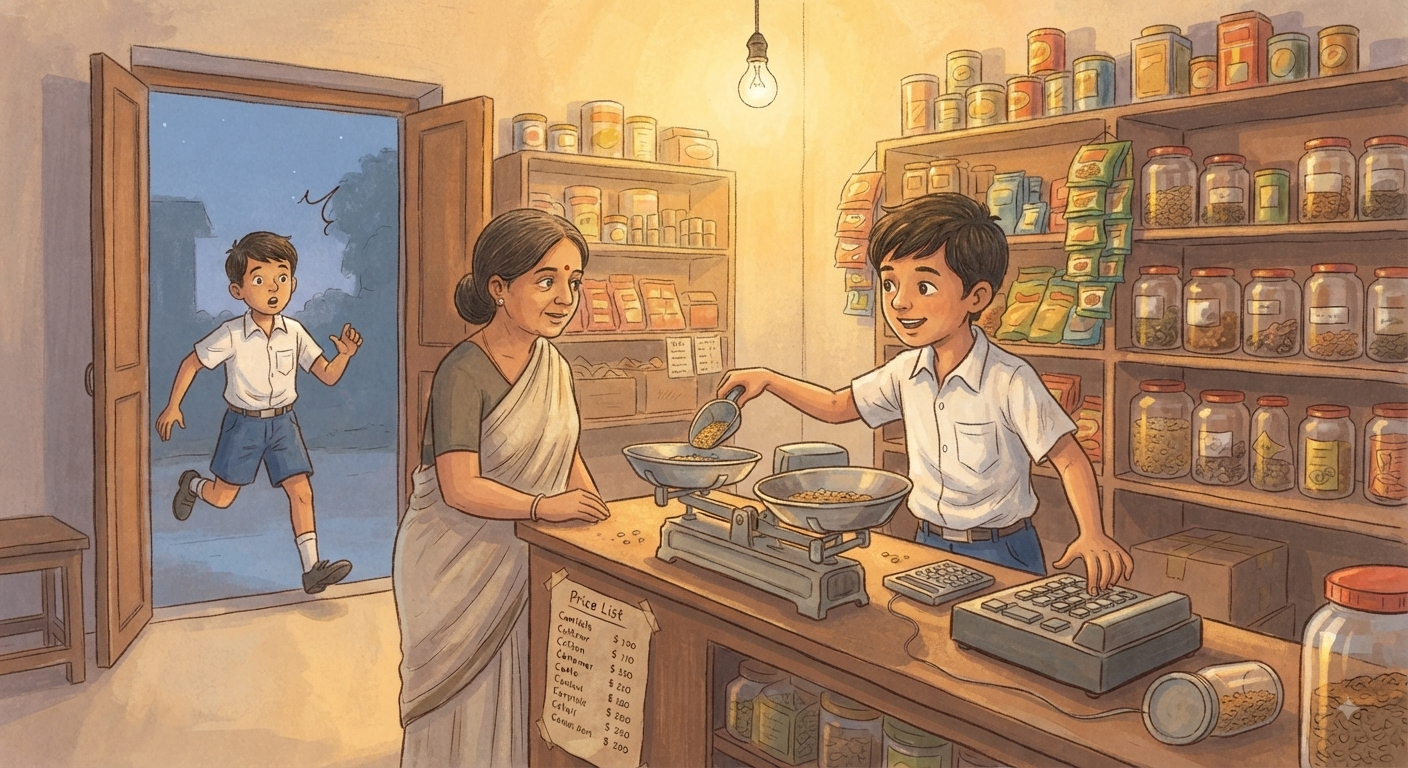
Rohan, in his own school uniform, was weighing sugar on a metal scale for an old woman in a green sari. He slid the little weights along the bar with two fingers until the needle settled. He pointed her toward the shelf with the tea, and said something that made her laugh. Then he rang up the total on a calculator taped to the counter, without seeming to think about it at all.
Mihir stood just inside the door for a moment. It was strange, seeing a boy from his own class do something so completely his own. Rohan’s hands moved sure and quick, like this was simply a thing he was good at.
Rohan looked up and saw him. He went still for a second, the way you go still when you are caught at something.
“You work here?” Mihir said. It was the only thing he could think to ask.
“My uncle’s shop,” Rohan said, and went back to counting change. “Wednesday he minds it himself. Rest of the week he’s off before it’s light — the wholesale market, or some queue at the bank. Someone has to be at the counter till he’s back.”
“Every day?” Mihir said.
“Till closing,” said Rohan. He said it plainly, the way you say something you stopped finding strange a long time ago.
Mihir looked at the shelves stacked to the ceiling, and the calculator with its worn buttons. He looked at Rohan’s hands, which knew exactly where every tin and packet was, without even looking. He bought the sugar and the tea and walked home slowly, past the shuttered tailor’s and the streetlight that always came on late.
He did not tell anyone at school. On Tuesday, the bell went, and Rohan was gone through the gate before Mihir had zipped his bag, same as always. But this time Mihir did not feel the small drop in his chest that usually came with it.
He knew, now, where Rohan was running to.
The next Wednesday, Mihir put two things in his bag. The tin, as always. And a spare gold pencil from the box at home, wrapped in a rubber band.
“For the shop,” he said, sliding it across. “In case the sun needs colouring in on a day you can’t stay.”
Rohan looked at the pencil for a moment. Then he put it in his pocket, not the bag, so it would not get mixed up with anything else.
He was still the funniest boy in Class 4 that Wednesday. He still drew the moustache on everything, quick as anything, and kept the gold one for the sun.
On Thursday, he went out through the gate fast, bag bouncing on his back, same as always. But this time he looked back once, just for a second, and lifted a hand.
Mihir lifted his back.
Talk About It
- Rohan seemed to change completely on the days that weren't Wednesday. Once you knew why, did the story feel different reading it again?
- Rohan shared his tiffin with Dev without being asked. What did that tell you about him?
- Has someone ever seemed distant, and it turned out they were dealing with something you didn't know about?
Did this story land tonight?
One tap helps us write better ones. No login, nothing shared publicly.
Thank you — this genuinely helps. 🌙