The Ant and the Dove
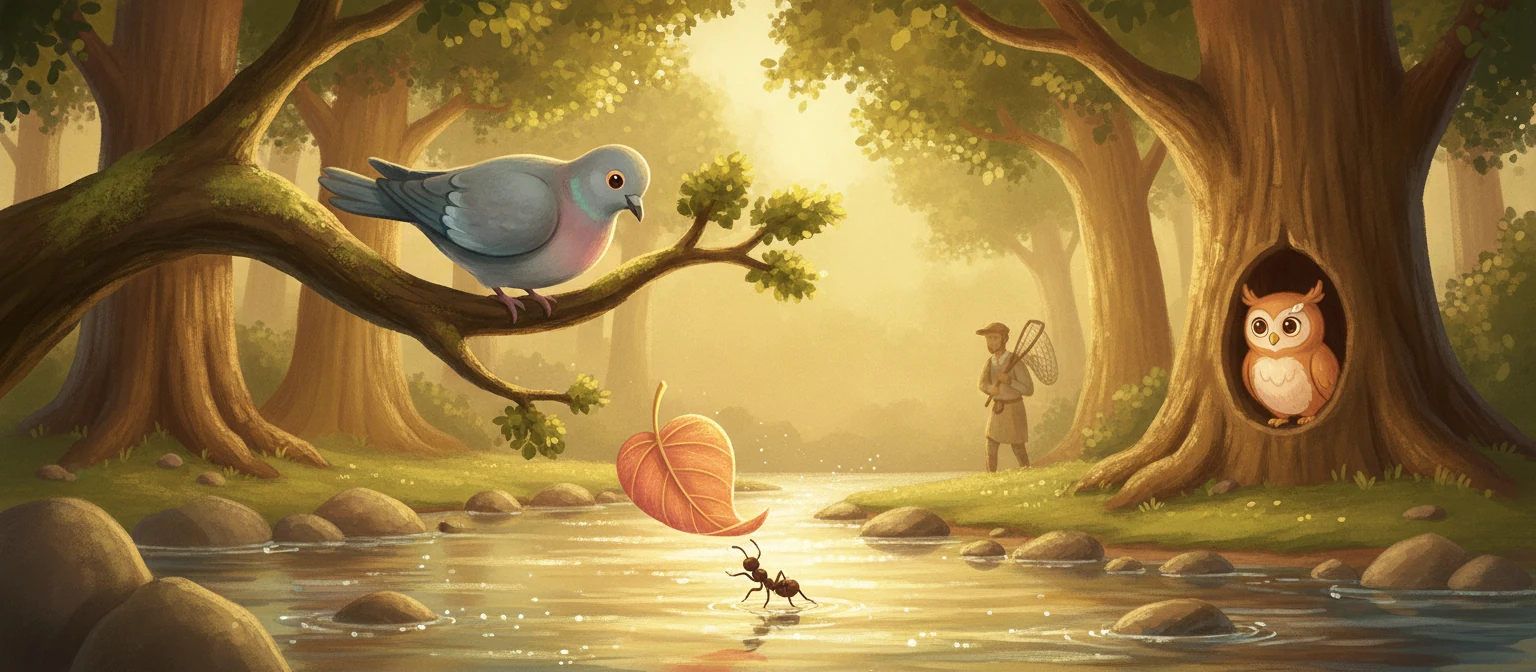
On the bank of a chattering stream stood an old peepal tree. In the tree lived a dove — soft, grey, and gentle-hearted, as doves mostly are.
One hot afternoon, an ant came down to the stream to drink. She was a small black ant, hardworking and ordinary, one of a line of thousands. She carried nothing that day but her thirst.
The wet stones were slicker than they looked. Her feet skidded. The stream picked her up like a leaf-boat with no leaf, and swept her away.
Now, an ant in a stream is a very small tragedy. The water didn’t notice. The stones didn’t notice. The whole enormous afternoon went on exactly as before — except for one drowning ant, struggling in a current a thousand times her size.
But the dove noticed.
She didn’t stop to weigh anything. Whether ants were worth leaves. Whether it was her business. Whether someone else’s wings were closer. She plucked the nearest leaf and let it fall. The leaf spun down and landed on the water, just where the ant was going under.
The ant climbed aboard with her last four legs’ worth of strength. The leaf-boat rode the current, bumped a root, and delivered her onto the bank. Soaked. Exhausted. Alive.
By the time the ant had caught her breath to say thank you, the dove had already flown back to her branch and her afternoon. That is the way with kind hearts. The kindness weighs so little to the giver that it slips their mind by evening.
It did not slip the ant’s mind.
Ants forget nothing. Every ant knows the way home, the way to sugar, and the face of anyone who has ever helped her. This ant now carried, along with her crumbs, a debt. She had no idea how an ant could ever repay a dove. She only knew that she would know the moment when she saw it.
The moment came many weeks later.
A fowler came walking the stream bank — a quiet man with quiet shoes and a net. The kind of man birds don’t hear until hearing is too late. He saw the grey dove dozing on her branch in the gold evening light. He crept close, one slow step at a time, and raised his net.
The dove saw nothing. The stream chattered. The net hung in the air above her like a closing hand.
But down in the grass, an ant looked up.
She knew that grey. She knew that branch. And she did not stop to weigh anything — whether an ant could matter, whether it was her business. She ran. Faster than she had ever run for sugar. Straight up the fowler’s quiet shoe, under the cuff — and she bit down on his ankle with everything her small jaws had ever learned.
“AI!” shouted the fowler — or whatever it is fowlers shout. The net jerked. The dove woke, saw everything in one round eye’s worth of looking, and was gone. Up through the branches. Out over the stream. Safe into the wide gold sky.
The fowler limped home netless. The stream chattered on. And the ant stood in the enormous quiet grass, watching the sky where the dove had vanished. Her debt was paid in full — one small bite, delivered at exactly the right moment.
The dove circled back at dusk and found her on the bank. The two of them — the very large kindness and the very small one — looked at each other for a moment. It was the look of creatures who will never quite speak each other’s language.
But here is what the peepal tree would tell you, and trees see everything by the water:
Neither kindness was small, and neither was large. The leaf was everything the ant needed. The bite was everything the dove needed. Kindness isn’t measured by the size of the giver.
It’s measured by the size of the moment. And it is wise to be kind to everyone — because you cannot know, on any hot ordinary afternoon, who is one day going to be exactly the right size.
Talk About It
- The dove forgot the leaf by evening. The ant never forgot. Why do you think small kindnesses feel bigger to the one who receives them?
- The ant's bite seemed tiny compared to the dove's rescue. Was it? How do you measure a kindness?
- Has someone small — or someone you didn't expect — ever helped you in a big way?
Did this story land tonight?
One tap helps us write better ones. No login, nothing shared publicly.
Thank you — this genuinely helps. 🌙