The Man Who Kept Our Cricket Balls
Every colony has one. In Shanti Enclave it was Colonel Uncle: ground floor, corner flat, garden with a low wall that ate cricket balls.
Every kid in the building knew the rules of his legend. He confiscated on sight. He did not negotiate. Appeals bounced off the door — even polite ones, even with folded hands, even the time Ishita cried real tears. Eleven balls this season alone had cleared the wall and vanished into enemy territory. That included the new season ball the boys had pooled birthday money for, gone on its third delivery. The kids’ collected intelligence on him ran like this: he was mean. He was probably ex-army, because someone’s father had once called him Colonel Sahib. He hated children. He hated cricket. And he definitely, definitely enjoyed taking the balls.
Dev was sent to his door on a Saturday in October. Not by choice. A parcel with the Colonel’s name on it had been delivered to Dev’s flat by mistake, and mothers do not accept “he eats cricket balls” as a reason to refuse an errand.
Dev rang the bell the way you’d touch a hot iron.
The door opened the whole way — the first surprise, since legend said it only ever opened a suspicious crack. Colonel Uncle looked down at him. Tall. Very straight. Slippers and reading glasses. Older up close than over the wall.
“Parcel came to us by mistake,” Dev said, at speed, holding it out like a shield.
The Colonel took it and read the label. Then he did the thing that rearranged everything. He said, “You’ll have water,” turned, and walked inside, leaving the door open behind him. In that generation, as Dev knew from his own grandfather, that is not a question. It is a settled fact about what happens next.
Which is how Dev came to be standing alone in Colonel Uncle’s drawing room when he saw the shelf.
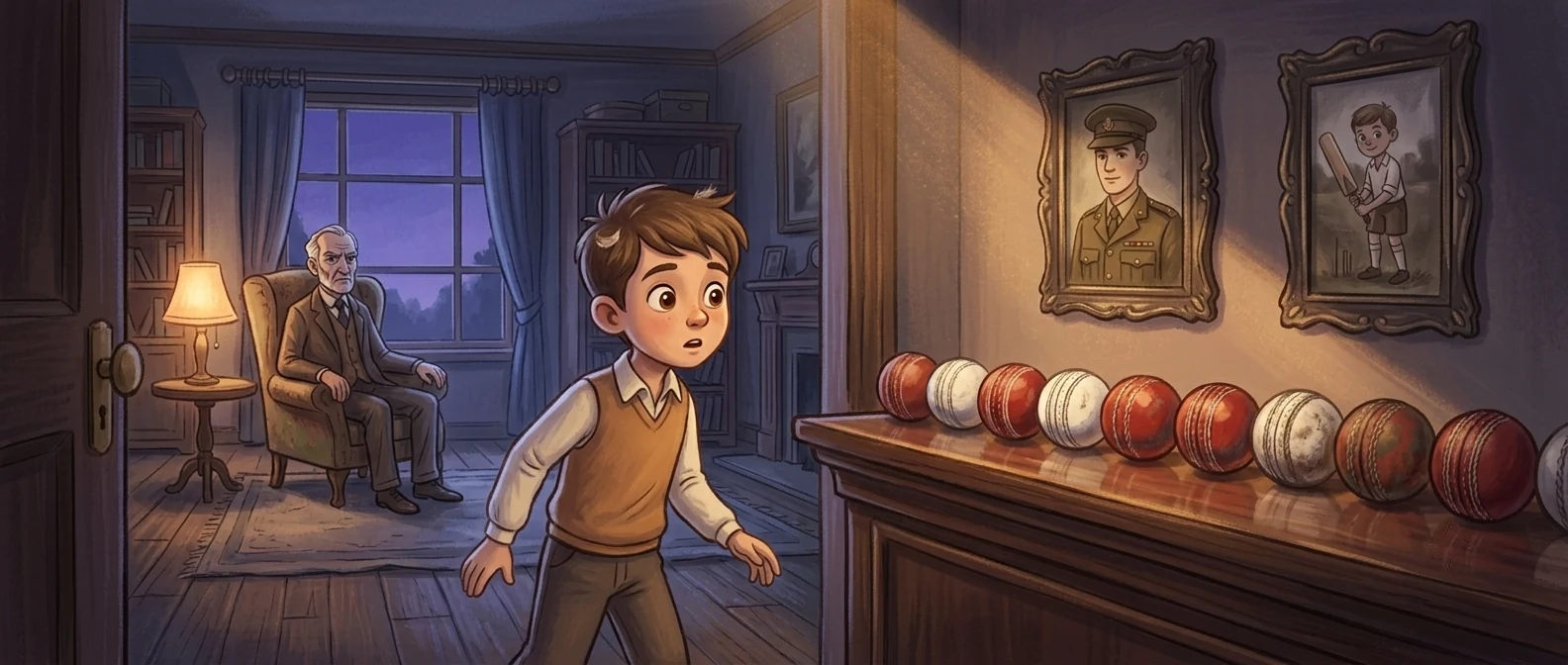
It ran along the wall by the window. Wooden, polished — the kind meant for trophies. And on it, spaced with parade-ground precision, sat cricket balls. Eleven of them. Dev counted without meaning to. Tennis balls sun-bleached to different shades of old green. And at the end, barely scuffed, the pooled-birthday-money season ball.
Not in a bin. Not in a cupboard. Displayed. Dusted, by the look of it.
Above the shelf hung photographs. A young man in an army uniform, laughing at something outside the frame. The same man younger, a teenager in cricket whites, holding up a bat. The same face again as a small boy, gap-toothed, riding the shoulders of a much younger Colonel Uncle — on what was unmistakably the colony lawn, back when the trees were half their height.
“My son,” said Colonel Uncle, from the doorway, holding a steel tumbler of water.
Dev took the water and did not know where to put his eyes.
“Sandeep. He grew up on that lawn of yours. Opening bat — a proper one, not your T20 slogging.” A long pause. “He’s in Toronto now. Two children. They visit—” and here, for the first time, the straight-line voice wavered, “—when they can. It’s far, and leave is short. It’s nobody’s fault. It’s far.”
He straightened a photograph one millimetre.
“The balls come over the wall,” he said, in the voice of a man deciding to say the true thing instead of the easy one, “and I know I should throw them back. But then it’s loud again on that side for a while. The shouting. The howzat. The arguing about lbw — the same arguments, you people haven’t invented a single new argument in thirty years—” He stopped. He looked at the shelf, and then out the window at the lawn.
“And someone rings my bell,” he said, quietly. “You’re the twelfth this season. I count.”
Dev stood in that room and felt the whole colony legend come apart in his hands. Mean. Hates children. Hates cricket. Enjoys it. They’d had every fact and gotten every one wrong — because their facts had all been collected from the far side of a wall. And then came the uncomfortable jolt: Colonel Uncle had only ever been given the doorbell version of them, too. A rotating cast of kids who wanted their ball back and were gone in forty seconds.
Everyone had been visiting nobody, for years.
The next Saturday, Dev rang the bell with no parcel and no errand. Colonel Uncle looked at his empty hands and understood the difference immediately. Dev watched him understand it. And here is what became of it: the boys got their season ball back. They lost it over the wall again within the month. It no longer mattered, because retrieval was now a ritual. You went in twos. You had your water. You heard about Sandeep’s cover drive, or the time the regiment team beat the officers. And on Sunday mornings, Colonel Uncle came to stand at his gate. Never on the lawn — that was too far to travel in one season. But at the gate, arms folded, he issued lbw verdicts nobody had asked for and everybody argued with.
The shelf stayed full, though the balls on it rotated. Dev asked him once why he still kept them up there, now that everyone just came and asked.
“Habit,” said Colonel Uncle, straightening one. And then, in his other voice, the true-thing voice: “They look like company.”
Talk About It
- The kids had a whole story about Colonel Uncle. How much of it turned out to be true?
- Why do you think he kept the balls on a shelf instead of throwing them away?
- Is there someone in your building or street that everyone has a 'story' about? What do you actually know about them, versus what gets said?
Did this story land tonight?
One tap helps us write better ones. No login, nothing shared publicly.
Thank you — this genuinely helps. 🌙