The Two-Tiffin Plan
It took Yash most of the term to actually see it. Later, that became the part he thought about most.
Farhan sat two rows over. At lunch, while the class exploded toward the courtyard with their tiffins, Farhan had a routine. He drank slowly and thoroughly at the water fountain. Then he found a reason to be somewhere — returning a book, asking a teacher something, walking the long way around the field with his hands in his pockets. He was good at it. It looked like a personality, not a strategy.
Then one Monday, Yash forgot his own tiffin at home. He spent lunch break trying to look busy near the library, his stomach embarrassingly loud. And from his spot by the bookshelf, he watched Farhan do the fountain, the errand, the long walk. Suddenly he understood, all at once, the way an upside-down word snaps into sense.
Farhan didn’t bring lunch. Farhan never brought lunch.
Yash was not a boy who sat on things. On Tuesday, tiffin restored, he walked straight to Farhan’s desk at the bell, held it out, and said — warmly, loudly, in front of the emptying classroom — “Hey, my mother packed extra today. You can have some, since you don’t have any.”
He had imagined several versions of what would happen next. Farhan’s face was not in any of them.
It shut like a door. Not gradually — all at once, everything behind the eyes stepping back and away. “I’m not hungry,” Farhan said, in a voice pressed flat. He picked up his bag, did the long walk earlier than usual, and did not look at Yash for the rest of the day. Or the next.
Yash went home miserable and confused in equal parts. He had offered food to someone with no food. How was that the wrong thing?
It was Dadi who untangled it, over the shelling of peas — because it is a law of nature that grandmothers extract the day’s real story in under four minutes. Yash told it. Dadi listened, splitting pods with her thumb.
“You announced it,” she said, when he finished.
“I offered it!”
“You offered it the way a prize is offered. Down, from up.” She dropped a handful of peas in the bowl. “Beta, hunger was the smaller thing. You took the bigger thing — and you took it in front of people. His privacy. He had built that whole clever business, fountain and errands and walking, brick by brick, every day, to keep one fact his own. You knocked it down in a sentence.” She said it without scolding, the way you’d state the score of a match. “Kindness that looks down is charity. Everyone can smell it. Kindness that sits down—” she gestured at the two of them, the peas between them, “—is friendship. Nobody refuses to sit.”
“So what do I do? He won’t even look at me.”
“You get clumsy,” said Dadi, and smiled at his expression. “Smart kindness announces itself. Clumsy kindness just… happens to be there. Tomorrow, you don’t fix his problem. Tomorrow, you have a problem. You have too much food. It’s very embarrassing for you. You need help with it.”
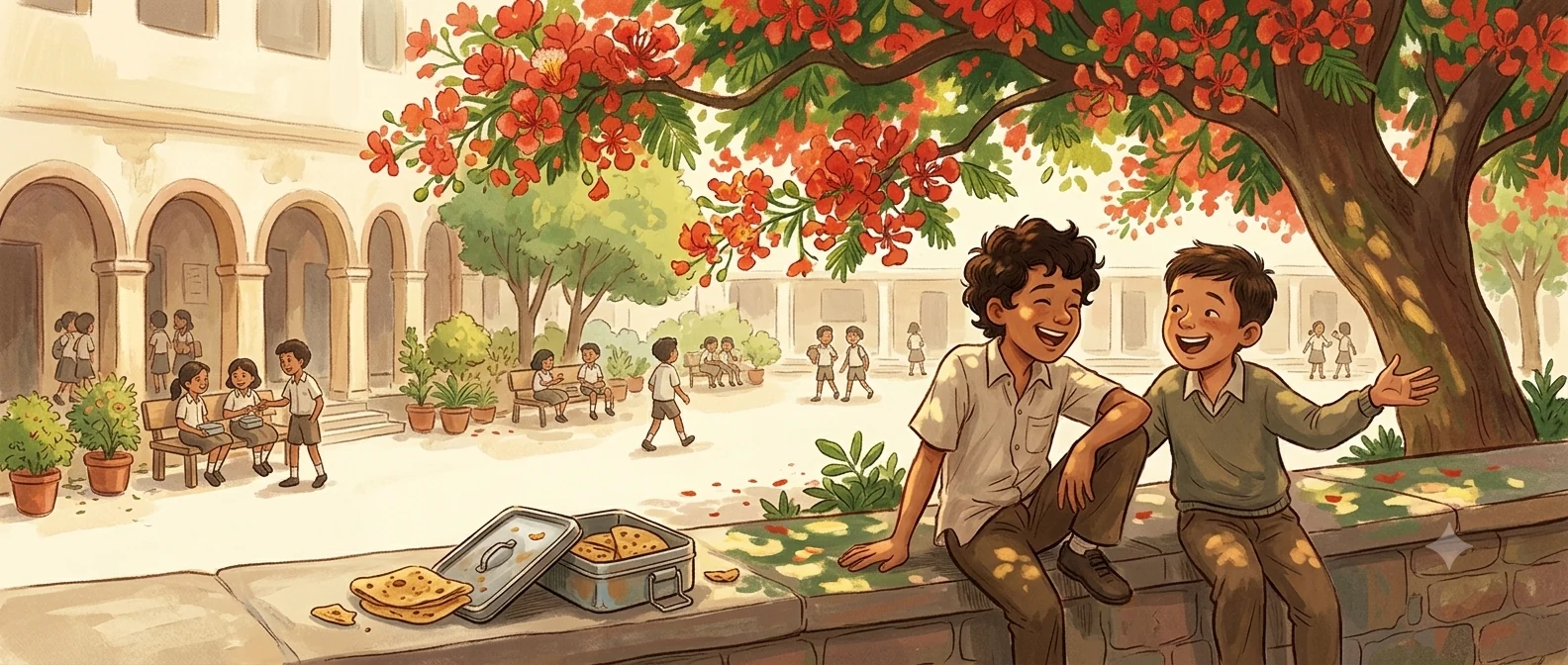
On Wednesday, Yash didn’t go to Farhan’s desk. He sat on the low wall under the gulmohar, right in Farhan’s long-walk flight path, and opened his tiffin. When Farhan passed, Yash groaned, with medium conviction: “Yaar, she’s done it again. Four parathas. She thinks I’m two people.” He tore one in half without waiting for an answer. “Sit, na. If I bring these home she’ll pack five tomorrow to prove a point.”
Farhan stopped. Considered. The whole shape of the moment was different, and both of them could feel it. Nobody was being rescued. A boy with too much food needed a hand with the extra.
He sat. He took the half. They talked about the maths teacher’s haircut.
That was the entire event. That was the plan, all of it. Its genius — Dadi’s genius — was that it could repeat. On Thursday there was too much poha. On Monday, Yash’s mother — who had been quietly briefed, and who from then on packed for two without one word ever said about it — tragically overdid the idlis. It became where they sat. It became their wall. Somewhere in week three it stopped being about the food at all and became just lunch. The fact at the middle of it — known by both, named by neither — was folded away so completely that some days Yash forgot it was there.
Farhan did tell him eventually. Months later, unprompted, in two flat sentences about his father’s shop and how the year had gone, said while they watched a house-match from the wall. Yash nodded, said “okay,” and passed him the pickle. By then he had learned the whole trick of it: some things you honour by making them small.
Funny thing about the wall. Other kids drifted to it, and it became a spot, the way spots form. Three tiffins open, then five, everything passed around until nobody could say whose lunch was whose. One big shared spread of parathas under the gulmohar.
Farhan ate like everyone else, from everywhere, like everyone else.
Which, Yash understood now, had been the whole point from the start.
Talk About It
- Yash's first offer came from a kind place. Why did it still go wrong?
- Dadi said, 'Kindness that looks down is charity. Kindness that sits down is friendship.' What's the difference, in your own words?
- Why do you think Farhan found it easier to accept half of something than the whole of it?
Did this story land tonight?
One tap helps us write better ones. No login, nothing shared publicly.
Thank you — this genuinely helps. 🌙