The Girl Who Didn't Need Words
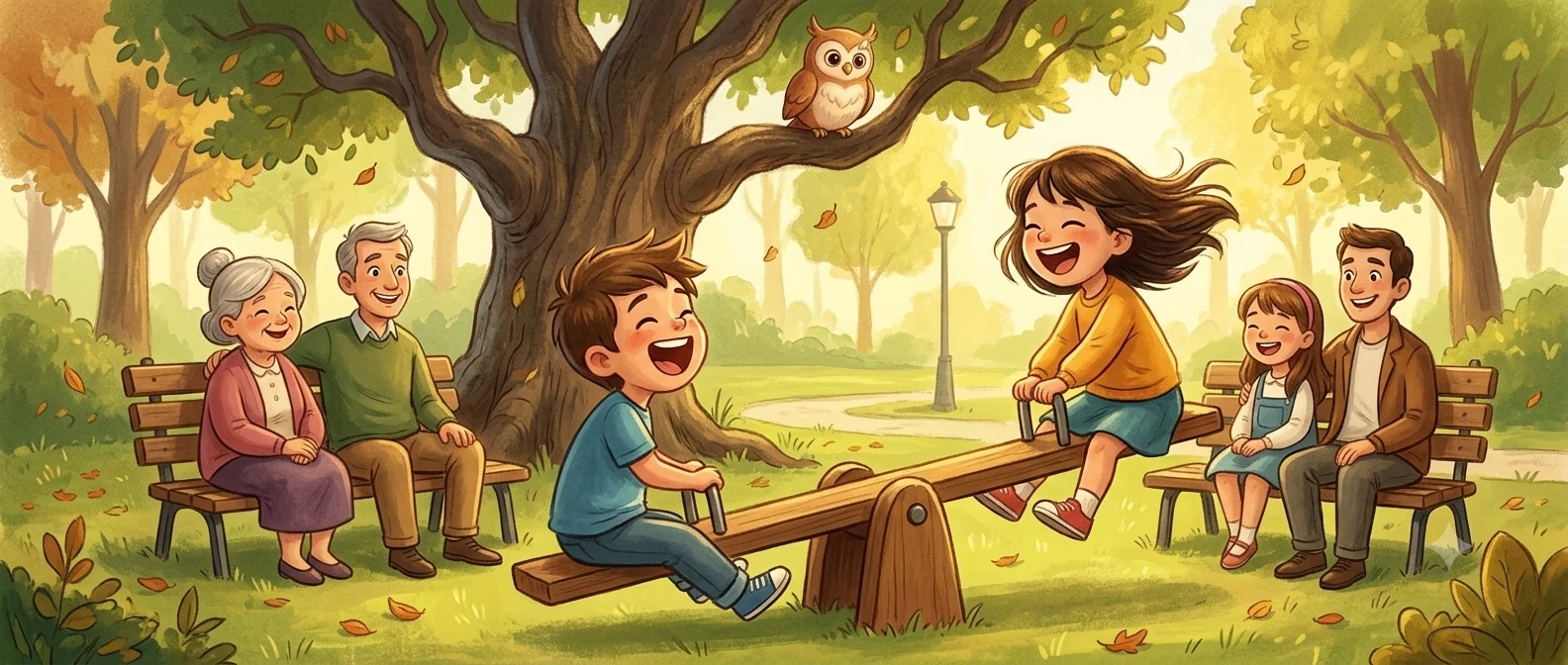
There was a new girl at the park.
She stood by the bench next to her grandmother, holding the hem of her jacket, watching the swings the way you watch something you want.
“Go say hi,” said Theo’s dad.
So Theo went over. “Hi! I’m Theo. Want to play?”
The girl said something back — but the words weren’t any words Theo knew. They were fast and pretty and completely mysterious, like a song from a country he’d never been to.
Theo tried again, slower: “Do… you… want… to… play?”
The girl said her mysterious words again, slower too. They looked at each other. It was like two radios on different stations.
Theo almost walked back. That was the moment — he almost did. But then he saw her look at the swings again. That look needed no translating at all. He knew that look from the inside. It was the I want to but I don’t know how to ask look. He’d worn it himself, at his cousin’s birthday, where everyone knew everyone except him.
So Theo stopped using words.
He pointed at the swings. He pointed at her. He made his eyebrows go up, which is how you say well? in every country in the world.
The girl’s whole face turned on like a light.
They swung side by side, higher and higher, and when Theo did his jump-off-at-the-top trick, she laughed — and laughing, it turns out, is the same in every language. Then she showed him HER trick, twisting the swing round and round and spinning loose like a firework. Theo clapped. Clapping needs no translating either.
After that it all came easy. Tag needs one tap and a run — she understood in half a second and was faster than him, which she told him with one look, no words required. The see-saw needs two people and no words at all. Hide-and-seek needs counting, so she counted in her language — “yek, do, tin…” — and Theo counted in his. Both counted with fingers held up. So really, they’d been speaking finger the whole time.
By the time the streetlights hummed on, they’d played six games, invented a seventh, and had one small argument about the rules of it. It was settled, wordlessly, with rock-paper-scissors — which may be the oldest language of all.
“Made a friend?” asked Theo’s dad on the walk home.
“Yeah. I don’t know her name yet. She doesn’t know mine.”
His dad smiled. “You know the important stuff. Names catch up.”
The important stuff was this: she liked to be pushed high but not TOO high. She was brave on the slide and careful on the climbing net. She shared the last of her crackers without being asked, half and half, exact. And when Theo scraped his knee, she was the one who ran to get his dad — before he’d even decided whether to cry.
You can know a whole person without one word in common. Words are just one of the doors in.
Her name was Amaya. He learned it the next Saturday, from her grandmother — right after Amaya, pointing at him across the park, called out her very first word in his language, saved up and practised all week:
“Theo!”
Talk About It
- How did Theo know the new girl wanted to play, without any words?
- What games could you play with someone who speaks a different language?
- How do you think it feels when nobody around you speaks your words?
Did this story land tonight?
One tap helps us write better ones. No login, nothing shared publicly.
Thank you — this genuinely helps. 🌙