Two Weeks in Nani's Village
Zara composed the review on day two. She was lying under a mosquito net at 5:04 a.m., while an entirely unreasonable rooster went off like a car alarm.
Nani’s village. One star. Wi-Fi appears for ten minutes a day on the roof, near the water tank, if you hold your phone toward Delhi. Baths are from a bucket. The toilet requires technique. Everyone stares at me. There is nothing — genuinely nothing — to do. Two weeks.
She was eleven, she was from London, and she had been shipped here — her word — for the summer. Mum said Nani wasn’t getting younger. Mum also said, you will thank me one day, Zara, which is the sentence parents use exactly when no thanks are coming.
The village was four hours from the airport, then forty minutes off the highway, then a last stretch of road that was mostly a suggestion. Nani’s house had thick cool walls, a courtyard with a neem tree, and a smell Zara couldn’t name yet. Something like woodsmoke, wet clay and cooking, all braided together. Mum had grown up here. That fact refused to fit. Mum — of the Tube map and the office lanyard — barefoot on this exact swept-earth courtyard.
For the first days, Zara moved through the village like a reviewer, making lists of what was missing. No shower. No screens. No point. The neighbour kids gathered at the gate to look at her, whispering. She kept her headphones on and wished the days away.
The flip began on day four, with the water. Afterward, she could point to the exact moment.
She had complained about the bucket baths again. Nani, instead of apologising, handed her two empty steel pots and said, “Come. See where your bath walks from.”
They went with the neighbour women in the early cool — a kilometre to the well, everyone laughing and talking the whole way, Zara sweating and silent. The filled pot was heavier than anything she had ever carried. She made it halfway home before her arms gave out. Then a girl her own age — Sana, one of the gate-whisperers — took the pot from her without a word, swung it up onto her own hip, and grinned.
“You hold your phone at the water tank,” Sana said, in Hindi Zara half-followed. “I hold this. Both need practice.”
Something in Zara’s review deleted itself.
That afternoon she started doing the thing she hadn’t thought to do: asking instead of judging. And the village turned inside out. It stopped being a list of missing conveniences and became a system — an old, deep, deliberate one. The thick walls she’d found gloomy kept the rooms cool through afternoons that would have melted London. The 5 a.m. rooster wasn’t rudeness. Five to nine were the golden hours, the whole village up and working and joking before the heat arrived. The staring kids became Sana’s whole gang, and Zara stopped being their strange specimen and started being their student. Kabaddi in the threshed field. Mango-theft routes. Which pump’s water tasted sweet. The courtyard game with tamarind seeds whose rules changed hourly. Boredom, it turned out, had never been the village’s problem. Boredom was hers — she was a girl whose fun had always arrived through a charger.
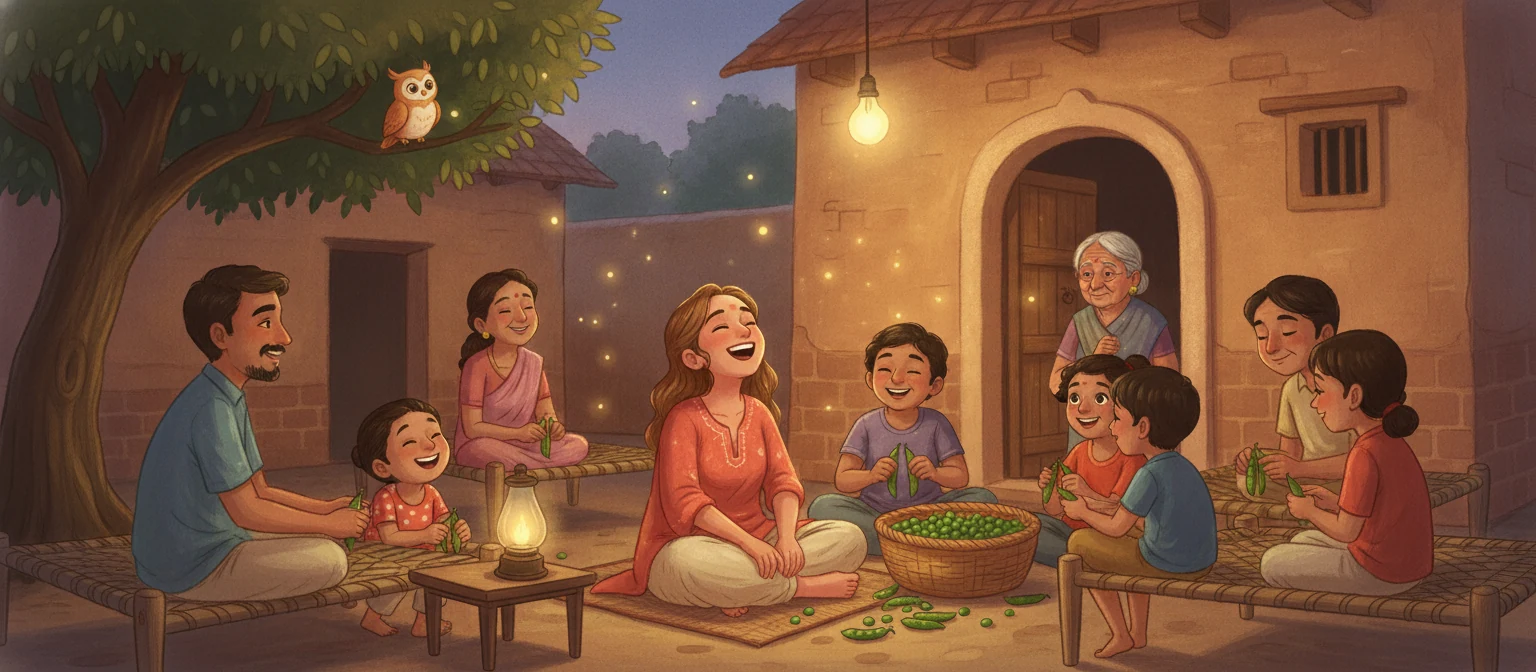
The evenings undid her completely. After dinner, charpais came out into the courtyard. Neighbours drifted in without invitation, because no invitation had ever been needed. The talking simply went on — stories, arguments, songs. Nani told tales of Zara’s mum aged nine, including one involving a buffalo and a school uniform that Zara made her tell twice. Above them hung actual stars, in actual thousands. Nobody checked anything. Nobody was somewhere else in their head. Lying on a charpai with Sana asleep against her shoulder, Zara realised something. In London, she had never once been in a gathering where every single person was entirely there.
“Everything here answers a different question,” she tried to explain to Mum on the crackly day-ten phone call, from the roof, by the water tank, no longer caring about the Wi-Fi. “London answers how do I get more time? Here it’s like… what is the time actually for?” Mum went very quiet. It was the exact sentence she had left home carrying, thirty years ago.
On the last morning, Sana walked her to the car and gave her a knotted cloth with a handful of tamarind seeds in it. The game. To teach London.
Zara cried from the village to the highway, which surprised her most of all.
Somewhere over Europe, she opened her phone and found the one-star review still sitting in her notes. It was written by a girl she could still remember being, but could no longer quite explain. She read it the way you read a stranger’s rude comments about someone you love.
She didn’t delete it. She kept it, and underneath she wrote the correction — the truer review, the one that had taken two weeks and a kilometre of carried water to earn:
Nani’s village. Everything I thought was missing was just something I hadn’t learned to see yet. The Wi-Fi is terrible. The connection is the best I’ve ever had.
Going back every summer. — Z.
Talk About It
- Zara arrived reviewing the village like an unhappy tourist. What flipped her from visitor to insider — can you find the moment?
- 'Everything here answers a different question' — what did Zara mean? What question does your home answer?
- If someone came from far away and reviewed your life in two days, what would they get completely wrong?
Did this story land tonight?
One tap helps us write better ones. No login, nothing shared publicly.
Thank you — this genuinely helps. 🌙