The Notebook from Guwahati
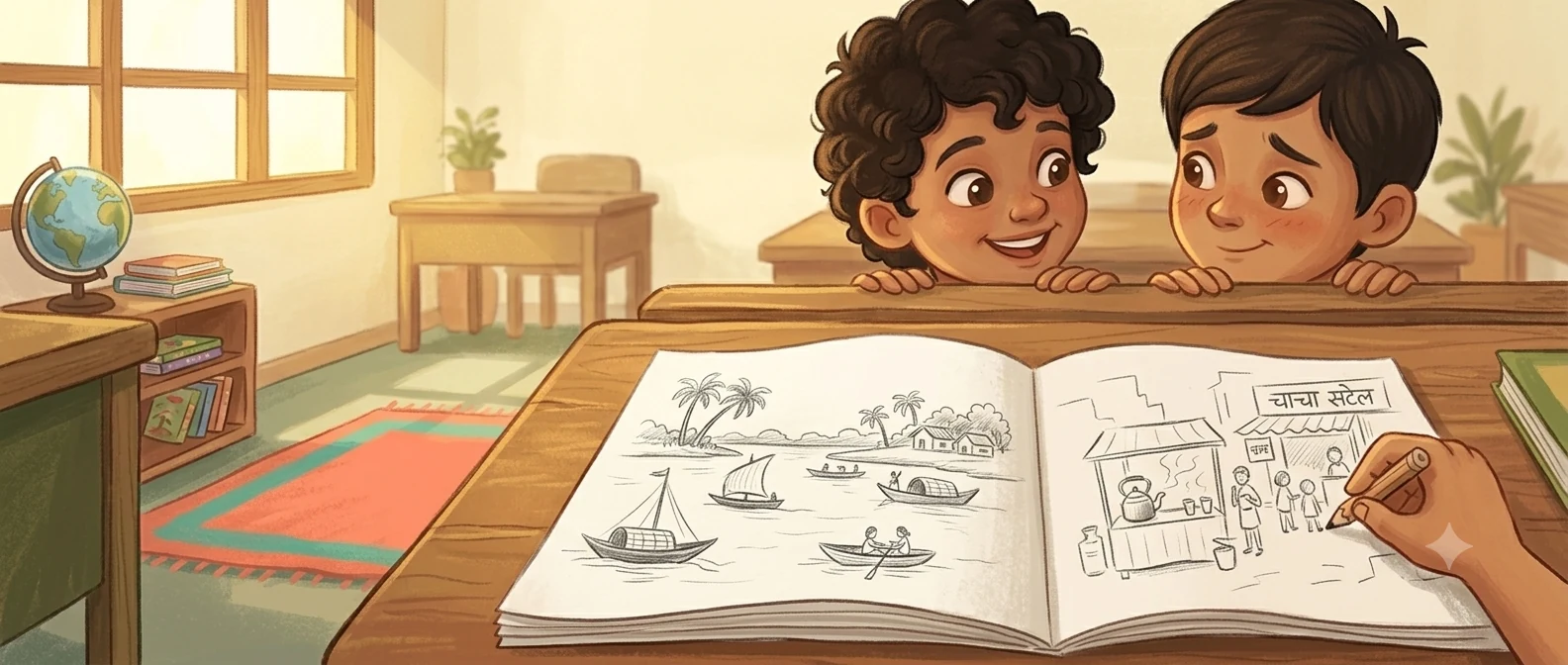
The new girl came in the middle of the term, which everyone knows is the worst time to come.
Her name was Rimi. She had moved from Guwahati, which Arjun had to find on the map at the back of his geography book — far away to the east, past more states than he had fingers. Ma’am put her at the empty desk next to Arjun’s, and Arjun said hi, and Rimi looked at her hands.
That was the whole conversation, and there wasn’t another one for two weeks.
“She thinks she’s too good for us,” Arjun told his mother at dinner. “She doesn’t talk to anyone. At lunch she just sits there.”
“Hm,” said his mother, in the way that meant she disagreed but was going to let him find out how by himself.
Then came the group project. Rivers of India. Partners: your desk row. Which meant Arjun and the girl who didn’t talk.
“You can do the drawing part,” Arjun said, sliding the chart paper over, not expecting much. “I’ll write the—”
Rimi’s school bag tipped. Books slid out, and one of them — a fat, soft-cornered notebook — fell open on the floor between their desks.
Arjun picked it up to hand back. And stopped.
The page was covered edge to edge in pencil drawings, the careful kind that take whole evenings. A wide river with long boats on it. A house on stilts with a bicycle leaning on it. A market street. A dog with one ear up and one ear down. A hill with a temple on top, drawn so exactly that you could tell the artist wasn’t imagining it — she was remembering it.
Under the drawings, in small letters, was one line of writing. Arjun couldn’t read the script. But he suddenly understood — the way you understand a whole room when a door opens for one second — that being new wasn’t Rimi’s biggest thing. Missing home was. Everyone she knew, every street, even the language on the shop signs — all of it was two days away by train. And here she was, sitting next to a boy who thought she was rude.
He didn’t say any of that. Saying it would have been like grabbing something out of her hands.
Instead he took out his own pencil, found a scrap of paper, and drew — much worse than she drew, he knew, but he did it anyway. Their street here. The chai stall with the crooked umbrella. The gate of the school. The dog who slept outside Sharma Stores, one ear up and one ear down, because apparently every neighbourhood in India is issued one dog like that.
He pushed the drawing across the desks and pointed at the dog, then out the window toward Sharma Stores.
“Ours is called Biscuit,” he said. “He’s useless. What was yours called?”
Rimi looked at the drawing for a long moment.
“Bhutiya,” she said. Her first word in two weeks, and it came with the very beginning of a smile. “He was also useless.”
The rivers project got done, eventually — Rimi drew the Brahmaputra from memory, and Ma’am held it up for the whole class. But that isn’t the part either of them remembered afterward.
The part they remembered was the two useless dogs, and the two drawings, side by side on the desks: one of a place missed, one of a place offered.
Talk About It
- Arjun thought Rimi was unfriendly at first. What was really going on?
- Why do you think Arjun drew a picture instead of asking another question?
- Have you ever been new somewhere? What did it feel like?
Did this story land tonight?
One tap helps us write better ones. No login, nothing shared publicly.
Thank you — this genuinely helps. 🌙