The Elephant in the Dark
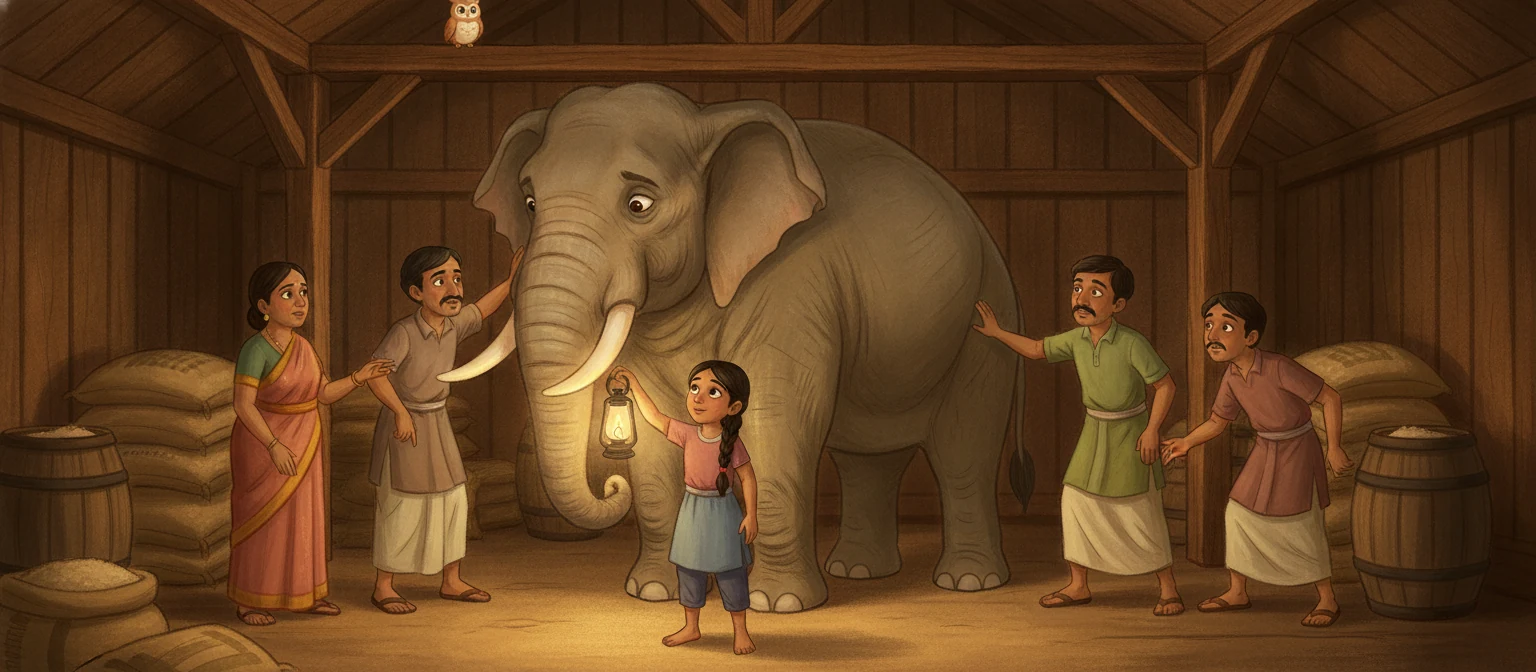
This story is old — so old it has been told in India for well over two thousand years, and has since walked to every corner of the world. It goes like this.
One evening, a travelling merchant arrived in a village and stabled his animal in the dark grain shed for the night. “Mind you don’t disturb it,” he said, and went to eat.
Well. Telling a village not to look at something is the surest way to gather a crowd. Six curious villagers slipped into the shed, where it was blacker than black — no lamp, no moon through the one small window. Unable to see so much as their own noses, they decided to feel what the mysterious animal might be.
The first villager reached out and found the trunk — long, muscular, moving. “Aha!” he cried, leaping back. “It’s a giant snake! Everyone stay calm, it’s a snake!”
The second, further along, caught hold of an ear — wide, flat, gently flapping. “A snake? Nonsense. It’s a huge fan! The kind that cools a king!”
The third wrapped both arms around a leg. “You’re both wrong. It’s a tree! Thick as a temple pillar — I’m touching the trunk of a great tree!”
The fourth pressed his palms against the animal’s side — broad, warm, endless. “Tree? This is a wall. A warm, breathing wall!”
The fifth found a tusk — smooth, hard, curved to a point. “Fools! It’s a spear! Sharp and dangerous!”
And the sixth, at the very back, caught the tail. “You’ve all lost your senses,” she announced. “It’s obviously a rope. A twitchy rope.”
And then — because each of them was completely certain, and nothing argues louder than certainty — the shed filled with the sound of six honest people calling each other liars. Snake! Fan! Tree! Wall! Spear! Rope! Each had touched the animal with their own two hands. Each had the evidence of their own skin. Each knew the others must be blind, or stubborn, or mocking them.
The shouting got so loud that it reached the merchant’s daughter, a girl of about nine, who came running with the thing everyone had forgotten:
a lamp.
She lifted it high, and the warm light spread up and out. Over the trunk, the ears, the legs, the great grey side, the tusks, the twitching tail. Over the whole, entire, patient elephant — who had endured the poking with the good manners elephants are famous for.
The shed went very quiet.
“I was holding the tail,” said the sixth villager, at last, in a small voice.
“I had an ear.”
“A leg. Only ever the leg.”
And here is the thing the villagers understood, standing together in the lamplight. It is the thing that has kept this story walking around the world for two thousand years. Not one of them had lied. Every single one had told the truth about their own handful of elephant. The snake was real; it was the trunk. The wall was real; it was the side. They were all right — and all wrong — at exactly the same time, because each had mistaken their piece for the whole.
The six of them walked home together, rather quieter than they’d arrived, and the story could end there.
But in that village, they say, it didn’t quite end — because the six became known for a habit that spread. Ever after, arguments still broke out at the well or the market. Two people shouting, both certain, both holding their own handful of the truth. And someone would eventually grin and say the words that had become the village’s proverb:
“Friends, friends. Which part of the elephant are you holding?”
And the arguers would stop. And laugh, usually. And then do the only thing that has ever worked in a dark shed:
put their pieces together, and go looking for a lamp.
Talk About It
- Every villager was telling the truth about what they touched. So how were they all wrong?
- What did the lamp change? What's the 'lamp' when two people are arguing — what lets everyone see the whole elephant?
- Think of a time you and someone else disagreed about the same event. Which part of the elephant was each of you holding?
Did this story land tonight?
One tap helps us write better ones. No login, nothing shared publicly.
Thank you — this genuinely helps. 🌙