The Party Everyone Knew About
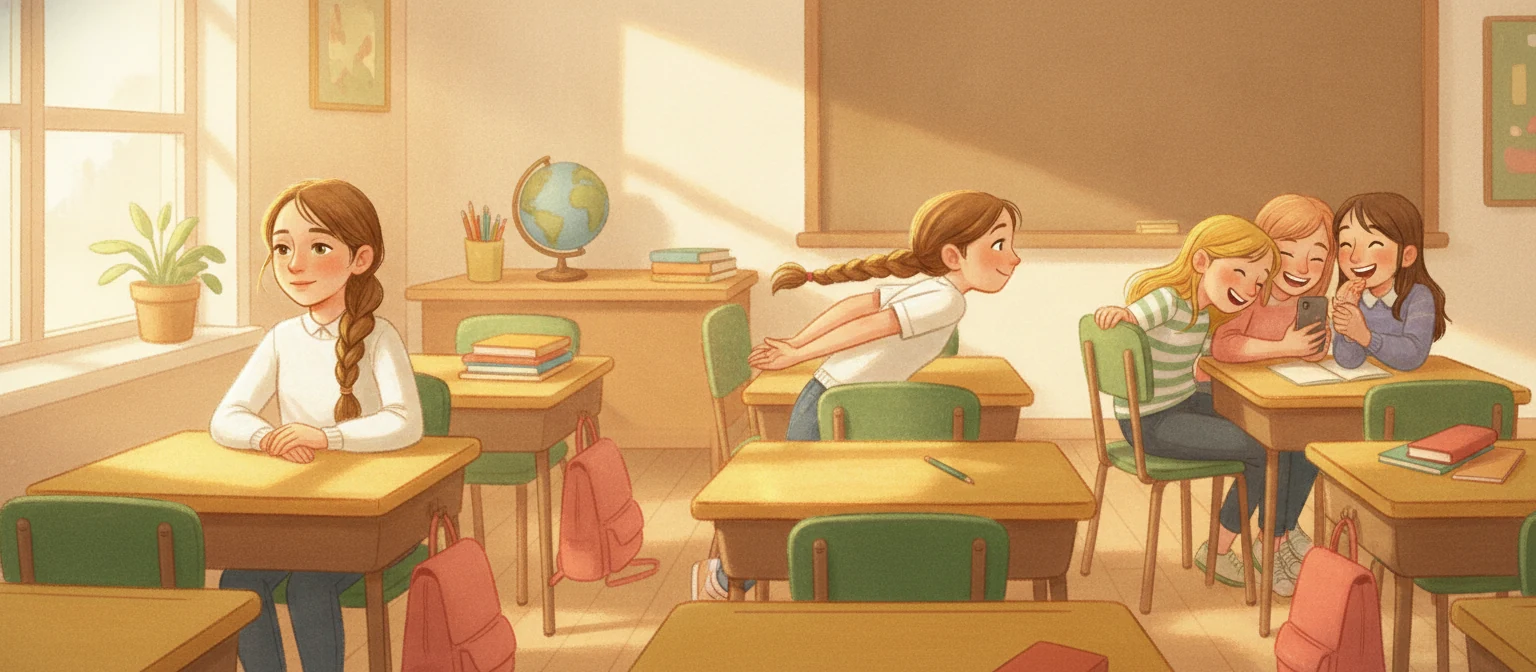
The lunch bell rang at half past twelve. Sana picked up her lunchbox and walked out of the classroom, as she did every day. For months, she had eaten lunch on a low wall behind the science room with Aisha, Meher, Ritu and Ishita. It was their usual place, and nobody had ever needed to decide who could sit there.
The wall was warm from the afternoon sun. A gulmohar tree stood nearby, dropping bright red flowers onto the ground. Aisha usually brought mango pickle in a small steel box, and Meher brought a cold bottle of water that everyone shared because the tap near the gate tasted warm and metallic. Ritu never brought anything for lunch and always announced it before anyone could ask. Sana’s mother packed six chapatis for her instead of four, because Sana was always hungry by lunchtime.
But when July arrived, things began to change.
At first, Sana could not understand what was happening. One day, she walked out for lunch and found the other four girls already sitting on the wall. There was a small space between Aisha and Meher, but Aisha’s bag was placed on one side of it and Meher’s bag on the other. Sana stood there for a moment, waiting for someone to move a bag or ask her to sit down.
Nobody did.
The girls smiled at her as if nothing was wrong. Sana smiled back because she did not know what else to do. Then she walked over to the step near the water tap and sat down by herself. She opened her lunchbox, ate two chapatis, and closed it again even though there were still four left.
The next day, the same thing happened.
After that, the exclusion showed up in lots of small ways. There was a joke that everyone seemed to understand except Sana because they had started it without her. Once, Meher was showing the other girls a photograph on her phone, but when Sana walked past, the phone suddenly disappeared under the table. During a relay race, everyone quickly found a partner while Sana was left standing beside the teacher, waiting for someone to choose her.
Nobody shouted at Sana.
Nobody pushed her.
Nobody called her a name.
That was what made it so difficult to explain.
If someone had hit her or said something cruel, she could have told a teacher exactly what had happened. But how could she explain that people were making space for everyone except her? How could she explain a bag placed on a seat, a joke she was never allowed to hear, or a phone turned face-down when she walked past?
Then came the party.
Meher’s birthday was in the last week of July. Sana heard about the party at school, just as everyone else seemed to have heard about it. She had not been invited, but that was not the worst part.
The worst part was that everyone knew.
During lunch, photographs from the party moved from one phone to another. Sana saw a big cake, a garden decorated for the birthday, and pictures of Aisha, Meher, Ritu and Ishita standing together and laughing.
Sana tried to look as though she did not care.
She even smiled at one of the pictures.
But when she went home that afternoon, she started wondering what was wrong with her.
Maybe her uniform was not nice enough.
Maybe her shoes looked old.
Maybe she talked too much.
Maybe she laughed too loudly.
Maybe there was something about her face that people did not like.
She began checking herself in the mirror. She looked at her hair, her teeth and her clothes. She checked her school uniform for marks and even washed her socks twice. At school, she started looking at the shoes other girls wore and comparing them with hers.
She was searching for an answer.
She thought that if she could discover what was wrong with her, she might be able to fix it.
Something else changed too.
Sana stopped raising her hand in class.
One morning, Ms. Rao asked the class a question about the water cycle. Sana knew the answer immediately. Usually, her hand would have gone up before she had even finished thinking. This time, she kept her hand on the desk. She stared at her notebook and pretended not to know.
At home, her mother noticed something else. Sana’s lunchbox was coming back with food still inside. The first time, her mother thought Sana had simply not been hungry. The second time, she wondered if Sana had eaten something at school. After several days, she realized that this was happening almost every day. She did not immediately ask Sana what was wrong. Instead, she waited.
One Sunday evening, Sana’s mother brought a pile of clothes into her daughter’s room and sat down beside her on the bed. There were shirts, school socks and two towels that needed folding.
“Help me with these,” she said.
Sana began folding the clothes.
For a while, neither of them spoke.
Then her mother asked, “Who do you sit with at lunch these days?”
Sana continued folding.
“People,” she said quietly.
Her mother smiled a little. “Which people?”
Sana did not answer.
She folded the same shirt again.
Her mother watched her for a moment and then put the clothes aside.
“I think something is happening at school,” she said.
Sana looked up.
Her mother told her about a woman at her office who sometimes did something similar. The woman never said anything openly rude. Instead, she would leave her mother out of meetings or forget to tell her about something important. If her mother asked why she had not been told, the woman would smile and say she was sorry.
“Nothing she does seems terrible by itself,” her mother explained. “But when it happens again and again, it makes you feel like you don’t belong.”
Sana was quiet.
“That is bullying too,” her mother said. “Bullying does not always look like shouting or fighting. Sometimes it is about making someone feel unwanted again and again.”
Sana looked down at her hands. “I thought maybe there was something wrong with me,” she whispered.
Her mother shook her head.
“There isn’t.”
She reached over and held Sana’s hand.
“Not your face. Not your clothes. Not your shoes. Not your laugh. None of those things caused this.”
For the first time in several weeks, Sana felt that maybe she had been looking for the answer in the wrong place. The next Tuesday, Sana and her mother spoke to Ms. Rao. Ms. Rao listened carefully. She did not call the whole class together. She did not point at the girls and demand that they apologize. Instead, she changed the classroom seating.
She arranged the desks in groups and began giving students partners for certain activities instead of allowing everyone to choose their closest friends every time. She also made sure that group activities changed regularly, so the same children would not always work together. She started handing out partners for group work by number. Aisha ended up at the front, beside a boy who collected bus tickets.
At first, Sana was nervous about the changes. She wondered if the other girls would be angry with her. But nothing dramatic happened. The next day, everyone simply sat in the new places. Nobody was punished. The wall behind the science room was still there at lunch. But the four of them were no longer sitting in one row for six hours a day.
That small change gave Sana some breathing room. Ishita sat two desks from Sana after the change. Ishita had been part of the group before. She had never been the one deciding who should be left out, but she had seen what was happening. She had laughed at jokes she knew Sana did not understand. She had watched Sana being left without a partner during games.
She had noticed what was happening. She just had not known what to do about it.
One Tuesday evening, Sana’s phone buzzed while she was doing her homework. It was a message from Ishita.
“Did you get question fourteen in maths? The one about the two trains?”
Sana replied with the answer. A few seconds later, another message appeared.
“I don’t really know what’s going on with everyone either. It’s weird. Do you want to sit with me tomorrow?”
Sana stared at the screen. She read the message once, then again, and then a third time. She read it eleven times before finally putting her phone down.
The next day, Sana sat with Ishita at lunch. For a while, it was just the two of them. Then another girl joined them, and a few days later, another girl came over. Soon, there were four children sitting together, talking about homework, cartoons, teachers and all the ordinary things children talk about at lunch.
Nobody had planned it. Nobody had decided who was allowed to join. That was what made it feel different.
Slowly, Sana began to feel like herself again. By November, her hand was going up in class. When Ms. Rao asked a question, Sana no longer stared at her notebook and pretended she did not know the answer. On Sunday nights, her stomach stopped hurting, and she started sleeping properly again.
Aisha never apologized. She never explained why she had treated Sana that way. For a while, Sana wished she would. But eventually, Sana understood something important: she did not need Aisha to explain what had happened before she could move forward. What mattered was that she was no longer alone.
Months later, in February, Sana walked outside for lunch with her lunchbox in her hand. As she passed the water tap, she noticed a girl from the second row sitting alone on the step.
Sana stopped.
She knew that step. She knew exactly how it felt to sit there while everyone else sat together. For a moment, she simply stood and watched. Then she walked over.
She did not ask the girl why she was alone. She did not make a big speech or tell her that she understood everything. Instead, Sana sat down beside her, and the two girls ate lunch together.
That evening, Sana sent the girl a message about the science homework. Before putting her phone away, she added one more sentence.
“Do you want to sit with me tomorrow?”
And this time, Sana knew exactly why she was asking.
Talk About It
- Nobody in this story shouted at Sana or pushed her. So why was it still bullying?
- Sana's mother talked about a woman at her own office. Why do you think she told that story instead of just saying 'this is bullying'?
- Ishita sent one message about maths homework and added one extra line. What is the smallest thing you could do for someone eating lunch on their own?
Did this story land tonight?
One tap helps us write better ones. No login, nothing shared publicly.
Thank you — this genuinely helps. 🌙