Dadu's Winter Coat
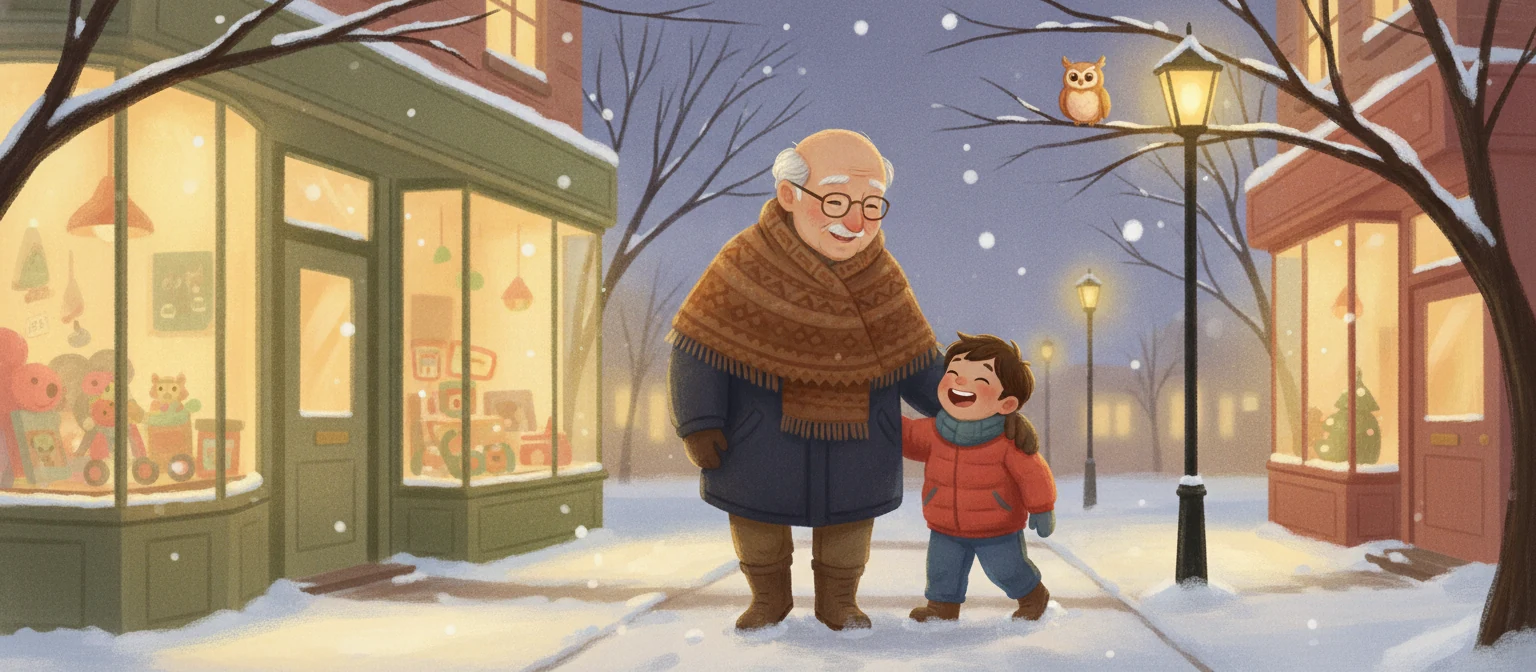
Dadu arrived at the Toronto airport in November, with two suitcases and his brown Kullu shawl folded over one arm, and moved into the room next to Aarav’s.
He had lived in Delhi for seventy-four years. All of them. The same city, and mostly the same block of houses around the same park. From what Aarav had seen on visits, Dadu had known every shopkeeper by name there. He had known every neighbour by their father’s name too. His evenings had a park bench, the bench had friends, and the friends argued over cups of tea about cricket matches from before anyone was born.
Now Dadi was gone. The doctor had said someone should be close by. And close by meant here: a snowy suburb where Dadu knew exactly one family — theirs — and the dark came down at 4:30 like a lid.
Aarav was eleven, and he loved his grandfather. That mattered, because of what came next.
What came next was that Dadu, in this new country, kept getting things wrong — and Aarav noticed every single one. He wore the shawl over his sweater deep into December, and left the new winter coat on its hanger in the closet, tags still on. At school pickup, in his shawl among the puffer jackets, he stood out like a man from another century. He called out to Aarav in loud, delighted Hindi across the schoolyard, hand raised over his head, while Aarav felt the eyes of the entire Grade 6 pickup line. He picked up every tomato in the supermarket bin before choosing one, the way you would at a Delhi bazaar. Once, at the checkout counter, in front of the whole line, he tried to bargain. He asked the mailman his father’s name, standing on the front step in his slippers. The mailman looked surprised and did not know how to answer.
And Aarav began treating his grandfather as if he were a problem that needed fixing. He walked faster across the schoolyard at pickup, two steps ahead. He answered the loud Hindi in quiet English, under his breath. “It’s not a market, Dadu.” “You can’t just talk to people here, Dadu.” Small, quiet fixes, said flatly, the way a teacher corrects a wrong answer. Dadu took each one without a word, just a small nod, like a man taking notes.
The evening that changed it came in January, in the middle of a cold snap. Mum sent Aarav upstairs to call Dadu down for dinner. He found the old man’s room dim, curtains open to the snow, no lamp on. Dadu sat on the edge of the bed with an old photo album open across his knees. The bench friends, squinting in some old sun. The colony gate. Dadi in a green sari at somebody’s wedding, one hand on her hip. He wasn’t crying. He was just sitting there, very still, with his whole former life in his lap. In the 4:30 darkness. Waiting to be called for dinner, in a country where he did not know a single person’s father’s name.
Standing in the doorway, Aarav finally understood how much Dadu had left behind.
He himself had moved house exactly once. One suburb over, age eight. He had cried over his old bedroom door and his old backyard swing for a month. Dadu, at seventy-four, had packed seventy-four years into two suitcases. The bench. The friends. The shopkeepers. The language on the streets. The whole shape of his days, and every person who remembered him young. He had boarded the plane without one complaint. And his welcome had been a coat he didn’t choose, and a grandson correcting his volume.
Standing there in the doorway, Aarav thought of the schoolyard. The raised hand. The loud Hindi across the fence. The same bench, back in Delhi. The same friends, calling out the same way, every single morning for seventy years.
Aarav didn’t say any of this. He was eleven. The feelings didn’t have sentences yet. Instead he walked in, sat down next to the album, pointed at the bench photo, and asked, “Which one’s the uncle who cheated at cards?”
Dadu looked at him. Something switched back on.
Dinner was late that night. The card-cheating uncle alone took twenty minutes.
The rest happened the way real repairs happen: small and unannounced. Aarav started answering Hindi with Hindi at pickup, at full volume, and discovered he didn’t actually burst into flames. Two kids in his class turned out to have their own loud grandparents. One of them said, “Your dadu’s cool, he talks to everyone.” Aarav filed it away. He took Dadu to the library and introduced him to the Saturday chess tables, folding chairs, chess clocks and all. Dadu sat down at a board and proved lethal. All those years of bargaining in the bazaar had taught him something about a trap. Over a rook sacrifice on a scratched wooden board, a retired Ukrainian engineer named Bohdan became the first friend of the Toronto era. The two of them now argue about chess openings just as Dadu and his old friends used to argue about cricket. Neither fully understands the other’s accent. It does not appear to matter.
And the coat? That resolved itself one morning when the cold was worse than usual, cold enough to make your eyes water on the walk to the car. Dadu finally gave in to the navy winter coat. He pulled it on and zipped it up. Then, quite deliberately, he wrapped the brown Kullu shawl over the top of it. He looked at Aarav with one eyebrow raised, daring him to say something.
Coat over sweater. Shawl over coat. Canada underneath, Delhi on top.
“Warm enough for this country,” said Dadu, in loud, cheerful Hindi, “and still dressed like myself.”
Aarav walked him to the corner that morning, matching his pace, in no hurry at all.
“Perfect,” he said. In Hindi. At volume.
Talk About It
- Aarav felt embarrassed by Dadu, and then felt ashamed of being embarrassed. Have you ever had both feelings at once? What do you do with them?
- Aarav realised Dadu had done 'the biggest move in the family' at seventy-four. What did Dadu leave behind that couldn't be packed?
- The coat went over the shawl, not instead of it. Why does that matter?
Did this story land tonight?
One tap helps us write better ones. No login, nothing shared publicly.
Thank you — this genuinely helps. 🌙