The Signature
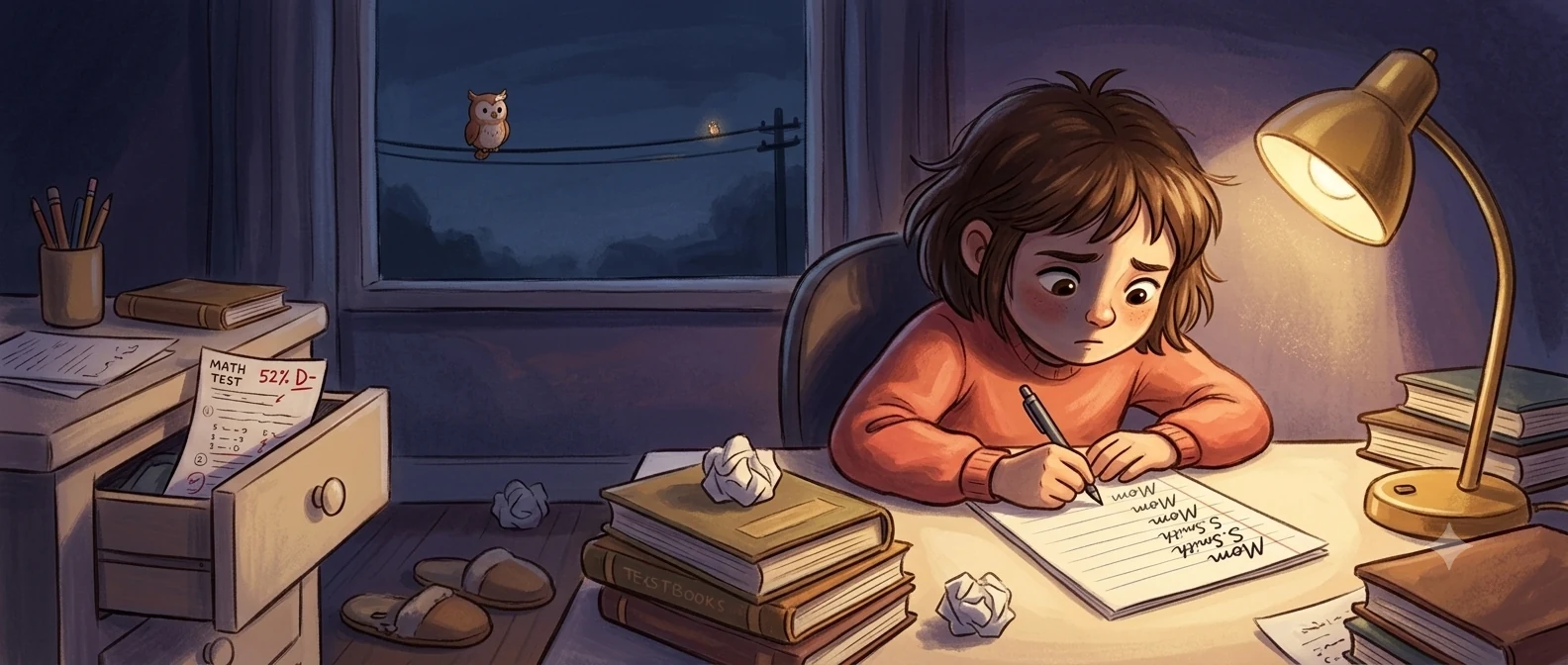
The test came back on a Tuesday, face down. Face down was never good news. Twelve out of forty.
Anvi had never scored twelve out of forty in anything. She was the girl whose report cards got photographed and sent to the family group. And that, she realised later, was the whole problem. She had no plan for twelve out of forty. Other kids seemed to have one. She had no speech ready for her mother, no thick skin, nothing. Just the test in her bag, glowing through the canvas like something dangerous, and Ma’s voice in her head saying we’ll go through it together — which was somehow worse than shouting.
The instruction was written on the board: Signed by parent. Return Thursday.
Wednesday night, in the lamplight at her desk, Anvi took a blank page and wrote her mother’s signature.
It was terrible. She tried again. Terrible. She found an old consent form in the drawer and studied the real thing — the swoop of the A, the quick line underneath — and tried again, and again. On the eleventh try, something clicked in her wrist, and the signature came out right. Four minutes, start to finish.
She signed the test in one smooth line and remembered thinking: that was easy.
It was the last easy thing for a month.
Because here is what nobody tells you about a forged signature: it doesn’t finish the job. It starts one. The signed test went back on Thursday. And from Thursday on, Anvi worked for that signature the way you work for a demanding boss.
The marks register went home to parents at month-end. So she had to reach the letterbox first, every single day, before Ma got home. Then her marks dipped again — because twelve out of forty had reasons, and hiding the test meant hiding the reasons too. So there was a second test to sign. Her wrist remembered. Two minutes, this time.
Ruhi asked her in the corridor why she’d gone weird about her bag. Ma asked at dinner why she flinched when the phone rang. Then Miss Kapoor announced parent–teacher meetings for the twentieth, and Anvi sat in the third row doing the sums. Ma. In that classroom. At that desk. Looking at a register full of marks she’d never seen and signatures she’d never signed.
You can’t forge your mother at a table she’s actually sitting at.
The strange part came clear to Anvi only afterward. She had stopped being afraid of the maths marks completely. Twelve out of forty felt small now — an honest little problem from a simpler time. What kept her awake was everything she had built on top of it, and how much of every day went into holding it up. She was tired the way liars are tired. A lie is work you can never finish and never show anyone.
On the night of the nineteenth, Ma was at the table with her office laptop. Anvi stood in the doorway for a full minute before her voice worked.
“Before tomorrow,” she said, “there’s something I have to show you.”
She brought all of it. The first test. The second. The page of eleven practice signatures — which she could have thrown away weeks ago, and somehow hadn’t. As if some part of her had been keeping the evidence for exactly this night.
Ma looked through it in silence. The silence went on long enough that Anvi’s ears rang.
“Twelve out of forty,” Ma said at last, quietly. “You know what I’d have done, if you’d brought this to me in October? We’d have sat here. Found what went wrong in chapters four and five. Fixed it. One bad evening.” She set the practice page down, and her hand wasn’t steady. That was what actually broke Anvi. Not anger. Her mother’s hand. “The marks were never the thing, Anvi. I don’t sign your tests to approve your marks. I sign them so that whatever’s happening to you, it’s happening to us.”
Ma went to the meeting the next day and heard everything at that desk, with her own ears. Anvi sat beside her through all of it, which was its own kind of consequence. It wasn’t the last one. The phone stayed with Ma for a month. And for a while after that, Ma double-checked things she had never used to check. Anvi had to live inside that checking. That is what broken trust really costs. Not a punishment with an end date — a season of being checked on.
But chapters four and five did get fixed, at the table, together, one evening at a time. And when the December test came back — twenty-nine out of forty, face down out of habit — Anvi carried it home and put it in front of her mother at dinner. Not scary this time. Not a trophy either. Just true.
Ma read it. Nodded. Signed it — the swoop of the A, the quick underline, four seconds, no practice needed.
“See?” she said, sliding it back. “Easy.”
Talk About It
- The forged signature worked — nobody caught Anvi for weeks. So what was going wrong, if nothing was going wrong?
- Why do you think telling the truth felt harder the longer she waited? What was growing?
- Anvi's mother said 'the marks were never the thing.' What was the thing?
Did this story land tonight?
One tap helps us write better ones. No login, nothing shared publicly.
Thank you — this genuinely helps. 🌙