The Boy Who Called the Wolf
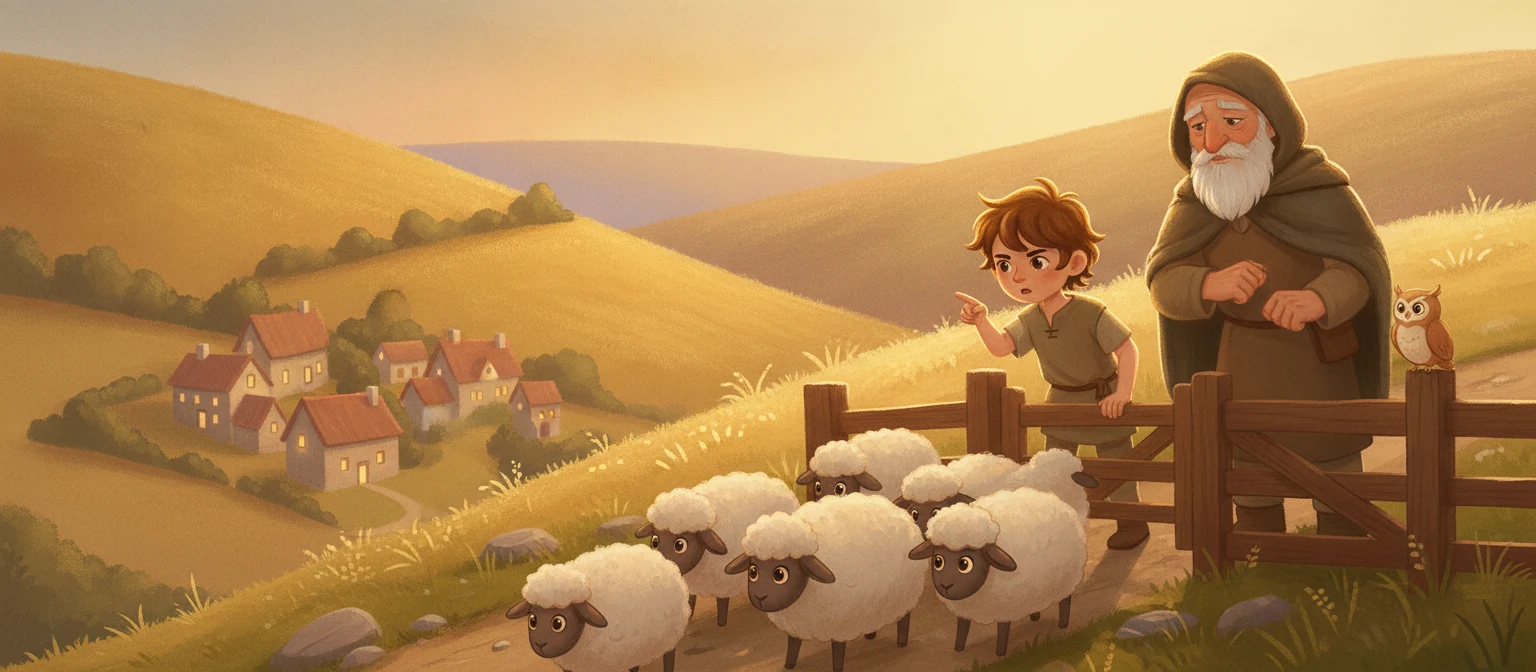
On the hill above the village, a boy named Sonu watched the sheep.
Watching sheep is important work. It is also — Sonu would tell you — very boring work. The sheep ate grass. Then they ate more grass. That was the whole show, all day long.
So one afternoon, just to make something happen, Sonu stood up and shouted down at the village:
“WOLF! WOLF! A wolf is after the sheep!”
Oh, what a commotion! Farmers dropped their spades. Aunties dropped their washing. The whole village came running up the hill with sticks and pots and one very loud whistle — and found the sheep eating grass, and Sonu laughing so hard he fell over.
“There’s no wolf,” he giggled. “You should have seen your faces!”
The villagers went back down the hill. Nobody laughed with him.
A week later, Sonu did it again. “WOLF! WOLF!” And again the village came running — fewer of them this time, and slower — and again there was no wolf, only a boy who thought faces were funny.
Then one evening, when the sun was going down orange behind the hill, Sonu saw something at the edge of the trees. Grey. Quiet. Walking low.
A real wolf. A truly real wolf.
“WOLF!” shouted Sonu, and this time his voice had real fright in it. “WOLF! PLEASE! A REAL ONE!”
Down in the village, the farmers looked up… and went back to their dinner. The aunties shook their heads. “That boy,” they said. “Again with his wolf.”
Nobody came.
Sonu did the only thing left. He banged his stick on the big iron water-drum, BANG BANG BANG, and yelled and waved. And the wolf, who did not like noisy dinners, slipped back into the trees. The sheep were safe. But only just. And only because of luck and a loud drum.
That night, the old shepherd came up the hill and sat down next to Sonu, who had been crying a little, privately, into his sleeve.
“Nobody came,” said Sonu. “There was a real wolf, and nobody came.”
“Mm,” said the old shepherd. “A voice is like a rope, boy. Every true thing you say makes it stronger. Every false thing cuts a few threads. You cut yours twice, for fun. Tonight you hung a whole flock on it — and it snapped.”
“How do I fix it?”
“The slow way. There’s no other way.”
So that is what Sonu did. Not with big promises — nobody believes those from a rope-cutter. He did it small and boring and every single day. He counted the sheep out loud each evening at the gate, exactly right, where everyone could hear. When one lamb had a thorn in its foot, he reported it, and it was true. When he broke the water-drum’s handle by swinging on it, he walked down and said so himself, before anyone asked — and paid for it with a week of extra chores, and didn’t argue.
True thing, by true thing, by true thing. Thread by thread by thread.
It took the whole season. But there came an evening, near winter, when Sonu called down the hill — “The stream’s flooding the low field, bring the sheep up!” And every single farmer moved at once. No checking. No shrugging. Quick as anything.
They believed him straight away.
Sonu stood there feeling the weight of it — a whole village, moving on his word alone — and understood at last what he’d been playing with, back when the faces were funny.
The rope was mended. He never cut it again.
Talk About It
- Why didn't the villagers come running the third time?
- What did Sonu have to do to make people believe him again? Was it quick?
- Have you ever played a trick that stopped being funny?
Did this story land tonight?
One tap helps us write better ones. No login, nothing shared publicly.
Thank you — this genuinely helps. 🌙