What Ruhi Heard
It started outside the staff room, with a door not quite closed.
Ruhi was waiting to hand in a form. Through the gap, she caught maybe nine words of the teachers’ talk — ”…Sana… her father… the police were involved, apparently…” — before the peon took her form and the moment passed.
That was the entire seed. Nine words. Half a sentence. A door ajar.
At lunch, Ruhi told Kavya and Mishti. She didn’t even tell it as a fact — that detail stayed with her long afterward, how little lying the thing had needed from her. She told it as wondering. “I heard something weird outside the staff room… something about Sana’s father and the police? Don’t say anything.” Two listeners. One “don’t say anything” — which, she would learn, is not a lock. It is a stamp. It marks a story as valuable enough to pass along.
By Wednesday, the story had grown a plot. Someone in B section knew someone whose uncle was a constable. By Thursday, Sana’s father had definitely been “taken in,” for something, over money. The story had grown more confident exactly as it grew less true, which is how rumours work. And on Friday, Sana walked into a classroom that went half a beat quiet. She looked around at all the eyes not looking at her, and sat down alone, surrounded by whispers that had all grown from nine words Ruhi had once mostly-heard through a door.
The truth came out on Monday, casually. Sana’s father, a lawyer, had indeed been at the police station — advising the residents’ association about the market-road break-ins. He had gone as the helper. The class digested this in about a minute and moved on, the way classes do.
Sana did not move on. Something in the way she carried her shoulders had changed, and it did not change back. And Ruhi sat two rows behind her, doing sums she hated. Nobody knew it had started with her. Kavya and Mishti had passed it on; the trail had long grown over. She could stay quiet and be safe forever — just one more person in a crowd that had all repeated it.
She lasted until Wednesday. Then she took it to Nani. Nani could hear a confession without gasping, which is why she got them.
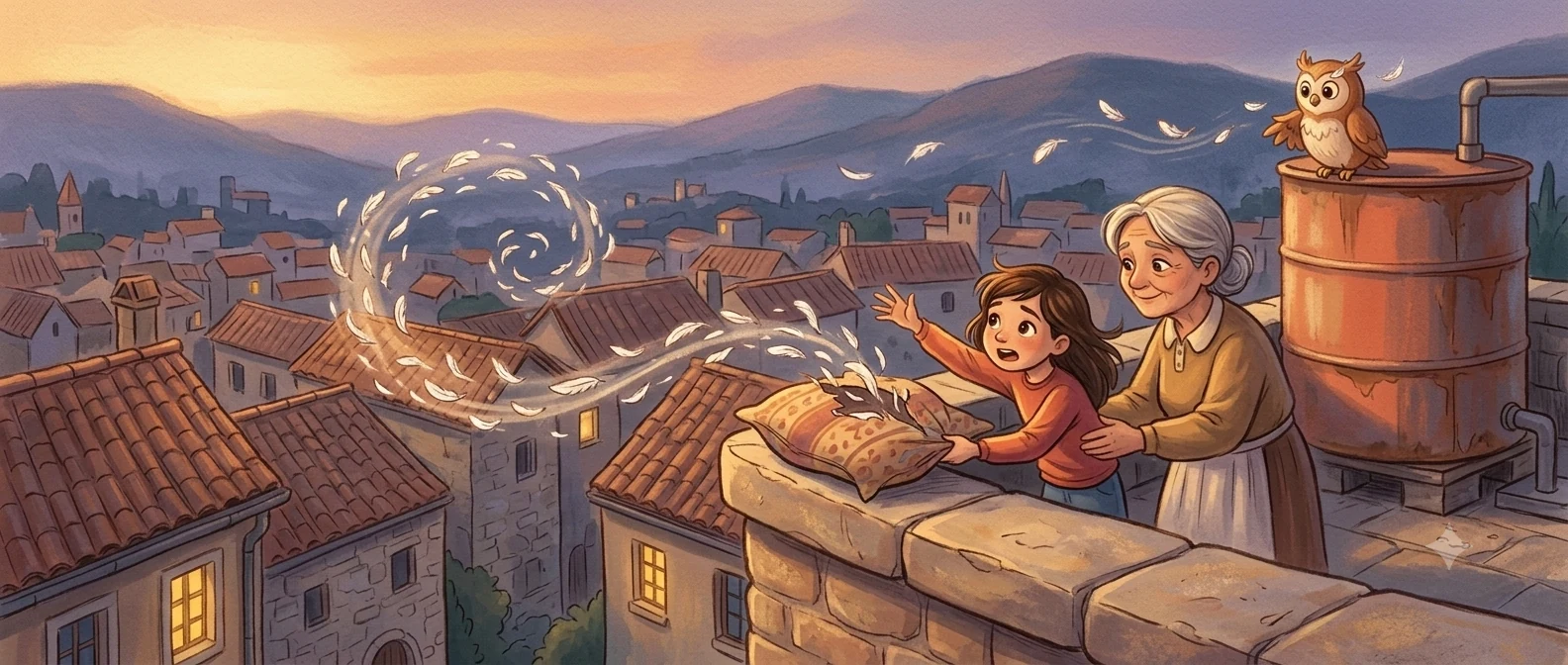
Nani heard it all. Then she got up, came back with an old torn cushion, and led Ruhi up to the terrace, into the wind.
“Open it,” she said. “Shake it out.”
Feathers went everywhere. A white spiral over the parapet, across the neighbours’ terraces, down toward the market road — gone in every direction at once, ridiculous and unstoppable. Ruhi actually laughed. Then she stopped laughing, because Nani said:
“Now bring them back.”
They stood watching the last feathers cross the water tank and vanish.
“That’s a rumour, beta. The tearing takes one minute. Now—” Nani folded the empty cover. “Some feathers you can still reach. Not all. The question is never can you undo it. You can’t. The question is: how many feathers will you go and pick up, knowing you’ll be seen doing it?”
Here is what picking up feathers turned out to mean, that week.
It meant telling Sana first. Not a corridor sorry — the whole thing, at her desk, before school. The door. The nine words. The “don’t say anything.” It was awful. Sana’s face went through disbelief, then anger, then something worse: tiredness. She said, “You? You’re not even someone I fought with.” Ruhi carried that sentence around for a month, because it was the exact shape of the wound. This hadn’t come from an enemy. It had come from a bystander who’d been careless with interesting information.
It meant telling Kavya and Mishti that the thing had been false from her end, so their copies of it were false too. And it meant asking them to say so onward, knowing some people wouldn’t bother.
It meant the hardest feather. During Monday’s homeroom, Ms. Almeida asked the class about “the talk going around” — did anyone know how it had started? A room of forty. Ruhi’s hand went up alone, into a silence you could feel on your skin. She was eleven, and it was the bravest thing she had done in those eleven years. The punishment — a note home, a talk with Sana’s class teacher present — turned out to be the lightest part of the whole affair. Consequences from adults, she discovered, are usually smaller than the ones you build for yourself out of hiding.
Sana forgave her eventually. Mostly. In the way of real things — not a movie hug, but a slow return of ordinariness. A pencil borrowed in December. A joke laughed at in January. The friendship that grew there later was slow, and a little scarred where it had mended. Ruhi never once resented that. Nani’s feathers had taught her the rule: some of what you scatter stays scattered. You pick up every feather you can reach, and you carry the count of the ones you couldn’t.
She kept the torn cushion cover, folded, in her bottom drawer.
Not as guilt. As the count.
Talk About It
- Ruhi never meant harm, and it still did harm. Does meaning well change what you owe afterward?
- Why wasn't apologising to Sana enough on its own? What did the mistake need that a sorry couldn't carry?
- The feathers in Nani's story could never all be gathered back. What do you think that means for how careful we should be at the start?
Did this story land tonight?
One tap helps us write better ones. No login, nothing shared publicly.
Thank you — this genuinely helps. 🌙