Finders Keepers
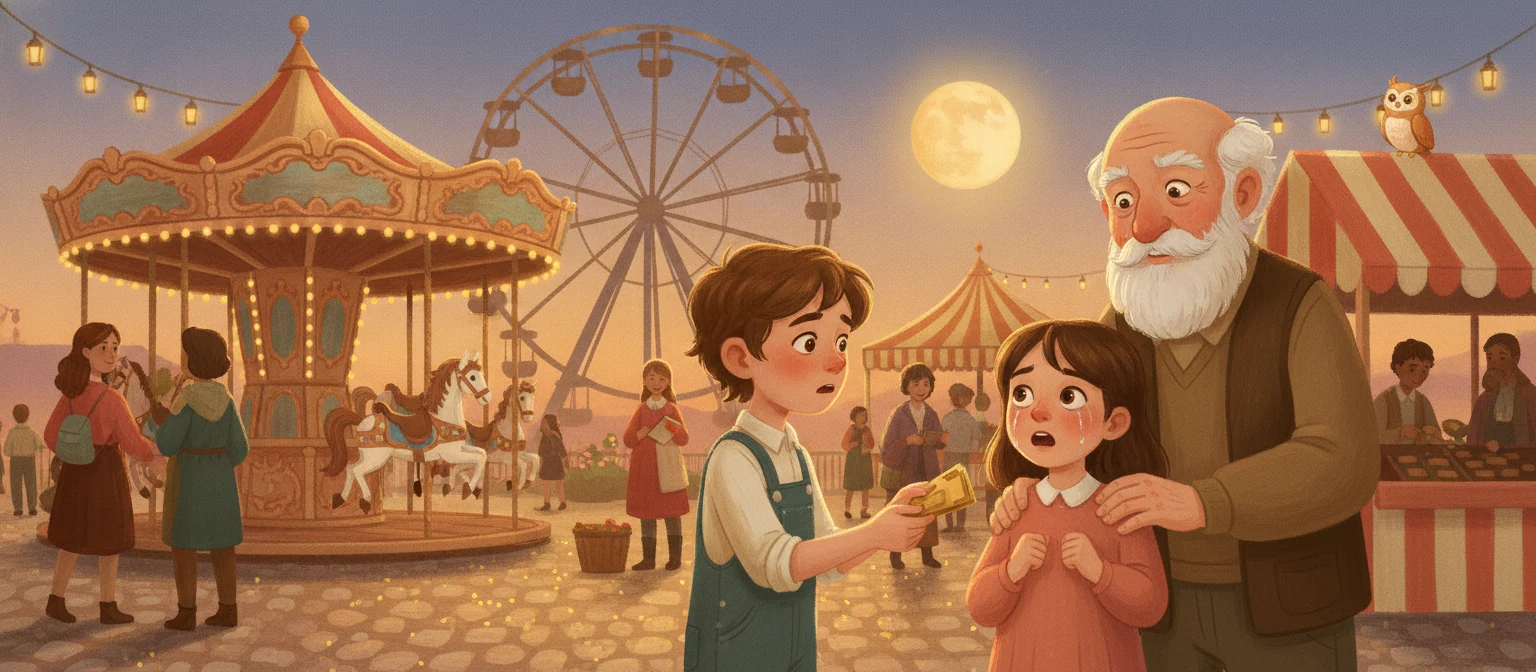
The note was lying in the grass between the toffee stall and the carousel, folded once, minding its own business.
Theo saw it, stopped, and did the fastest look-around of his life. Fairground crowds everywhere — legs, prams, balloons. Nobody looking down. Nobody patting their pockets. Nobody connected to the note in any visible way.
He picked it up. It was more money than Theo had ever held that was even slightly his.
And it was his. The oldest law of the playground said so, and every kid on earth knows the words: finders keepers. He hadn’t stolen it. It was lying in the grass, ownerless, like a conker or a lucky stone. Whoever dropped it was gone. Probably some grown-up who wouldn’t even miss it. The note was barely in Theo’s pocket, and his mind had already spent it twice. The big wheel. The hoopla. Toffee apples for himself AND his sister. Glory.
Finders keepers. He said it to himself again, walking toward the wheel. And he noticed — the way you notice a stone in your shoe — that he needed to keep saying it.
That was the first strange thing. Truly-yours money doesn’t need defending. Nobody walks around muttering “my birthday money is mine” over and over. He was repeating the law because some part of him had started asking questions and wouldn’t stop. Somebody had folded that note — folded it the careful way you fold money that matters to you. Money doesn’t belong to nobody. It belongs to somebody who doesn’t know where it is yet.
He was actually in the queue for the big wheel when he saw her.
A small girl — six, maybe — was walking the grass between the toffee stall and the carousel with her head down. Retracing. Retracing. Her grandfather walked beside her, scanning the ground. The girl was doing the crying you do when you’re trying hard not to. Chin crumpled. Wiping her face with the back of her wrist between steps.
Theo watched her check the same patch of grass twice. The exact patch.
He could have stayed in the queue. That’s the part he remembered afterward — how completely possible it was. Two more minutes and he’d have been up on the wheel. The girl would have been a small sad blur below, and finders keepers would have held. The law only works, he realised, standing there, when the loser stays invisible. That’s the whole trick of it. It isn’t really “finders keepers.” It’s “finders keepers, as long as you never have to watch the loser weeping.”
She checked the patch a third time.
Theo got out of the queue.
“Excuse me — did you lose something?” He said it to the grandfather, but the girl answered, in the wet, hiccupy voice of someone who had been saving for something. “My birthday money. It was folded. Grandpa said I could hold it myself and I did hold it, I held it the whole time, and then—”
Theo took out the note, still folded once. “By the toffee stall,” he said. “In the grass.”
The girl looked at the note, then at Theo. Her face did something he kept for the rest of his life — like the sun coming up in fast-forward. She clutched the note in both fists. Her grandfather put a hand on Theo’s shoulder and tried to give him some of it. A proper reward. Really pressing.
Theo — surprising himself — turned it down. He couldn’t have said exactly why. Something about how taking a cut would have turned the whole thing back into money, when for a second there, it had been something better.
“Then you’ll ride the wheel with us at least,” said the grandfather, in a voice that wasn’t asking. And that is how Theo ended up at the top of the big wheel at sunset anyway. The whole fair spread out golden below. The small girl pointing out everything to everyone. He had paid for the ticket, in a way, with somebody else’s birthday money — by giving it back.
Finders keepers, losers weepers. He thought about the old law up there, and made his private correction to it, the one he kept:
Finders: checkers, first.
Because everything lying in the grass is still attached to somebody — by a string you can’t see until you look.
Talk About It
- 'Finders keepers' felt completely fair to Theo at first. What changed his mind — the rule, or seeing the loser?
- Money 'belongs to nobody' when it's lying in the grass. Does it? What did Theo work out about that?
- What would you do — honestly — if you found money somewhere? Does it matter how much, or where, or whether anyone saw?
Did this story land tonight?
One tap helps us write better ones. No login, nothing shared publicly.
Thank you — this genuinely helps. 🌙