The Extra Coin
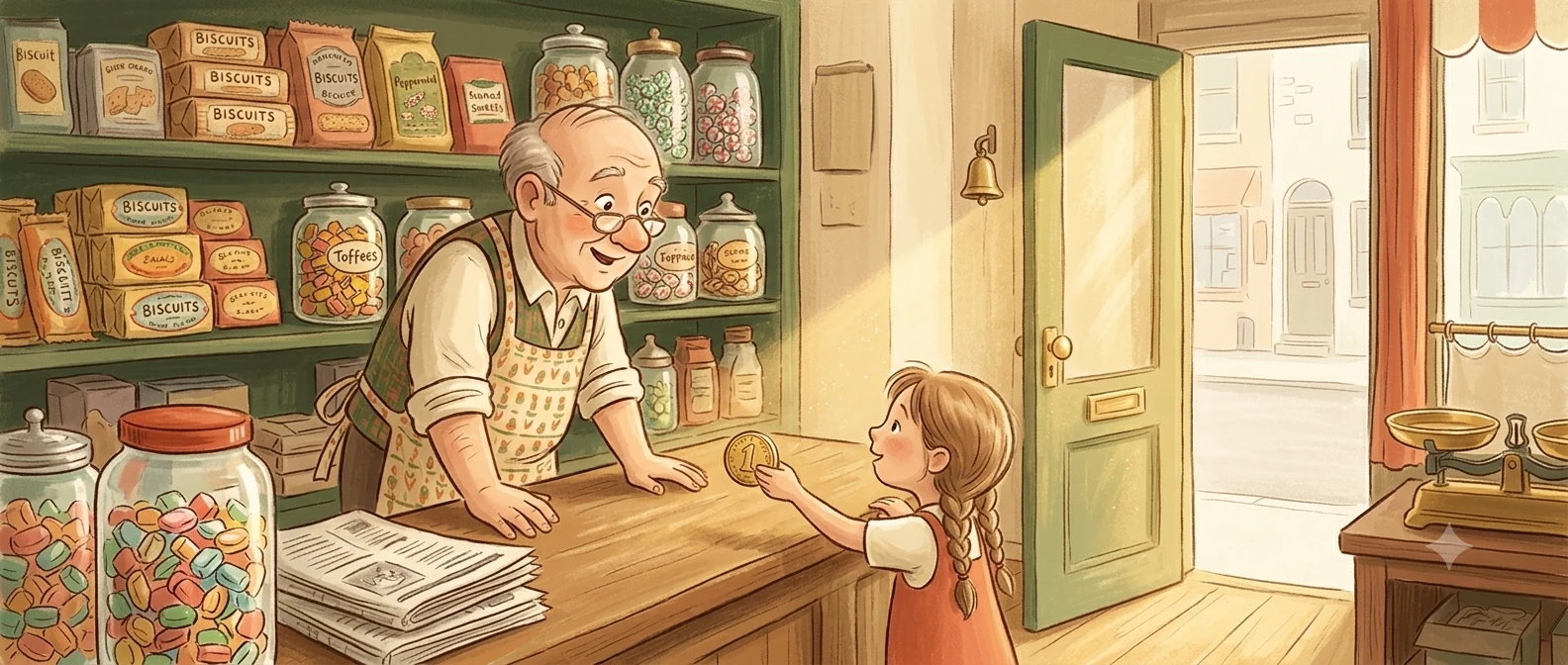
Every Sunday, Aanya walked to Manohar Uncle’s corner shop with a ten-rupee note. And every Sunday she bought the same thing: one packet of glucose biscuits for her grandfather, who claimed his tea refused to be drunk without them.
The shop was small and smelled of cardboard and toffees. Manohar Uncle was old and quick, and could find anything on his crowded shelves without looking. But this Sunday the shop was even busier than usual. Three customers deep. A delivery boy shouting about crates. A radio going somewhere under the counter.
“Biscuits for Dada’s tea!” Manohar Uncle called over the noise, taking her note. He slapped the packet in her hand, counted her change without looking, and turned to the delivery boy in the same motion.
Aanya was halfway down the lane before she counted it herself.
He’d given her back too much. One whole shiny ten-rupee coin too much.
She stopped walking.
Ten rupees was not nothing. Ten rupees was an orange ice lolly, the good kind with the plastic squeezer. Ten rupees was two rounds of the token video game outside Sharma Stores.
And nobody knew. That was the strange thing she kept turning over. The shop had been loud and full; Manohar Uncle hadn’t looked at his own hands; there was no register, no receipt, nothing. The coin had simply crossed over into her pocket the way a bird flies over a wall — and no one on either side had seen it go.
He’d never even miss it, she thought.
She bought no ice lolly. She played no video game. She walked home, and the coin came with her, and here is the thing she discovered on the way: it weighed more than the other coins.
Not really, of course. It was the same size as any ten-rupee coin. But it sat in her pocket the way a pebble sits in a shoe. At dinner she thought about it. During homework she thought about it. It was hers now, technically, sort of, wasn’t it? — and yet every time she thought the word “hers,” something in her chest disagreed.
On Monday morning, before school, Aanya walked back to the shop.
The shop was quiet now. Manohar Uncle was arranging newspapers.
“Biscuits again so soon?”
“You gave me extra change yesterday.” She put the coin on the counter, where it spun once and lay flat. “Ten rupees. The shop was noisy. You didn’t see.”
Manohar Uncle looked at the coin. Then at her. He was quiet for what felt to Aanya like a very long time, and she suddenly worried she’d somehow done a wrong thing after all.
“You know,” he said finally, “I’ve had this shop for thirty-one years. Money goes wrong all the time — a coin here, five rupees there. It disappears down the lane and never comes back.” He picked up the coin. “You walked back. For ten rupees.”
“It was heavy,” said Aanya, which she knew didn’t quite make sense.
But Manohar Uncle nodded slowly, like it made perfect sense to him.
The Sunday after that, when Aanya reached the counter, her biscuits were already waiting, set aside from the crowd. And the Sunday she came up short — a five-rupee coin lost somewhere between home and the lane — Manohar Uncle just waved his hand and slid the packet across.
“Pay next week,” he said, already turning to the next customer. “Your account is good here.”
He didn’t even look at her hands, and she understood: he knew he didn’t need to.
Talk About It
- Nobody would have found out about the coin. So why do you think it felt heavy to Aanya?
- What did Aanya get back that was worth more than ten rupees?
- Has something small ever bothered you until you fixed it?
Did this story land tonight?
One tap helps us write better ones. No login, nothing shared publicly.
Thank you — this genuinely helps. 🌙