The Triangle
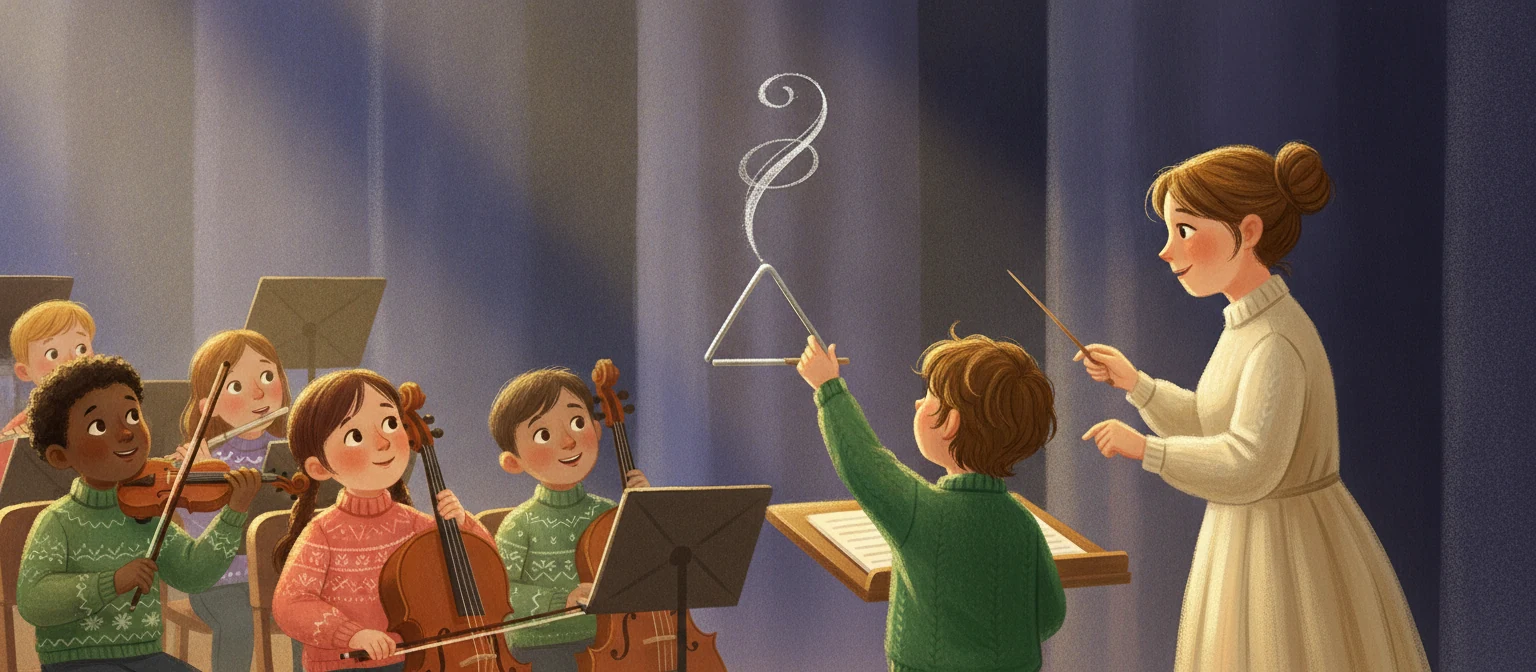
When Miss Beaumont handed out the instruments for the winter concert, Omar had one hand already reaching for the drums.
He got the triangle.
The triangle. A shiny metal squiggle on a string, plus a little beater. While Ren got the drums, and Lily got the cymbals, and even Marcus — Marcus! — got the tambourine, Omar stood holding an instrument you could post through a letterbox.
It got worse. When the sheet music came around, Omar counted his part. The piece was four minutes long. The triangle played… once. One note. A single ding, at bar forty-seven, in the quiet part. That was the entire job.
Omar sulked with a thoroughness that impressed even his little sister. He sulked through dinner, through the first rehearsal, into the second. There he slouched at the back, arm barely lifting. At bar forty-seven he produced a resentful little tink that landed somewhere in the wrong beat and died.
Miss Beaumont stopped the whole orchestra.
“Again from forty,” she said. And then, conversationally, while everyone found the bar: “Omar. Do you know why the triangle part is the one I give the most carefully?” Omar, expecting sarcasm, said nothing. “Count with me what happens at bar forty-seven. The strings go quiet. The drums stop. The whole piece holds its breath — thirty children, absolutely silent — and into that silence comes ONE sound. Yours. Nothing covers you. Nothing hides you. If the drums rush a beat, no one hears it — there’s a whole orchestra around them. If YOUR note is late, or timid, or dead —” she let the pause do it ”— every single person in that hall hears the hole where it should have been.”
She raised her baton. “The big parts carry the piece, Omar. The small parts are exposed. I gave you the naked note. Kindly treat it accordingly.”
Omar sat up.
It turned out — he discovered over the following rehearsals — that playing one note is a genuine, learnable, surprisingly deep craft. He had to count forty-six bars of rests without drifting, which is harder than playing; the whole time the orchestra swirled around him, and his job was to stay found. He learned the difference between a tink (beater too tight, wrist stiff) and a ding (loose grip, strike and release, let the metal sing). He learned that his note had to arrive not on the beat but as the beat — that for one moment at bar forty-seven, the entire orchestra would set its watch by him.
He practised at home. One note. His sister thought he’d lost his mind. His sister had never been the only sound in a silent hall.
Concert night: the gym packed, the lights hot, “Winter River” flowing along its four minutes. Omar stood at the back, counting like a lighthouse keeper — thirty… thirty-eight… forty-four — and then the strings hushed, and the drums stopped, and the great silence opened up exactly as promised, a hundred parents holding their breath inside it —
Ding.
Clean. Round. Dead centre of the moment. The note floated up over the whole silent gym like a single silver star, and hung there for its full shining second. Then the orchestra came back in around it, right on time — because he’d given them their time.
Afterward, three separate grown-ups found Omar at the biscuits table to say the same thing: that little bell bit in the quiet — that was my favourite part. Ren the drummer overheard the third one. He rolled his eyes so hard it was practically percussion.
“One note,” Ren said. “I played four hundred.”
“Yeah,” said Omar, with the serenity of a man who had held a silence in his hand and not dropped it. “But nobody heard any of yours alone.”
Miss Beaumont, passing with her tea, raised it slightly in his direction.
Next term, she gave him the drums. He was good at them — steady, unhurried, never rushing the quiet bits.
Everyone assumed drums had taught him that.
It was the triangle.
Talk About It
- Omar's part was one note — and the conductor called it the most exposed job in the room. What did she mean?
- What's the difference between a small part and an unimportant part?
- In your class, team, or family — whose 'triangle part' goes unnoticed? What would be missing without them?
Did this story land tonight?
One tap helps us write better ones. No login, nothing shared publicly.
Thank you — this genuinely helps. 🌙