Stone Soup
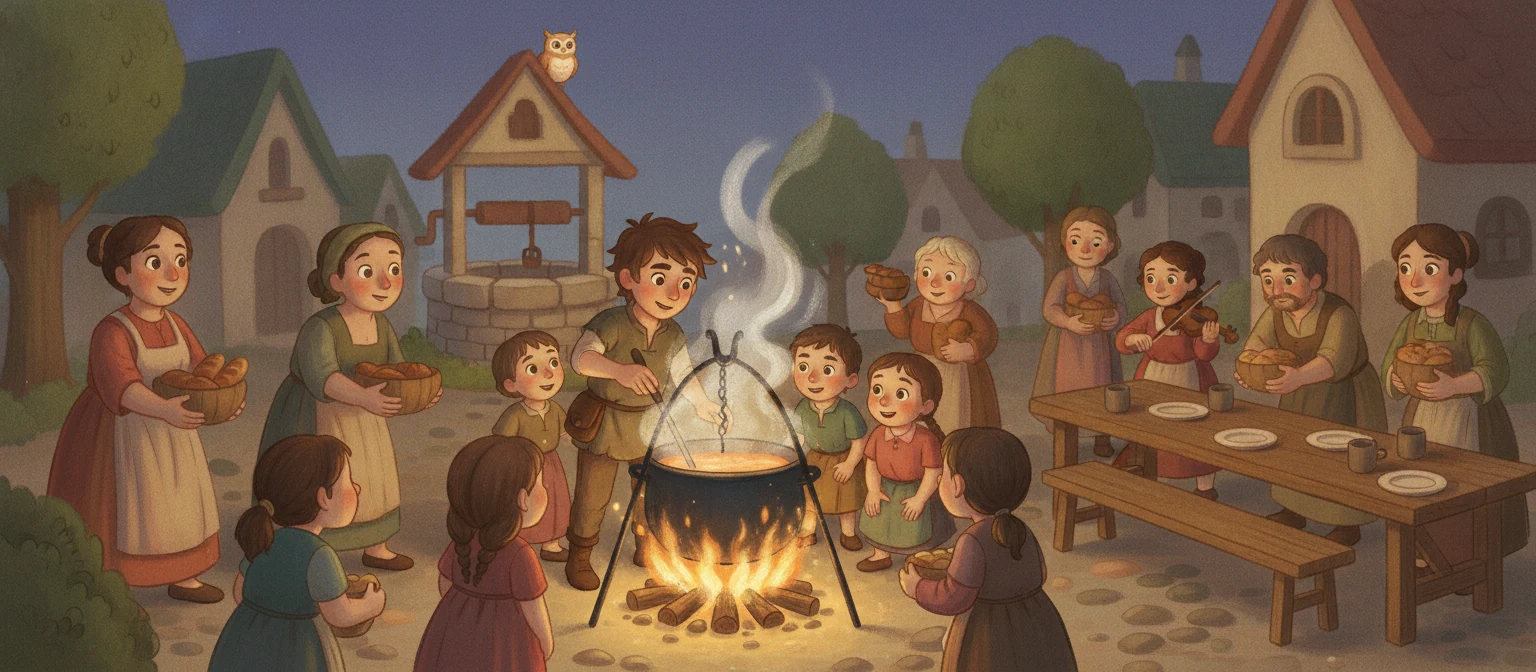
A traveller came walking into a small village one evening, with dusty boots, a big cooking pot, and nothing in his bag but nothing.
He knocked at the first house. “Good evening! Could you spare a little food for a hungry traveller?”
“Food!” said the woman at the door, closing it a little. “We’ve barely any for ourselves. Nothing to spare. Nothing at all.”
The next house said the same. And the next. Every cupboard in the village, it seemed, was empty — though the traveller noticed the village didn’t look hungry. It looked careful. It was the kind of village where everyone kept their own little store behind their own closed door, just in case, and “nothing to spare” was just how you said hello to strangers.
“Well then,” said the traveller cheerfully, to the whole street at once, “if nobody has anything — it’s lucky I have my stone!”
He set his big pot right in the village square, filled it with well water, lit a fire beneath it, and then, from his pocket, with enormous care, he drew out… a stone. A smooth, round, completely ordinary stone. He dropped it in with a plop, sniffed the steam, and smiled like a man with a secret.
“Stone soup,” he announced. “The finest dish there is.”
Doors opened a crack. Windows too. A village can’t resist a mystery.
“Soup? From a stone?”
“The best soup in the world,” said the traveller, stirring, “from this stone in particular. It never fails.” He tasted the water and closed his eyes. “Mmm. Beautiful already. Though—” he sighed a small sigh, “—stone soup is even better with one onion. Such a pity nobody has anything.”
A pause. Then a boy ran home and came back with one onion. “We had ONE,” he said. In it went.
The traveller tasted again. “Magnificent! The stone is working. You know what a stone like this deserves? A carrot or two. But of course, nothing to spare…” Two carrots appeared, from the house that had closed its door first. In they went.
And now the smell began — the real, warm, oniony smell of actual soup — and the smell went down the street and knocked on every door better than the traveller ever could. A cabbage arrived. Potatoes. A handful of beans. Salt from one house. A stick of butter from another. A bone with good meat on it from the big house at the end, whose owner said gruffly, “for the stone,” and stayed to stir.
Everyone gave one small thing. Nobody missed what they gave.
And the pot — the pot filled up like a promise, bubbling and steaming under the first stars, until the whole square smelled like a festival. Somebody fetched bowls. Somebody else fetched bread. Somebody’s grandfather fetched his fiddle. And the village that had nothing to spare sat down at long tables, all together, to the biggest, warmest supper anyone could remember.
The soup was delicious. Everyone agreed the stone had done wonders.
In the morning, the traveller fished the stone out, washed it, and — since the village children were watching — solemnly gave it to them to keep. “Take good care of it,” he said, shouldering his pot. “It only works when everybody adds something.”
They understood, the children. Children always do first.
The stone sat on the well wall in that village for years and years. And whenever times got thin, and doors began to close, somebody would point at it — and out would come the big pot, and one onion, and everything after.
Talk About It
- Was the magic really in the stone? Where was it actually?
- Every villager said they had 'nothing' — but the soup got made anyway. How?
- What one small thing could you add to something everyone shares — a game, a meal, a clean-up?
Did this story land tonight?
One tap helps us write better ones. No login, nothing shared publicly.
Thank you — this genuinely helps. 🌙