The Captain's Answer
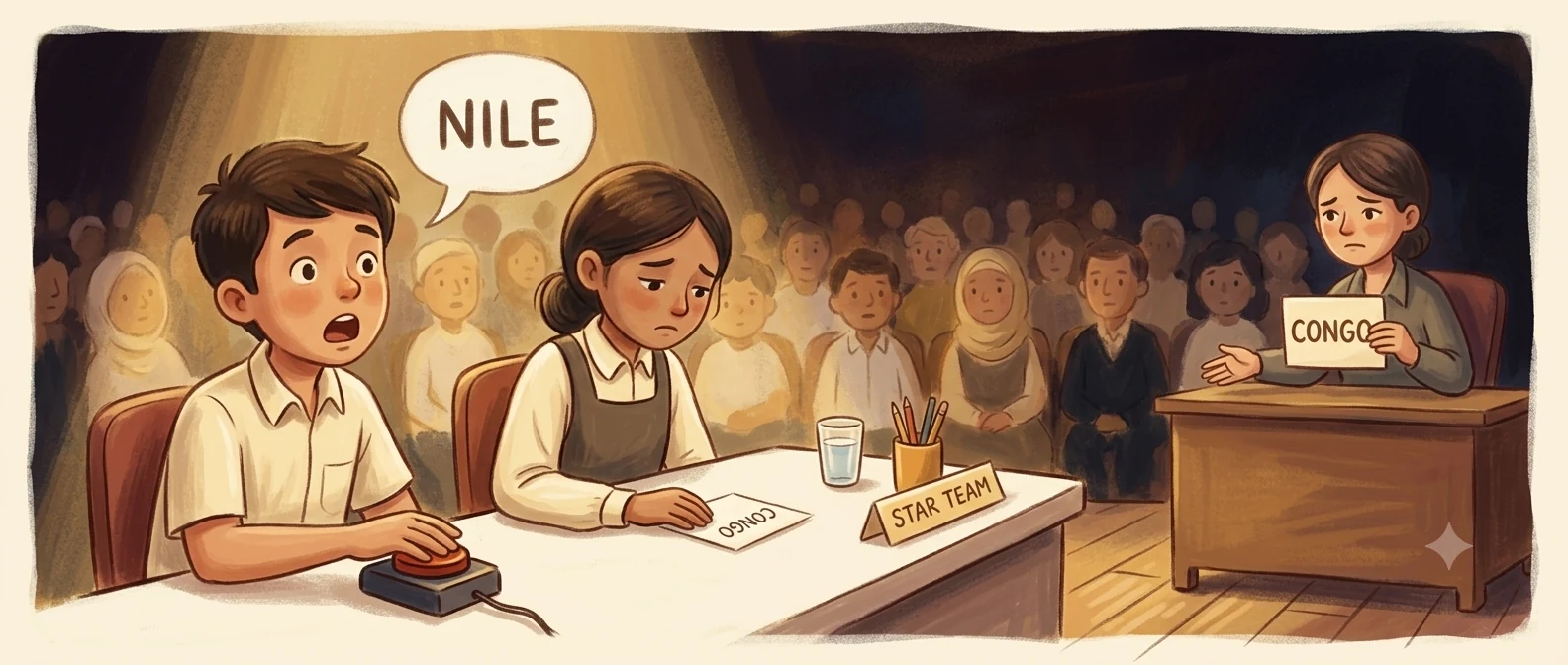
Dev’s shelf held two quiz trophies. If you asked him — and even, mostly, if you didn’t — he could tell you the winning answers of both finals, because he had given them himself.
He was good. That part was simply true. He read encyclopedias for fun. He knew capitals and moons and Mughal succession orders. He could name the scientist and the year. His buzzer-thumb was so fast the team called it the mongoose. St. Xavier’s quiz team was, in every practical sense, Dev plus three assistants. Everyone understood this. Chiefly Dev.
Then Ilma transferred in mid-year, sat the selection quiz, and scored two marks below him.
She was quiet, in a way Dev at first filed under nothing much there. She didn’t call out answers in practice. She wrote things in a fat, rubber-banded notebook instead of announcing them. When she did speak, it was after everyone else, softly. And — he began to notice, with a feeling he didn’t examine — she was almost never wrong. Not flashy-right, the way Dev was right, slapping the answer down like a winning card. Quietly right. Right in the last two inches of the question, where the trick lived.
The inter-school final that year came down, as finals like to, to a tiebreaker. Sudden death. One question. Teams confer, captain answers.
“Name the only river,” said the quizmaster, “that crosses the equator twice.”
Dev’s mind lit up like a switchboard. River. Equator. Africa, obviously. And out of the switchboard came Nile — enormous, famous, first — even as some back room of his brain raised a hand to object.
Beside him, Ilma had already written on her slip. She slid it two inches toward him. One word: Congo. Under it, tiny, in her exam handwriting: bends across it — Nile only touches north.
Confer time: ten seconds. Here is what happened inside Dev in those ten seconds. He examined it many times afterward, always with a wince. He saw the slip. He knew Ilma was almost never wrong. And a voice in him — not knowledge, only dressed like knowledge — said: You’re the captain. You’ve won two of these. Who’s she? The voice felt exactly like being sure. That was the discovery that cost him the trophy. From the inside, being sure and being the senior one feel exactly the same.
“Nile,” said Dev, into the microphone, alone.
The quizmaster paused, a little too kindly. “The answer is the Congo.”
The other school’s table erupted. Behind him, Dev heard his teammates say nothing, which was louder.
There was no rematch. That needs saying plainly, because Dev spent that night half-inventing versions where there was one. The trophy went to the other school and stayed there, engraved with their name, permanently, the way trophies do. A year of Tuesday practices, gone on one syllable. His syllable — chosen over better information that had been lying on the table, two inches from his hand, in exam handwriting.
The apology happened at Monday practice. He made himself do it with the whole team watching, because the overriding had happened in front of everyone, and a private sorry would have been paying a public debt in secret. “I had the right answer next to me,” he said. “I chose mine because it was mine. That’s the whole reason. It’s not a good one.”
Ilma had said nothing all weekend. No I told you so — a restraint Dev found more instructive than any amount of telling him so. She looked up from the fat notebook.
“Want to see how I knew?”
The notebook, unbanded, turned out to be the most interesting thing Dev had seen in three years of quizzing. Not facts. Traps. Page after page of questions sorted by their tricks. “Sounds like X, is actually Y.” “Famous answer vs. correct answer.” A whole section headed WHEN THE OBVIOUS THING IS THE BAIT. She had been keeping it for years. “The Nile was on page four,” she said, tapping it, without cruelty. “Famous-vs-correct. It’s the oldest trap there is.”
Dev went home and started his own notebook. First entry, page one, under her borrowed heading: The obvious thing was the bait. The bait was me.
They made the final again the next year. Dev was still captain, but a different kind. The kind who had learned that a captain’s real job is not knowing the most. It is losing nothing the table knows. He routed questions now. He had learned who held which territory — Sameer’s sports, Priya’s cinema, Ilma’s beautiful minefield of traps — and the mongoose thumb now bought thinking time for four people instead of showing off one.
And when it came, as it does, to sudden death — one question, geography again, the whole gym holding its breath — Dev listened, felt the old switchboard light up with a big, famous, immediate answer…
…and slid the microphone two inches to his left.
“Captain answers,” said the quizmaster.
“She is,” said Dev.
Talk About It
- Dev knew a lot. What did he not know, and why was that the more expensive kind of not-knowing?
- The team lost the trophy for real — no rematch. What did Dev do with a mistake that couldn't be fixed?
- Being the best at something and being sure you're right feel similar from the inside. How do you tell them apart?
Did this story land tonight?
One tap helps us write better ones. No login, nothing shared publicly.
Thank you — this genuinely helps. 🌙