First Pick
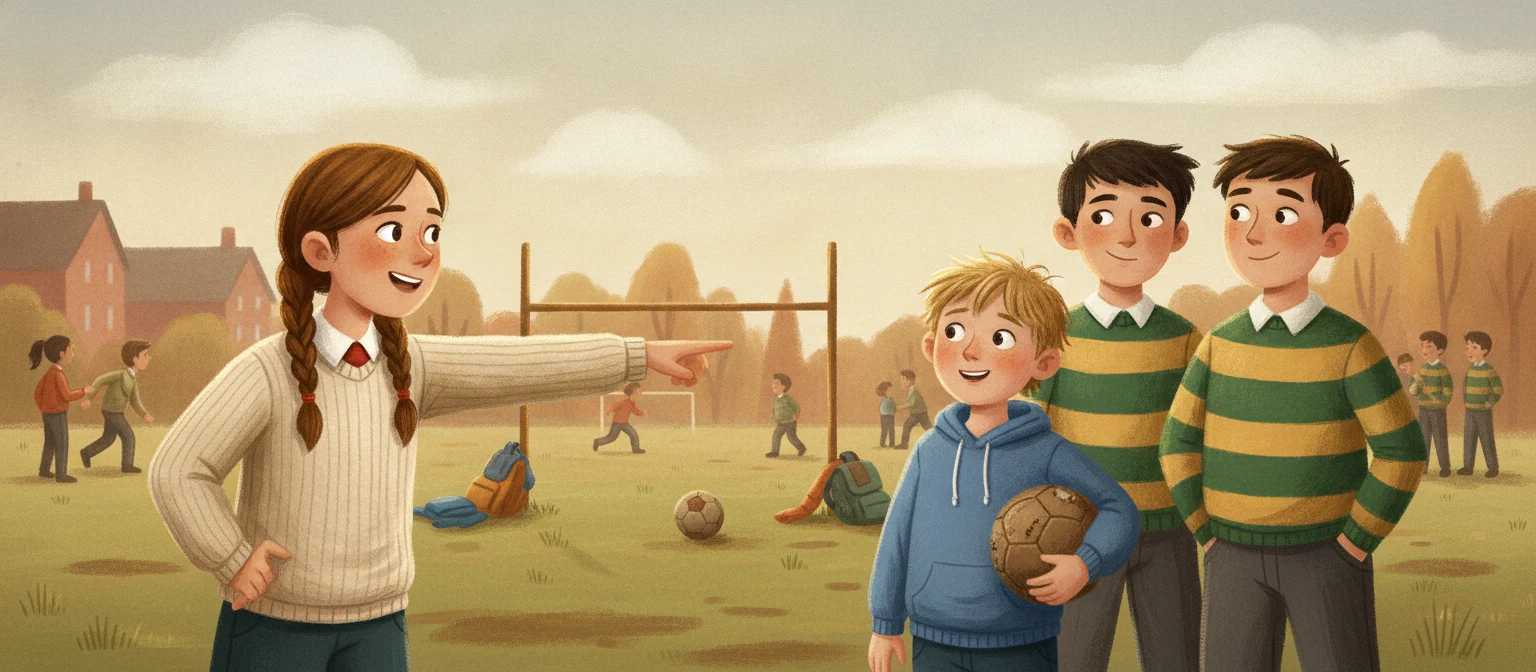
At Sam’s school — like at every school, in every country, wherever a ball and a lunchtime exist — teams were picked the same way.
Two captains. Everyone else in a line. Then the slow, public countdown. The best players picked first, by name, fast. The middle picked in clumps. And then the end, where the last few stood being not-chosen in front of everyone. Until finally there was Oliver, alone, and one captain would shrug to the other: “Fine, you can have him.”
You can have him. Every day. Those exact words, or close enough.
Nobody was being cruel, exactly. That’s what everyone would have said. Oliver was slow, his kick sliced sideways, and lunchtime football was Serious Business. It was just picking. Just the fair sorting of talent. Except Maya, waiting in the line each day, had started watching Oliver during the sorting. The way he studied his shoes near the end. The way he arranged his face, in advance, into I don’t care. That’s the armour you build when you know exactly how the next minute goes — because it has gone that way a hundred times.
She knew that face’s real name. Nobody wears I don’t care over nothing.
Maya was good. Top-three-picked, every day. A striker with a left foot the boys had stopped making jokes about a year ago. Which meant that one lunchtime a week, when the rotation came round, she was captain.
On her next turn, she won the coin toss. First pick of the whole yard. Danny stood at the front of the line — best player in their year — already stepping forward on autopilot.
“Oliver,” said Maya.
The line physically turned to look at her. Somebody laughed, then stopped, unsure. Danny’s mouth opened. Oliver himself looked behind him, certain there must be another Oliver.
“You. Oliver. First pick. Come on, we’re wasting lunch.”
Here is what Maya had understood, watching from the line. The picking order wasn’t just sorting the game. It was telling people, publicly, daily, exactly what they were worth — and everyone had agreed to pretend it was only football. You couldn’t fix it with kindness afterwards. A nice word at the end of the line doesn’t undo the line. The only place it could be touched was at the top, with the first pick, by someone whose football reputation could afford the bill.
Her team lost that day, for the record. 5–3. This is not that kind of story. And anyway, that isn’t the point of what happened next.
What happened next was that Maya kept doing it. Not Oliver-first every time — that would have been its own kind of show. She scrambled the order. She picked the line’s forgotten end early and often. She played Oliver at the back, where his one real gift actually mattered: he was, it turned out, completely unafraid of charging down a shot. And she told him so, specifically, in front of people. “That block saved us, Ol.”
The thing about picking orders is that they’re just habits wearing a uniform. When Danny was captain, he started mixing his picks too. First out of confusion. Then because Maya’s teams kept being strange and fun, and the games had gotten better, looser, less predictable. The end of the line stopped being a fixed address. Within a term, the slow public countdown had lost its sting almost entirely — because nobody could be sure anymore where anyone would go.
Oliver never became good, exactly. He became something better than good: a regular. A person with a position and a nickname and one famous lunchtime — the day he charged down Danny’s penalty with his face. That event is still celebrated on its anniversary.
Years later, Maya wouldn’t remember the score of any of it. But she’d remember what she learned about lines that sort people, in schoolyards and everywhere after:
They hold their shape only as long as the people with first pick keep spending it on themselves.
Talk About It
- Being picked last, every time, in front of everyone — what does that do to a person, even though nobody's 'doing' anything?
- Maya gave up her best players to pick Oliver first. What was she actually trading, and what did she get?
- Is there a picking-teams moment at your school? Who ends up where Oliver was?
Did this story land tonight?
One tap helps us write better ones. No login, nothing shared publicly.
Thank you — this genuinely helps. 🌙