The Fourth Runner
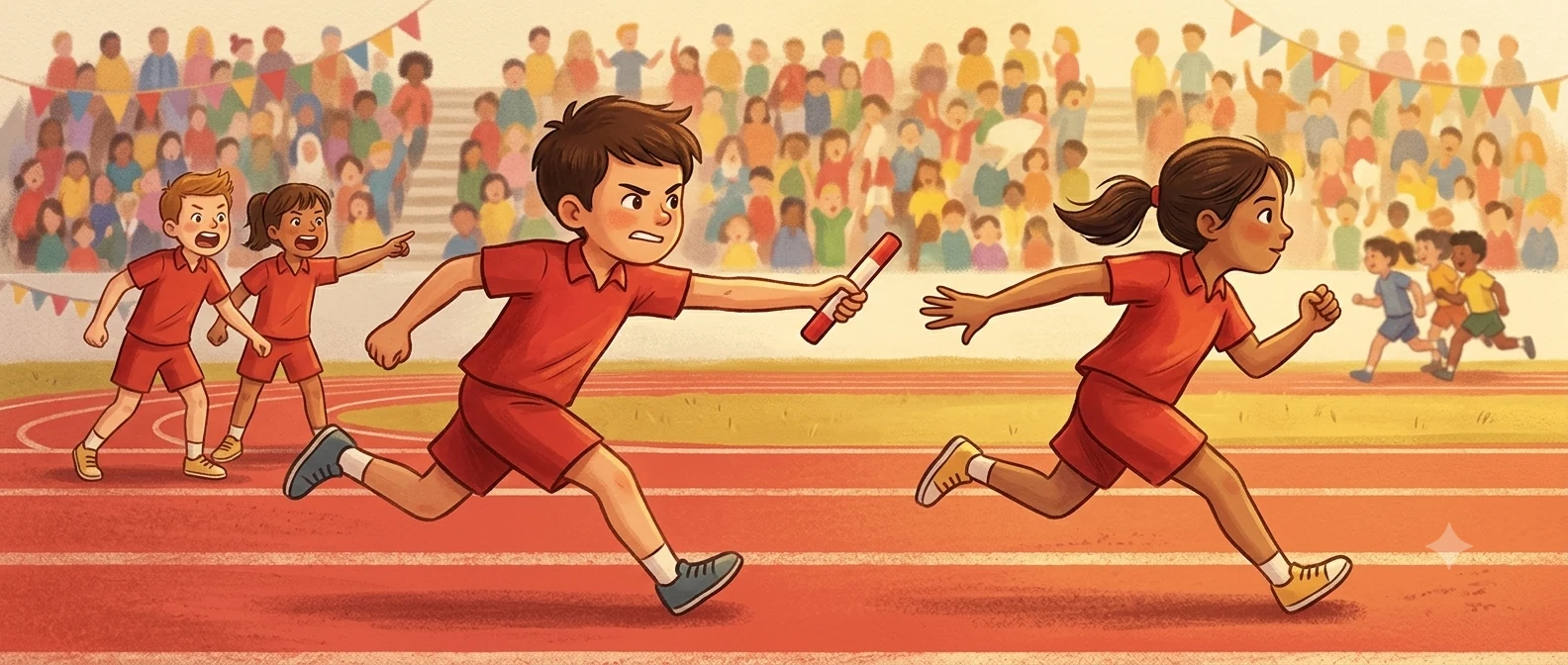
The house relay team picked itself, mostly. Arjun was the fastest boy in Class 7, full stop, with the spikes and the sunburnt neck to prove it. Zaid and Imran were quick and hungry. And the fourth spot went to Tanmay — because trials said so, fair and square, stopwatch and chalk line and all. Fourth-fastest in Blue House, by the watch, twice.
Tanmay retied his left shoelace three times before every single race, always the left one first, and nobody had ever worked out why.
The problem was the gap. Between Imran’s time and Tanmay’s there lived a fat second and a half, and in a relay, a second and a half is enormous. Everyone could see it at practice. Three legs of the race gaining ground. One leg leaking it. Red House were the defending champions, with four genuinely quick boys. They watched Blue’s practices from the pavilion steps, sunflower seeds in one hand, with the relaxed faces of boys who had already done the maths.
Ten days before sports day, the maths found a voice. Dhruv Mehta from 7C had come fifth at trials, missing the team by one place. He started his campaign politely, catching Arjun by the water cooler. “Just saying, I’ve been training. Time me again, that’s all. For the house.” By day three, the campaign had backers. A second and a half, people repeated in the corridor, as if they’d clocked it personally. Someone said it near Tanmay, on purpose, at lunch, over the clatter of tiffin tins: we’re carrying him.
Tanmay came to Wednesday practice with a face like held breath, and offered to step down. He retied his left shoelace while he said it, three times, even though nobody had blown the whistle yet.
What happened next, Arjun thought about for years. He was captain, and the easy road was right there, paved and lit. Accept gracefully. Walk Dhruv over to the stopwatch. Take the faster four. Thank Tanmay for understanding, shake his hand, maybe. Probably win gold. Nobody would even blame him. They would blame the watch, which never once had to eat lunch in the canteen and explain itself.
But Arjun had run beside Tanmay for six weeks, spikes on the same red track. Tanmay never missed a practice. He was there before everyone, and stayed after. He had shaved a third of a second off himself since trials while nobody was watching, because everybody was busy watching his gap instead.
And Arjun remembered last year’s team. Four fast boys, handed a baton each and nothing else. No team. Fumbled baton. Fourth place.
Arjun grabbed his own water bottle off the bench before he answered. “Nobody’s stepping down,” he said. “Trials picked four. We’re the four.” Then, because captains need more than loyalty: “But we’re done practising running. Everyone can run. We’re going to practise the relay.”
Coach D’Silva supplied the plan, called in by Arjun that same afternoon, whistle still round her neck from the last period’s PE class. “A relay is not four races added up,” she said, walking them to the exchange zone’s painted lines, tapping the chalk mark with her shoe. “It’s one race with three handovers. And handovers are where relays are actually won and lost. A clean exchange at full speed buys you three, four tenths. Three exchanges — you do the sum. You want to find a second and a half? It’s lying right here on the track, in the twenty metres everyone’s too bored to practise.”
So that became the plan, unglamorous as homework. Red House ran fast laps looking magnificent, dust rising gold off the track behind them. Blue House drilled exchanges in the shade of the long-jump pit, until the exchanges stopped being events. Zaid’s launch timed to Imran’s incoming stride, socks pulled up to the knee for luck. The flat palm. The baton, warm from someone else’s hand, placed, not thrown. Eyes forward, trusting the incoming man to arrive instead of turning to check. They also redesigned the running order around honesty instead of pride. Tanmay asked for the second leg — the straightest and shortest of the four. Know your gap, place your gap. And he drilled both his handovers, receiving and giving, until he was, by unarguable stopwatch, the cleanest exchanger on the team. His running gap: still there, trimmed to just over a second on the stopwatch. His hands: steady on the baton, every single time.
Sports day. Loudspeakers, dust, the smell of orange squash from the drinks table. Final. You want the truth, so here it is, all of it.
Red House won. By a stride and a bit, four boys crossing the white line in a row like a fence falling flat. Their raw speed was real, and gold went exactly where the maths always said it would.
But here is what the whole ground actually watched, hands shading eyes against the noon sun: Blue House ran the race of the day. Every exchange snapped clean, like something machined. The second one — Tanmay to Arjun, at full flight — drew applause from neutral houses. They finished second, four tenths behind, in a time that beat last year’s winning time. It also beat their own trial-day sum by nearly two full seconds. On paper, this team should have lost by three and a half seconds. The team they had built lost by four tenths. They had found more time in the handovers than Dhruv Mehta’s legs had ever offered — and everyone who could subtract could see it.
Dhruv found Tanmay by the water table afterward, two paper cups crushed in one fist, not quite looking at him. “That exchange,” he said. “That was actually insane.”
Blue House went up for silver at the medal line. Tanmay bit his medal for the photo like an Olympian. Arjun watched him do it, and said the captain’s sum out loud one last time, to no one in particular:
“Fastest four would’ve been faster runners.” He shrugged. “We were a faster team.”
Talk About It
- Swapping Tanmay out would probably have won them gold. Do you think they made the right call anyway? What exactly did they win instead?
- Coach said 'a relay is not four races, it's one race with three handovers.' How did that change what practising meant?
- Have you ever been the strongest one in a group — or the weakest? What did you want from the others in each case?
Did this story land tonight?
One tap helps us write better ones. No login, nothing shared publicly.
Thank you — this genuinely helps. 🌙