Four Hands on One String
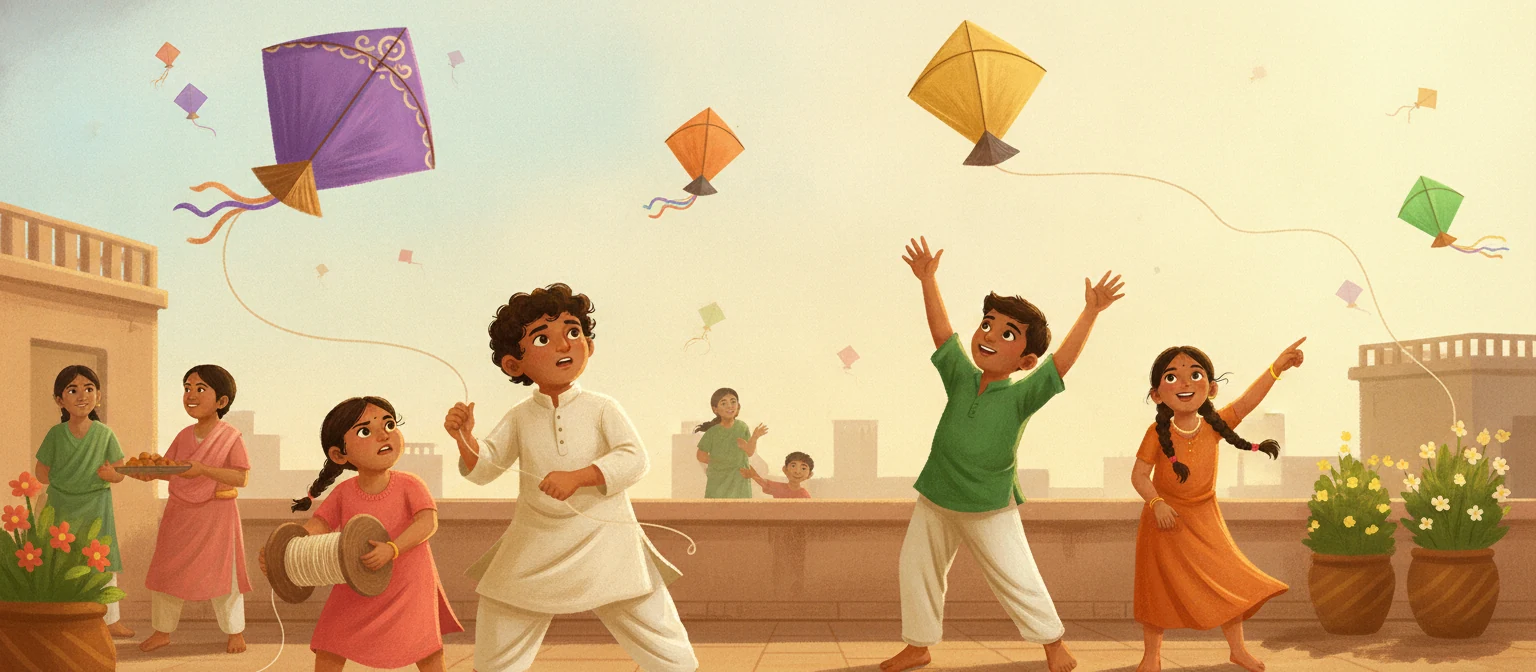
On the morning of Makar Sankranti, the sky over the colony was filled with kites, like a giant festival in the air. Red kites, yellow kites, kites with tails, kites with attitude. And on the terrace of B-block stood Ishaan, alone, with a brand-new purple patang and a full spool of string.
Alone was the plan. This year’s kite was going to be his kite, flown by his hands, all the way up to where the big kites fight. Last year Adil had helped, and then told everyone the kite was half his. Not this year.
Ishaan held the kite in one hand and the spool in the other, and ran.
The kite hopped, flopped, and face-planted into the water tank.
He tried propping the kite against the parapet and running backward with the string. The kite fell over before the string went tight. He tried holding the spool between his knees while throwing the kite upward — a technique he invented that instant. He got twenty centimetres of flight and a string burn.
The sky roared on above him, full of other people’s kites. From the neighbouring terrace, an uncle flying a giant black kite shouted the oldest advice in kite-flying, the advice every kid ignores once:
“Beta! A patang takes four hands! Two are never enough!”
Ishaan ignored it. Forty minutes and one small tear in the purple paper later, he sat down against the water tank — sweating, string-burned, grounded. And he finally did the maths he’d been refusing to do. Launching needed one person to hold the kite high and release on the count. Flying needed one person on the string. Climbing fast needed the spool held steady and paid out smoothly, by somebody who wasn’t also doing everything else. He had two hands. The job had never once, in the entire history of Sankranti, been a two-hand job.
Adil arrived on the terrace as if summoned by the sound of a plan failing. Behind him came his little sister Sana, and Myra from the ground floor.
There was a moment. Last year’s argument stood on the terrace with them, invisible and awkward.
“It needs four hands,” said Ishaan. From a nine-year-old on a festival morning, that was as close to sorry and please as it gets. And Adil, who wanted the sky more than the argument, just said, “Roles first this time. So we don’t fight after.”
They divided the sky like professionals. Adil: launcher. Best arms, releases on three. Sana: spool-holder — a job everyone thinks is nothing until the string snarls mid-fight. She held it like a queen holds a crown. Myra: wind-watcher. Myra was good at noticing changes in the wind, especially the different directions it came from around the buildings. And Ishaan: the string. The kite stayed his. The flight was about to become something else.
“Left lane, NOW,” said Myra, feeling the gust arrive on her face.
“One — two — THREE!”
Adil released, arms up. Ishaan tugged. Sana payed out smooth as milk. And the purple patang caught the lane, bucked once, and climbed. Ten metres. Thirty. The string went alive in Ishaan’s fingers. Up through the small kites’ layer. Up past the neighbouring uncle’s respectful nod. Up to where the wind ran straight and strong, and the kite steadied into that magic tightness every flyer waits for. A purple diamond standing at the top of the sky — higher than Ishaan had ever flown anything in his life.
The fight found them, of course. A red kite came hunting after lunch. What happened next happened too fast for one person, and exactly fast enough for four. Myra called the cut. Ishaan tugged. Sana braked the spool at the perfect half-second. And it was the red string that went drifting down toward the mango trees, to a roar from three terraces at once.
They flew until the light went copper and the sky emptied, kite by kite. Walking down the stairs — sunburned, string-burned, hoarse — Sana asked the question of the day:
“Whose kite cut the red one?”
Ishaan opened his mouth to say mine, out of habit. He heard himself say the true thing instead:
“Ours. Mine’s just the paper part.”
The purple patang hangs on his wall now, tear taped, retired with honours. And on it, in marker, in four different handwritings, the flight crew signed their names — the way you sign anything that took exactly four hands.
Talk About It
- Ishaan could hold the spool OR the kite OR run — but not all three. Why do some things simply need more hands?
- Each kid on the terrace was doing a different job. Whose job was the most important?
- What's the difference between 'my kite that you're helping with' and 'our kite'? When did it change for Ishaan?
Did this story land tonight?
One tap helps us write better ones. No login, nothing shared publicly.
Thank you — this genuinely helps. 🌙