The Summer the Screen Ate — The Story for the Kid Who "Just Wants to Finish the Game."
There is a particular week near the end of a long holiday when a parent does the maths. School starts on the such-and-such. That leaves eleven days. And of the summer already gone, a real fraction of it — you don’t want to count how much — went into a screen, one afternoon at a time, none of them feeling like a decision.
Nobody planned it that way. It’s just that a game is built to be finished, and a holiday is built to be filled, and the two things fit together a little too well.
Tonight’s story: “The Summer of the Hundredth Level”
The Summer of the Hundredth Level (ages 10–12, 8 minutes) opens with Veer’s summer plan, written on the last page of his school diary on the last day of term: finish Kingdom Quest, all 100 levels. He is on level 61 when the holidays begin, comfortably ahead of his friend Rohan and his cousin in Indore. For two weeks it goes exactly to plan — a morning session, an afternoon session in the hot dead hours, an evening session achieved through diplomacy.
Then the neighbourhood transformer makes a sound like a dropped metal plate and dies, and the electricity office says the replacement part has to come from the city. A week. Maybe more.
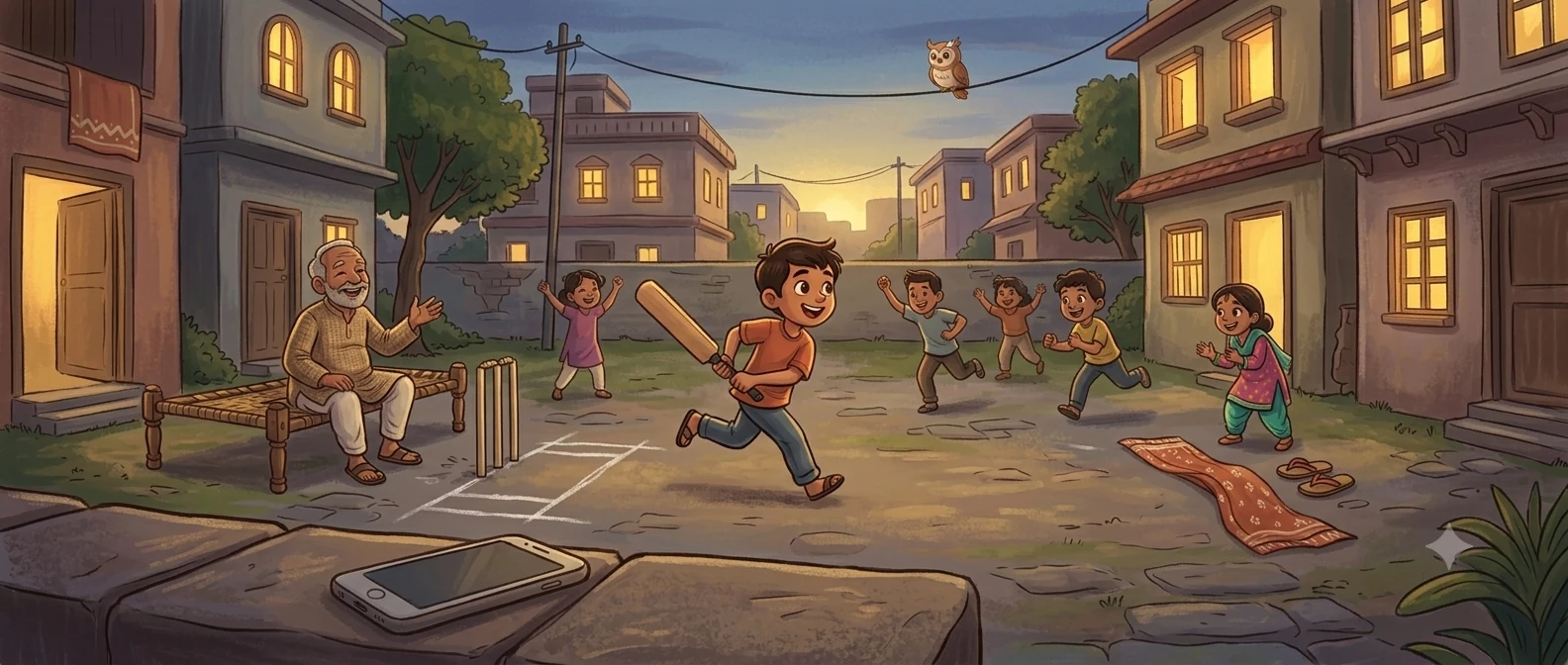
The phones last one evening of careful rationing. By the third day every child under fifteen is standing in the courtyard at dusk holding a dead rectangle — until Veer’s grandfather stands up from his chair and asks who knows how to play gilli danda. Nobody does. “Then tonight,” he says, “level one.”
What follows is nine evenings of borrowed games with changing rules, a straight ball nobody can read, forty kids Veer has somehow never met, and one round of stolen mangoes eaten on top of the water tank. When the power finally comes back and Veer does finish the game four days later — the last dragon down, the screen full of gold coins, a banner reading CONGRATULATIONS, HERO — he sits in the afternoon quiet and waits for the feeling to arrive. It’s smaller than he expected. The banner doesn’t even have his name on it.
Afterwards, ask one of these — one, not all, and not as a quiz:
- When Veer finally finished level 100, why do you think it felt smaller than he’d expected?
- What did the courtyard evenings have that the game didn’t? What did the game have that the courtyard didn’t?
- If the power went out for a week at our place, what do you think you’d end up doing?
Why the story doesn’t take the screen away
Veer’s grandfather never confiscates a phone. Nobody in the story delivers a lecture about screen time, and the game isn’t written as a villain — finishing it is a real achievement, and the story lets it be one. What changes Veer’s summer isn’t a ban. It’s nine evenings of something that turned out to be bigger, discovered only because the choice got made for him for a week.
That’s the piece worth borrowing. The argument a child can’t stand is the one about the screen. The thing a child will actually follow is a courtyard that’s more interesting than the screen — and most of the time, the only way to find that out is to be a little bored first, together, for longer than feels comfortable.
More stories about life on the other side of the screen
If your child is younger, the same idea scales down:
- The Two-Hundred-Day Streak (ages 7–9, 6 min) — Leo hasn’t missed a day of his game in 214 days, and the flame icon proves it. Then a camping weekend with no signal puts the flame out, and he feels awful, and then — strangely — lighter. A story about who a daily streak is really built for.
- Papa’s Other Face (ages 4–6, 4 min) — Noor’s father has two faces: the one that looks at her, and the flat one that looks down at his phone. So she invents a game about it. The screen-time story that’s honest that the adults are in this too.
- Bye-Bye, Tablet (ages 0–3, 2 min) — the rhymes are over and the tablet is tired; time to wave bye-bye, because the world outside the screen has been waiting to play. A gentle wind-down for the youngest, with do-together prompts instead of questions.
- The Loudest Notification (ages 10–12, 8 min) — Naina’s class group chat never sleeps, and falling behind on 400 messages a day feels like disappearing. A week at her grandmother’s, where the network barely reaches, runs an experiment she’d never have agreed to.
Why none of these ends with a moral
Every story on NestOfValues ends with a Talk About It block — two or three open questions — instead of a stated lesson. Veer’s grandfather never explains what the courtyard is for. He just marks out the wickets in chalk and starts the game, and the story ends on Ananya’s straight ball knocking the middle stump flat while somebody’s little sister runs off with the chalk — the real game, the one with no last level, going on.
The full screen time collection is free, original, and sorted by age — no login, no ads, and every story set in a home where devices exist without being the enemy.