Some Promises Don't Need a Thread. A Raksha Bandhan Story About Siblings.
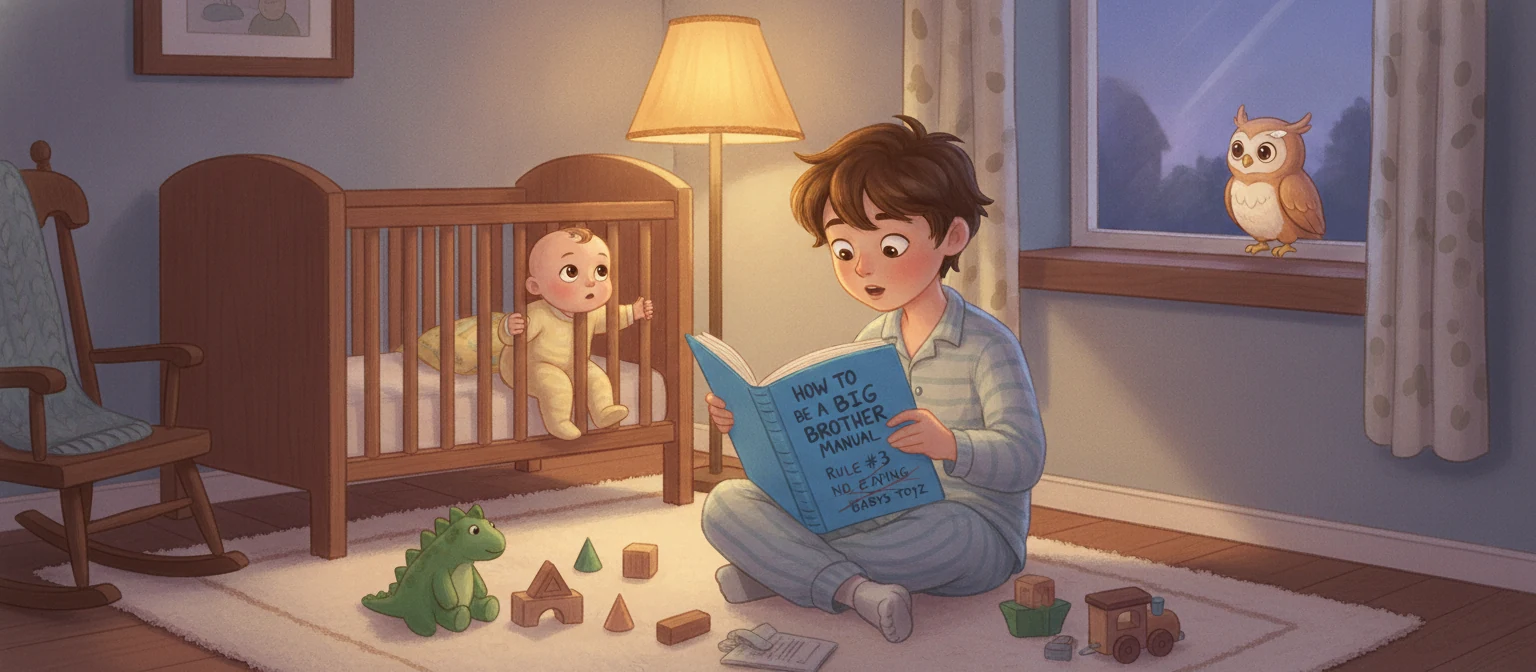
A rakhi is a strange little object when you think about what it’s actually asking a thread to carry: I will look out for you. No child needs the thread explained to them — they’ve usually already made some version of that promise on their own, badly, long before anyone tied anything to their wrist. This is a story about a boy who tried to make that promise properly, in writing, and found out the hard way that the promise that actually works was never the one on the page.
Tonight’s story: “The Big Brother Manual”
The Big Brother Manual (ages 7–9, 6 minutes) is about Milo, a boy who reads every instruction before touching anything. When his parents announce a baby is coming, Milo does the obvious thing: he asks for the manual. There isn’t one. So he writes it himself — fourteen stapled pages, feeding times, nap schedules, a chart for the four kinds of crying. His new sister June follows exactly none of it. By the end of her first week home, the manual is a battlefield of crossed-out rules, and Milo is, by his own engineering standard, a failure.
Except for Rule 7 — written smaller than the others, the one he’d thought hardest about: if she cries and nobody knows why, somebody should just stay next to her so she isn’t alone. It’s the only rule that survives. Not because it fixes anything. Because staying is the whole thing a manual can never quite cover.
Afterwards, ask one of these — one, not all, and not as a quiz:
- Why do you think Milo wanted a manual so badly? What was the manual really for?
- Rule 7 was the only rule the baby followed. Why do you think that one worked when the others didn’t?
- If you wrote a manual for someone joining your family, what would rule one be?
That last question tends to say more than any of the others — a rule a child writes for a sibling, unprompted, is usually a closer look at what they actually believe love is than anything they’d say if you asked them directly.
More stories for the sibling shelf, by age
Raksha Bandhan is really a whole-family occasion, not a single-story one — a few more from the collection:
- The Tiny Laugh (ages 0–3, 3 min) is gentle enough for a toddler still working out what a baby even is: everyone in the house is trying to make the new baby laugh, and the baby is waiting for one particular person.
- The Night the Moon Got a Little Sister (ages 4–6, 4 min) moves the whole thing into the night sky — the Moon has always had the dark to herself, and now a tiny bright star is getting all the attention.
- Half My Room (ages 10–12, 8 min) is for the older end of the sibling shelf — a preteen who loves the baby and can’t stand him, in the same hour, and doesn’t get asked to pick just one feeling.
Why none of these ends with a moral
Every story on NestOfValues ends with a Talk About It block — two or three open questions — instead of a stated lesson. Milo never gets told “the real gift is showing up.” He finds it out the way a sibling actually does: by staying next to the cot on a bad night and noticing, slowly, that staying is what worked.
The full new sibling collection is free, original, and sorted by age — no login, no ads, one decision: which story tonight.