Explaining Pet Death to a Child — The 4-Minute Story That Says the True Words Gently.
There is rarely a good rehearsal for this conversation. The pet has just died — that morning, that night, sometimes while your child was at school — and now there’s a real question sitting in front of you with no good deflection available: what do you actually say. “He went to sleep” invites a fear of beds. “He went away” invites a wait by the window. The honest, plain words are almost always the kinder ones, even though they’re the harder ones to say out loud first.
Tonight’s story: “The Biscuit Box”
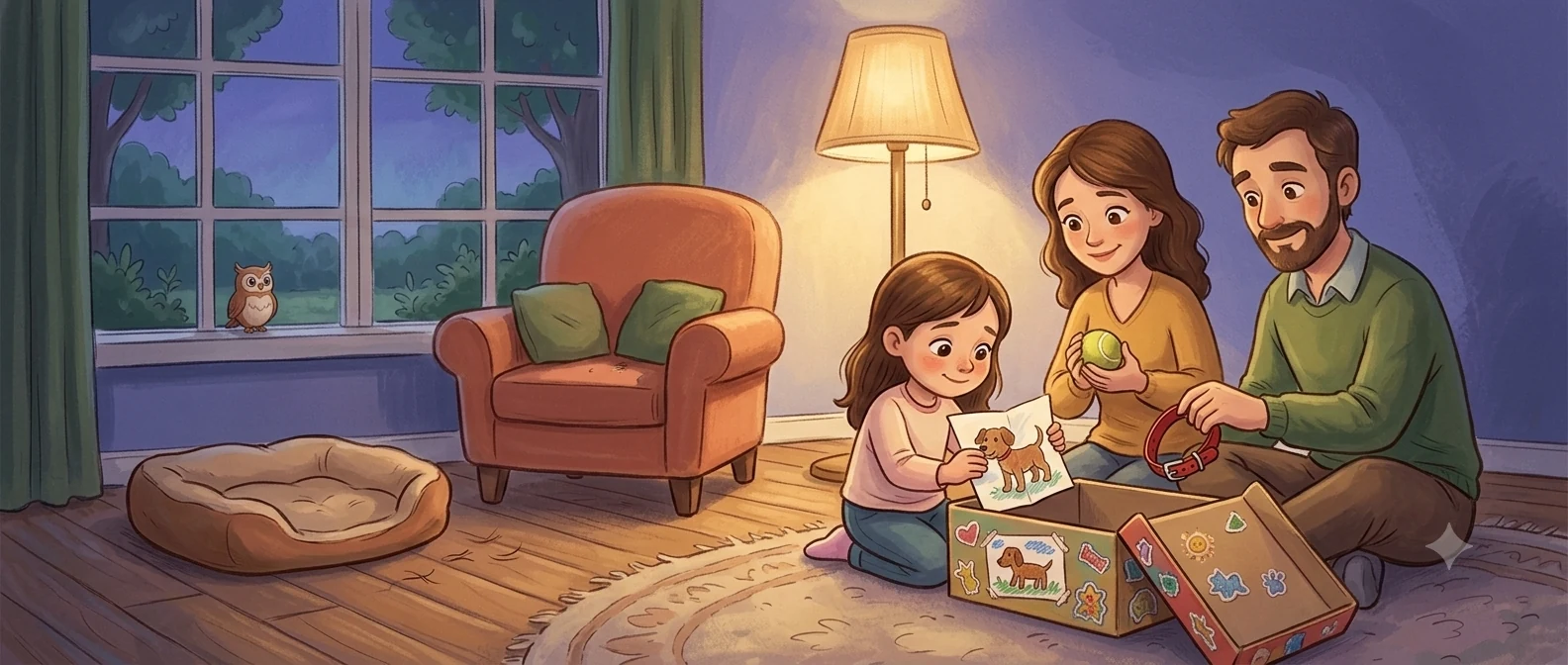
The Biscuit Box (ages 4–6, 4 minutes) opens the morning after Biscuit, an old, slow, warm family dog, has died in his sleep. Rosa’s parents tell her plainly — “his body finished working, all peaceful, right there on his cushion. He isn’t hungry or tired or hurting anymore. But he’s gone, and he isn’t coming back.” Nobody tells Rosa not to cry. The house goes quiet in the particular way a house goes quiet when a regular sound — a tail thump, claws on the kitchen floor — simply stops arriving.
What the family does next is small and concrete: a shoebox, painted Biscuit-brown, filled slowly with his collar, his smooth old tennis ball, Rosa’s drawing of him with an extra-thumpy tail “because that was the truest part.” A photo goes in too — of the time he stole a sock from the laundry and wouldn’t give it back — and everyone laughs, really laughs, in the middle of a hard week, and nobody treats that laugh as a betrayal of the sadness sitting right next to it.
Afterwards, ask one of these — one, not all, and not as a quiz:
- What did the family keep in Biscuit’s box? What would you put in a box like that?
- Rosa’s sad came back sometimes even after a long while. Is that okay? What did her family do when it came?
- Is there someone or some pet you remember? What’s your favourite remembering about them?
Why the box, specifically, matters
A remembering box does something a single conversation can’t: it gives a feeling that will keep returning — days later, months later, at random moments that have nothing to do with anything — somewhere concrete to land. The story is honest that grief doesn’t resolve in one sitting: “sad about someone you love doesn’t go away all at once. It comes back in little waves.” When it does, Rosa’s family doesn’t manage it by changing the subject. They open the box.
That’s the piece worth borrowing directly, whatever the pet and whatever your child’s age: a small physical place — a box, a drawing pinned up, a particular photo — that turns “I don’t know what to do with this feeling” into “we know exactly what to do when this comes back.”
A few things this story deliberately does not do
It doesn’t promise the pet is “in a better place” or “watching over” anyone — claims a young child will take literally and then interrogate. It doesn’t rush the story to a tidy resolution inside four minutes; the box goes back on the shelf at the end, not closed forever, opened again “on Biscuit’s birthday, with two biscuits each in his honour.” And it doesn’t hand Rosa’s family, or your family, a stated moral about grief. It just shows what one family did, and lets the story’s last line — “that job is a job for always” — do the only explaining it needs to do.
Why none of these ends with a moral
Every story on NestOfValues ends with a Talk About It block — two or three open questions — instead of a stated lesson. Nobody in “The Biscuit Box” explains grief to Rosa in a single tidy sentence. The story shows a family folding laundry, painting a box, telling the sock story one more time — and trusts that showing is enough.
The full loss of a pet collection is free, original, and sorted by age — no login, no ads, one decision: which story tonight.