My Older Kid Resents the Baby. Here's the Story for Tonight (and 3 Questions to Ask After)
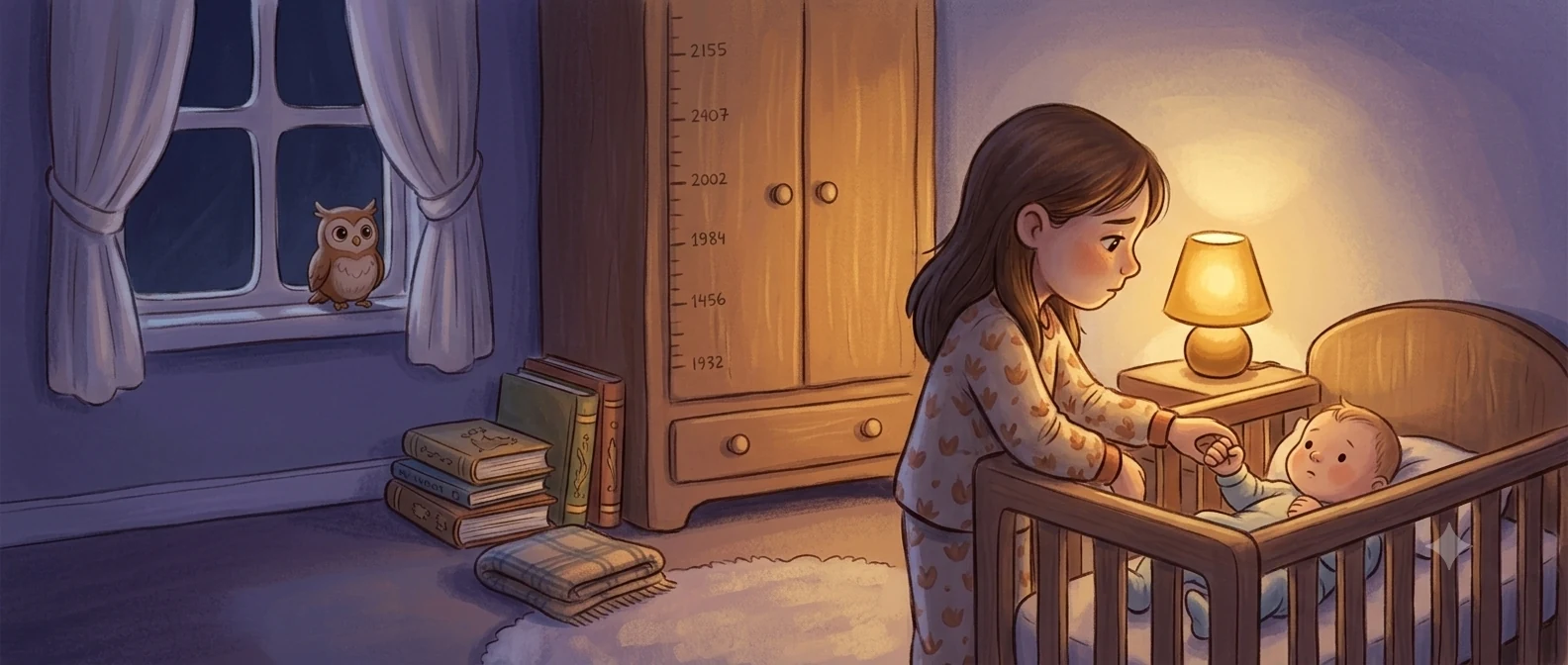
Somewhere between the crib arriving and the third week of everyone’s tiredness rolling downhill onto her, your older child said something that stopped you cold — “I wish you’d never brought him home” — and then, an hour later, stood guard over the same baby’s nap like a small furious bodyguard. Both were true. That’s the part nobody warns you about: it isn’t jealousy replacing love, it’s jealousy sitting right next to it, all week, sometimes all in the same afternoon.
The instinct is to correct the first feeling — “you don’t mean that,” “you love your brother” — which teaches her the fast feeling is the wrong one and the slow one is the only one allowed in the room. She already knows both are in there. What she doesn’t have yet is proof that having both doesn’t make her a bad big sister.
A story can carry that proof better than a conversation can, because nobody has to be reassured out loud.
Tonight’s story: “Half My Room”
Half My Room (ages 10–12, 8 minutes) opens with the least sentimental version of this story you’ll find: a girl named Myra loses half her bedroom, her parents’ attention, and her Nani’s visits, in that order, the week her brother is born. She tells no one the cold thought she has some nights, listening to him wail through the wall. She also tells no one about the ten minutes she spends most afternoons just standing at his crib, ready to fight anything that comes through the door.
Nothing in the story asks her to resolve which feeling is real. What changes things is a three-a.m. night in June, when she takes the baby from two exhausted parents and does something none of them expected — and discovers, mid-bounce-and-sway, a version of herself that is neither purely resentful nor purely noble. Just eleven, and capable of both, at once, like everyone else in the house.
Afterwards, ask one of these — one, not all, and not as a quiz:
- Myra loved the baby and couldn’t stand him in the same week — sometimes the same hour. Do you think one of those feelings was the “real” one, or were both?
- What’s something only the oldest one in a family can do — not a chore, but actually do?
Then stop. The question isn’t checking whether she’s grateful for her sibling. It’s giving the feeling she can’t say out loud somewhere honest to land.
If your child is a different age
New-sibling feelings look different at two than they do at eleven — the library covers the spread:
- The Tiny Laugh (ages 0–3, 3 min) is gentle enough for a toddler still working out what a baby even is: everyone in the house is trying to make the new baby laugh, and the baby is waiting for one particular person.
- The Night the Moon Got a Little Sister (ages 4–6, 4 min) moves the whole thing into the night sky — the Moon has always had the dark to herself, and now a tiny bright star is getting all the attention. A soft way to name the grumbliness out loud.
- The Big Brother Manual (ages 7–9, 6 min) is for the kid who copes by preparing: Milo writes an actual instruction manual for the baby before he arrives. The baby, on arrival, has clearly not read it — and the one rule that does work isn’t the one Milo expected.
Why none of these ends with a moral
Every story on NestOfValues ends with a Talk About It block — two or three open questions — instead of a stated lesson. A child who’s asked “do you think one of those feelings was the ‘real’ one?” gets to arrive at the answer that a child who’s told “you should be happy for your brother” never gets the chance to reach.
The full new sibling collection is free, original, and sorted by age — no login, no ads, one decision: which story tonight.