You Know How "The Lion and the Mouse" Ends. We Changed One Thing.
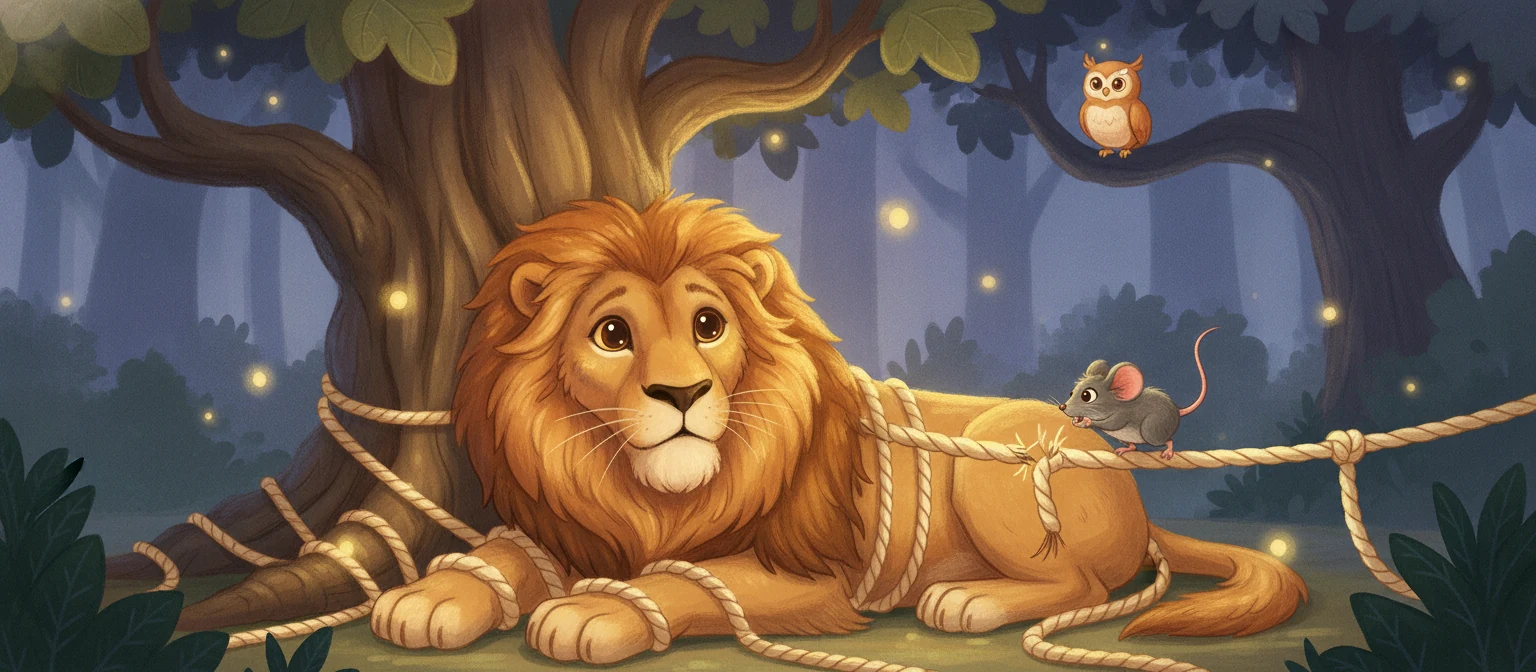
You already know this fable. Everyone does — it’s one of the first ones a child hears, right after the tortoise beats the hare. A mouse begs a lion for her life, the lion laughs and lets her go anyway, and later the mouse gnaws him free of a hunter’s net. And then, in almost every version you’ve ever read, someone — the narrator, a caption, a closing line in bold — says it out loud: the moral of the story is, no act of kindness is ever wasted.
That last sentence is the one thing we took out.
Not because the idea is wrong. Because saying it costs something. A child who’s told the lesson gets to file it away as something a book said. A child who’s left to work it out herself — from the lion’s face when he realizes who’s saving him, from the size difference between a paw and a mouse’s whole body — gets to file it away as something she figured out. Those two things sit in a child’s memory very differently, and only one of them tends to come back on its own, later, at the moment it’s actually needed.
Tonight’s story: “The Lion and the Mouse”
The Lion and the Mouse (ages 4–6, 4 minutes) keeps everything that makes the original work — the laugh, the promise nobody takes seriously, the net, the small teeth against thick rope in the dark. What it leaves out is the line telling your child what to think about all that. The story ends on the lion looking at the mouse for a long moment, not on a stated conclusion.
Afterwards, ask one of these — one, not all, and not as a quiz:
- Why did the lion laugh at the mouse’s promise? Was he right to?
- The lion’s kindness took one second — he just opened his paw. Why did such a small kindness matter so much later?
- Has someone smaller or younger than you ever helped you? How?
That last question is usually the one that lands hardest — every child has a “mouse” moment, some time a smaller sibling, a younger cousin, or a quieter classmate did something that mattered more than their size suggested it would.
More kindness stories, by age
Small kindnesses show up differently at every age — a few more from the collection:
- The Wet Little Sparrow (ages 0–3, 2 min) is kindness at toddler scale — one soaked bird, one warm windowsill, no explanation needed.
- One Red Mitten (ages 0–3, 2 min) follows a single dropped mitten through a snowy park, and the small detective determined to reunite it with its cold-handed owner.
- The Well at the Edge of the Village (ages 4–6, 5 min) is for the slightly older child ready for kindness with a bit more at stake — help offered to someone the rest of the village has stopped noticing.
Why none of our stories end with a moral
This isn’t just true of one fable — it’s every story on NestOfValues. Each one ends with a Talk About It block, two or three open questions, instead of a stated lesson, and every retelling we publish (Aesop, Panchatantra, Jataka, and beyond) keeps the plot and drops the closing sermon on principle, not just for this one. It’s slower to write than pasting the traditional ending back on. We think it’s the only version that actually works.
The full kindness collection is free, original, and sorted by age — no login, no ads, one decision: which story tonight.