Nobody Shouted. Nobody Hit Her. It Was Still Bullying — The Story for Tonight.
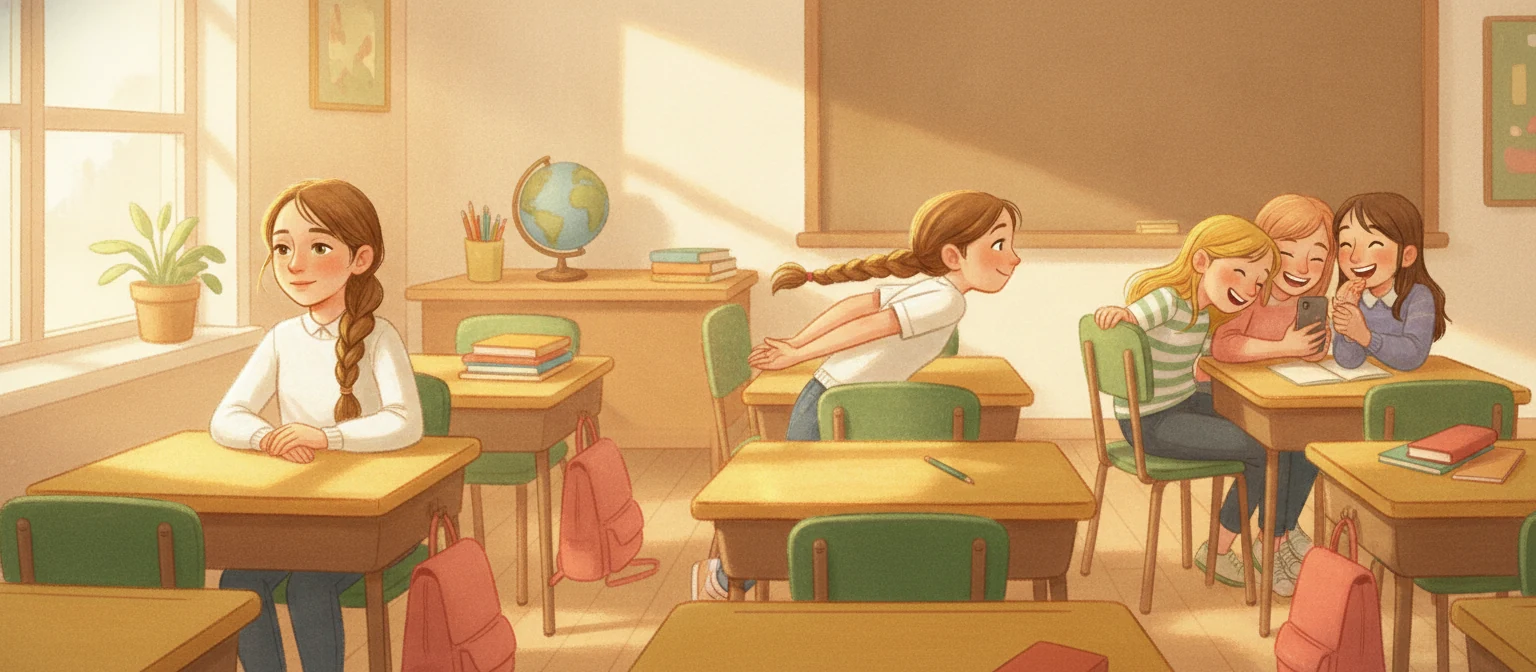
If your child came home and said “someone hit me,” you’d know exactly what to do next. It’s the other kind that’s harder to act on — the kind where nothing happened that you could point to. A bag left just slightly in the wrong place on a bench. A joke that started before your child arrived and never got explained to her. A phone that goes face-down when she walks past. None of it looks like anything, one at a time, which is exactly what makes it so hard for a child to explain and so easy for adults — even well-meaning ones — to miss.
Tonight’s story: “The Party Everyone Knew About”
The Party Everyone Knew About (ages 10–12, 8 minutes) is about Sana, who has eaten lunch on the same low wall with the same four girls for months — until one ordinary day in July, when she finds a school bag placed on either side of the one gap she’d normally sit in. Nobody says anything unkind. Nobody has to. It happens again the next day, and the day after, in small ways that are each individually impossible to complain about — a joke she wasn’t there for, a phone turned over, a relay-race partner she never gets. Then a birthday party goes around the whole class in photographs, and Sana starts doing the thing kids do when there’s no other explanation available: she starts checking the mirror, looking for what’s wrong with her.
It’s her mother — not a lecture, but a story of her own, about a colleague who does the exact same thing at the office — who finally puts a name to it: “Bullying doesn’t always look like shouting or fighting. Sometimes it’s about making someone feel unwanted, again and again.” What changes things afterward isn’t a punishment or a big confrontation. It’s one girl who noticed, and one short message: “I don’t really know what’s going on with everyone either. Do you want to sit with me tomorrow?”
Afterwards, ask one of these — one, not all, and not as a quiz:
- Nobody in this story shouted at Sana or pushed her. So why was it still bullying?
- Ishita sent one message about maths homework and added one extra line. What’s the smallest thing you could do for someone eating lunch on their own?
- Has something like this ever happened to you — or has someone else been the one left out?
That last question matters more than it looks. A lot of children have been on both sides of a wall like this one, sometimes in the same year, and most have never been asked outright which side they’re remembering.
Why “was that actually bullying” is worth asking out loud
Kids are good at spotting cruelty that comes with volume — the pushing, the name-calling, the stuff that shows up on a form. They’re much less equipped to name the version that comes with a smile, because every individual moment of it has a plausible, boring explanation: the bag was already there, the joke wasn’t planned, the phone thing was probably nothing. Naming the pattern — not any single incident — is the actual skill, and it’s one most children have never been taught, because most adults never got taught it either.
Sana’s mother doesn’t get there by interrogating her daughter. She gets there by waiting, noticing the lunchbox coming home full, and eventually telling a true story about her own life that happened to rhyme.
A related read, if your child’s version looks different
Not every exclusion story starts this quietly, and not every version needs a mother’s colleague-story to unlock it. Not Your Weather (ages 10–12, 8 min) follows a boy carrying something closer to the classic shape — a joke about his glasses that never stopped — from July to October, and the one question from a cousin that finally gets it out. Between the two stories, most of what “bullying that doesn’t look like bullying” actually looks like is covered.
Why none of these ends with a moral
Every story on NestOfValues ends with a Talk About It block — two or three open questions — instead of a stated lesson. Sana’s mother never says the word “bullying” as a verdict on Aisha and her friends; she says it as a description of a pattern, and lets Sana decide what to do with that. The story shows the exclusion, shows the noticing, shows the one small message that broke it — and stops.
The full dealing with bullying collection is free, original, and sorted by age — no login, no ads, one decision: which story tonight.