Your Child Is Scared of the Dark. Here's the 2-Minute Story for Tonight (and What to Ask After)
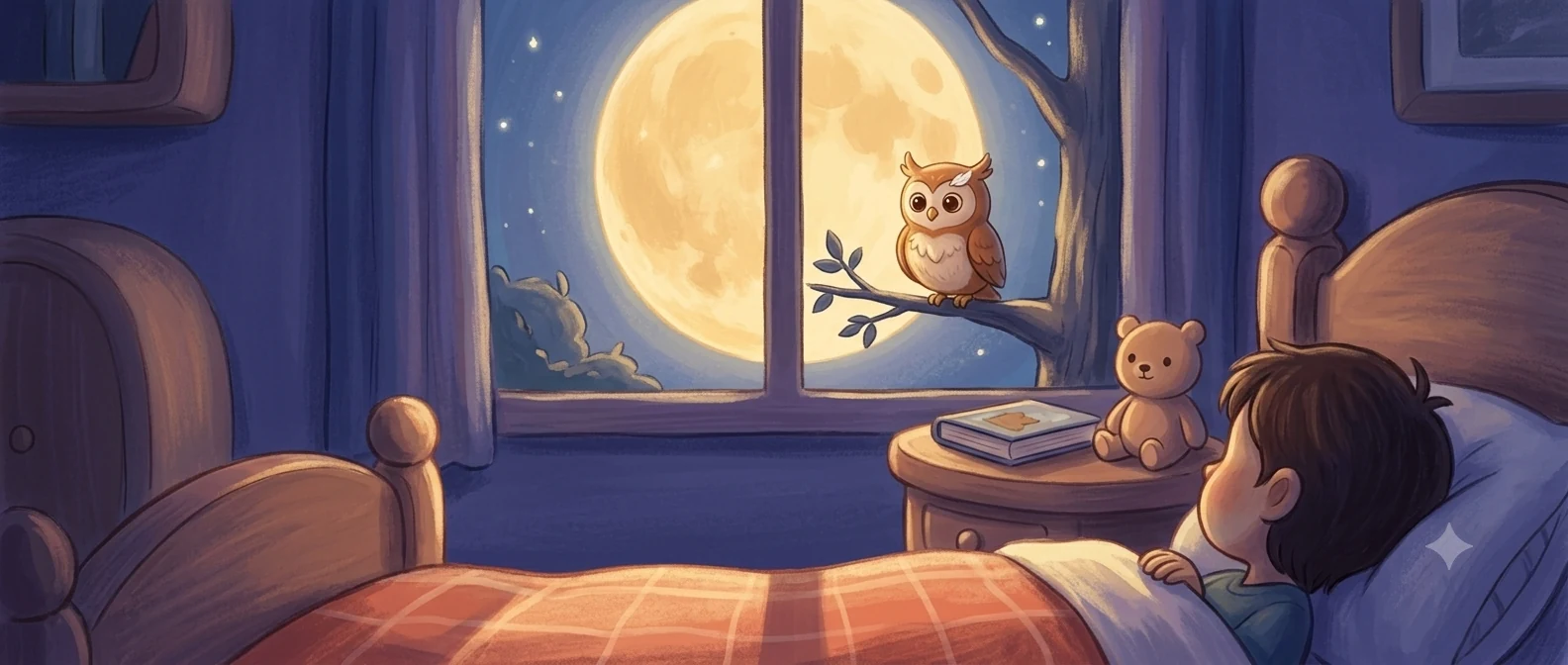
It’s 8:47pm. Teeth brushed, water fetched, story read — and then your hand touches the light switch and the negotiation begins.
You’ve probably already tried the two standard scripts. “There’s nothing there” fails because your child isn’t reporting a fact, they’re reporting a feeling, and feelings are famously unmoved by evidence. “You’re a big kid now” fails harder — now they’re scared and embarrassed about being scared, which is two problems where there used to be one.
There’s a third option, and it’s older than both: hand the fear a story. Not a story that argues with the dark, and not one that ends with a lesson read out loud — a story that quietly changes what the dark is.
Tonight’s story: “Goodnight, Little Light”
Goodnight, Little Light (ages 0–3, 2 minutes) walks through the house saying goodnight to every light in it — the kitchen light that cooked with us, the hallway light that showed us the way to bed, click, sleep well. By the time the bedside lamp clicks off, the story has already made its one quiet move: the dark isn’t a thing that arrives. It’s the blanket the lights pull up when they’re tired. Even lights need to rest.
And the last thing your child is left holding isn’t the dark at all — it’s the moon in the window, “the night light for the whole world,” which never clicks off and leaves a little silver on the windowsill, just for them.
It’s two minutes. It works read slowly, in a low voice, as the actual last thing — not a story that winds a tired child back up, but one shaped like falling asleep.
Afterwards, ask one of these — one, not all, and not as a quiz:
- Which lights go to sleep in your house at night?
- What did the moon leave on for you?
Then stop. The story already did the reframing; the question just lets your child say it back in their own words. That’s usually the moment the grip loosens — not when they’re told the dark is fine, but when they hear themselves explaining that the lights are sleeping.
If your child is past the picture-book stage
Fear of the dark doesn’t vanish at four. It just learns to hide — and the hiding is its own weight.
- The Torch Game (ages 4–6, 4 min) turns checking the room into a game your child runs, torch in hand. An anxious five-year-old with a job is a very different creature from an anxious five-year-old with nothing to do but listen to the house.
- Who Switches On the Stars? (ages 0–3, 2 min) is tonight’s story’s sibling — the same gentleness, built on counting the tiny lights the night keeps on.
- The Sleepover (ages 7–9, 6 min) is for the child who’s fine at home — where the door sits just so and the hallway light stays on — and quietly dreading the first night somewhere else. Two boys, one sleepover, and the same secret each is sure only he has.
- Lights Out at Camp (ages 10–12, 8 min) is the preteen version, where the fear costs more to hide than to feel. Dhruv is eleven, far too old to be afraid of the dark — which is why absolutely no one can ever find out. Then comes school camp, and the night duty roster. Its best question to ask after: why do we each assume we’re the only one?
Why none of these ends with a moral
Every story on NestOfValues ends with a Talk About It block — two or three open questions — instead of a stated lesson. This isn’t a stylistic quirk; it’s the whole editorial policy. A child who answers “what should we check first?” is doing something a child who’s told “see, there was nothing to be afraid of” never gets to do: working it out themselves, out loud, with you in the room.
The full fear-of-the-dark collection is free, original, and sorted by age — no login, no ads, one decision: which story tonight.