Your Child Says "I Can't" Tonight. Here's the Story About Doing It Scared.
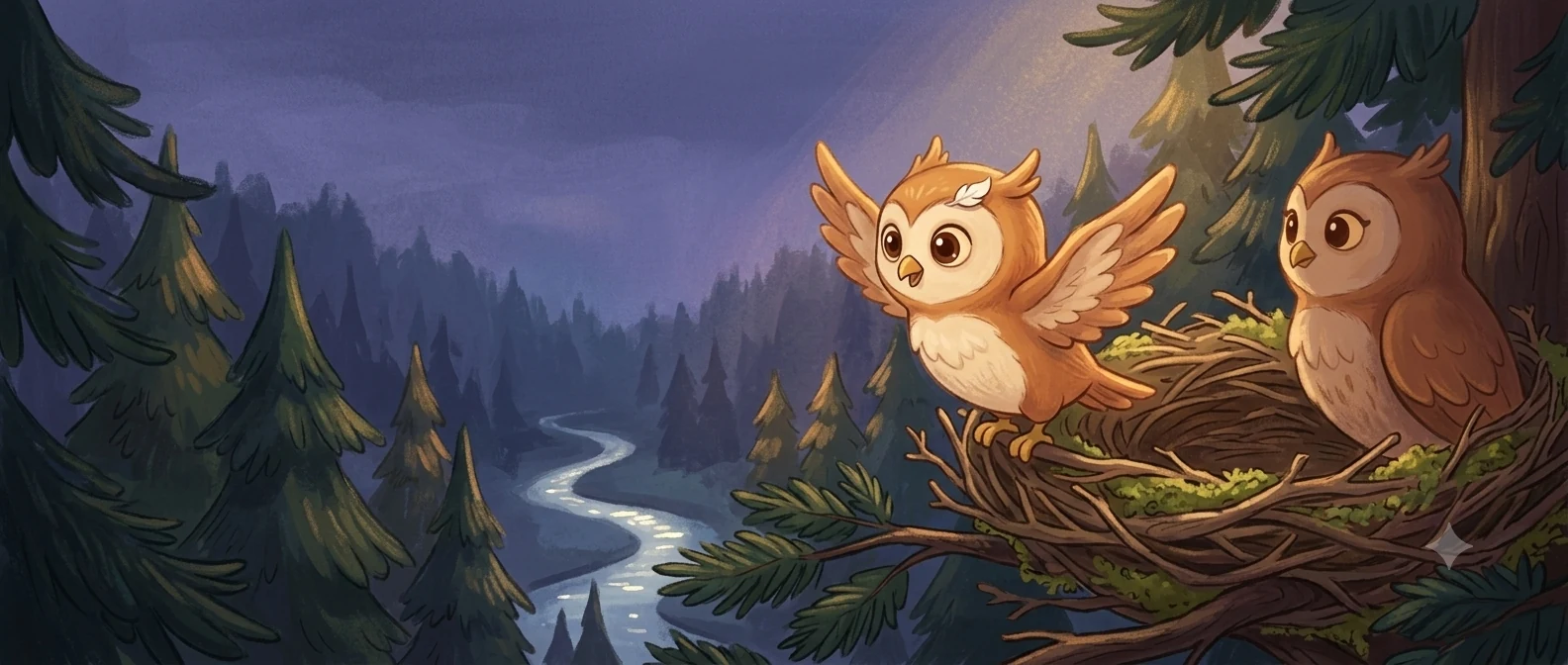
Somewhere in the last week, your child has said some version of “I can’t” about something that wasn’t actually dangerous — the diving board, the school play, telling a teacher they didn’t understand, walking into a room of kids they don’t know. You already know the two things that don’t work. “There’s nothing to be scared of” argues with a feeling instead of answering it. “Just be brave” asks for a result without offering a method — as if courage were a light switch instead of a thing you’d have to build, in the moment, out of whatever’s on hand.
Here’s the method most bedtime advice skips: courage rarely gets built by facing a fear head-on, alone, for its own sake. It gets built sideways — by having a reason bigger than the fear itself.
Tonight’s story: “Nino and the Long Night”
Nino and the Long Night (ages 4–6, 5 minutes) doesn’t pretend its small owl stops being afraid of the dark. He’s afraid on the very first page and afraid on the very last one — the dark is exactly as dark at the end of the story as it was at the beginning. What changes is smaller and more useful than “he got brave.” His mother can’t fly, so someone has to cross the wood’s darkest stretch to fetch healing moss. Halfway across, frightened and flying anyway, Nino finds something even more frightened than he is — a lost mouse — and picks it up.
That’s the whole mechanism, and it’s worth naming out loud for the parent listening: helping someone else be brave is often the only door into being brave yourself. Not information about the dark. Not reassurance about the dark. A job, and someone smaller than you counting on you to do it.
Afterwards, ask one of these — one, not all, and not as a quiz:
- Has there ever been a time you did something even though you were scared?
- Why do you think helping the mouse made Nino feel braver, even though the dark hadn’t changed at all?
Then stop. The point isn’t to get your child to declare they’re not scared anymore. It’s to let them notice — in their own words — that scared and doing-it-anyway can happen in the very same breath.
New this week: “Nino and the Long Night” now has a free narrated video too, if your child would rather watch the Long Night than picture it — watch it here.
If your child is a different age
Courage looks different at two than it does at eleven — the library covers the spread:
- The Brave Wave (ages 0–3, 3 min) is small enough for a toddler: the sea keeps sending waves, and one small pair of feet keeps deciding, again, to stand in them.
- The Question Nobody Asked (ages 7–9, 6 min) is for the child whose hand won’t go up — Meera doesn’t understand fractions, everyone else seems to, and her raised hand feels like it weighs a hundred kilos.
- The Deep End (ages 10–12, 8 min) is for the preteen who’s built an elaborate cover story rather than admit what they’re actually afraid of — Riya is the fastest swimmer in her class, as long as her feet can touch the bottom.
Why none of these ends with a moral
Every story on NestOfValues ends with a Talk About It block — two or three open questions — instead of a stated lesson. A child who’s asked why helping the mouse made Nino braver gets to arrive at their own answer about where courage actually comes from, instead of being handed one.
The full courage collection is free, original, and sorted by age — no login, no ads, one decision: which story tonight.