Your Kid Has Already Decided Someone Is "Just Mean." Here's the Story for Tonight
Every kid has one: the neighbor who confiscates the ball, the teacher who never smiles, the classmate who sits alone and apparently prefers it. By age nine or ten, your child usually already has a whole theory about this person — assembled from a few doorbell-length interactions and passed around the playground until it hardens into fact.
You’ve probably tried the direct approach. “Maybe he’s just having a hard day” fails because it’s an abstraction — your child has no evidence for it, so it sounds like grown-up spin, not truth. “Be nice to him anyway” fails harder, because it asks for the behavior without touching the belief underneath it, which is the part actually running the show.
There’s a third option: a story where the theory turns out to be wrong, and lets your child watch it come apart in real time, from the inside of somebody else’s doorway.
Tonight’s story: “The Man Who Kept Our Cricket Balls”
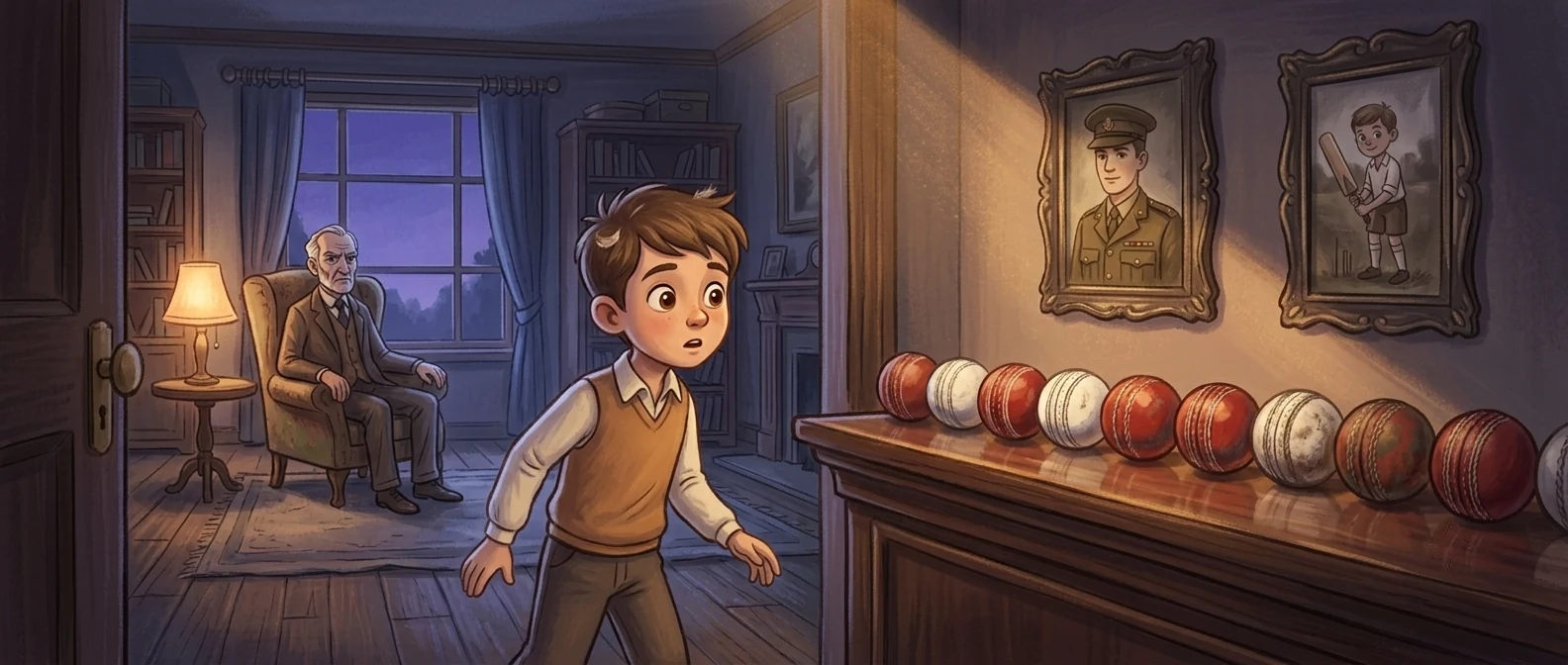
The Man Who Kept Our Cricket Balls (ages 10–12, 8 minutes) opens with a colony legend everyone agrees on: Colonel Uncle confiscates every ball that crosses his wall, eleven this season, and enjoys it. Then Dev gets sent to his door with a misdelivered parcel — and sees the shelf. Eleven balls, dusted, displayed like trophies, under photographs of a son who’s far away and doesn’t visit enough.
The story doesn’t announce its own turn. It just lets Dev stand in that room and feel the whole colony legend come apart in his hands — and then, a beat later, realize the Colonel had only ever been given the doorbell version of the kids too. Nobody in this story was wrong on purpose. Everybody just had one version of somebody, collected from the wrong side of a wall.
Afterwards, ask one of these — one, not all, and not as a quiz:
- The kids had a whole story about Colonel Uncle. How much of it turned out to be true?
- Is there someone in your building or street that everyone has a “story” about? What do you actually know about them, versus what gets said?
Then stop. The story already showed the gap between the two; the question just lets your child notice it in their own life, in their own words.
If your child is a different age
Empathy starts small and grows real teeth by the preteen years — the library covers the spread:
- The Baby on the Bus (ages 0–3, 2 min) is empathy at toddler scale: a crying baby, a bus full of grown-ups looking away, and one small girl who knows exactly what crying needs.
- The Girl Who Didn’t Need Words (ages 4–6, 4 min) is for the new kid who doesn’t speak the same language — and the discovery that swings, and tag, and most of the good stuff don’t need words either.
- The Notebook from Guwahati (ages 7–9, 6 min) sits a boy next to the new girl who hasn’t said a word in two weeks — until her notebook falls open, and he sees why.
- Two Weeks in Nani’s Village (ages 10–12, 8 min) is for the preteen who’s certain, on arrival, that they already know how this visit is going to go. It doesn’t survive the two weeks.
Why none of these ends with a moral
Every story on NestOfValues ends with a Talk About It block — two or three open questions — instead of a stated lesson. A child who answers “what do you actually know about them, versus what gets said?” is doing something a child who’s told “don’t judge people” never gets to do: checking their own theory against the evidence, out loud, with you in the room.
The full empathy collection is free, original, and sorted by age — no login, no ads, one decision: which story tonight.