He Squeaked in Front of Everyone. Here's the Story for After.
Every child eventually has the version of this: they practised, they showed up, and the thing that came out of them in front of everyone was not the thing they’d practised. A recital note that cracks. A line in the school play that vanishes. An answer that sounded right in their head and came out backwards out loud. The particular sting of this kind of failure isn’t the failing — it’s that it happened in public, with witnesses, at the exact moment trying hardest was supposed to pay off.
Tonight’s story: “The Lion Cub Who Couldn’t Roar”
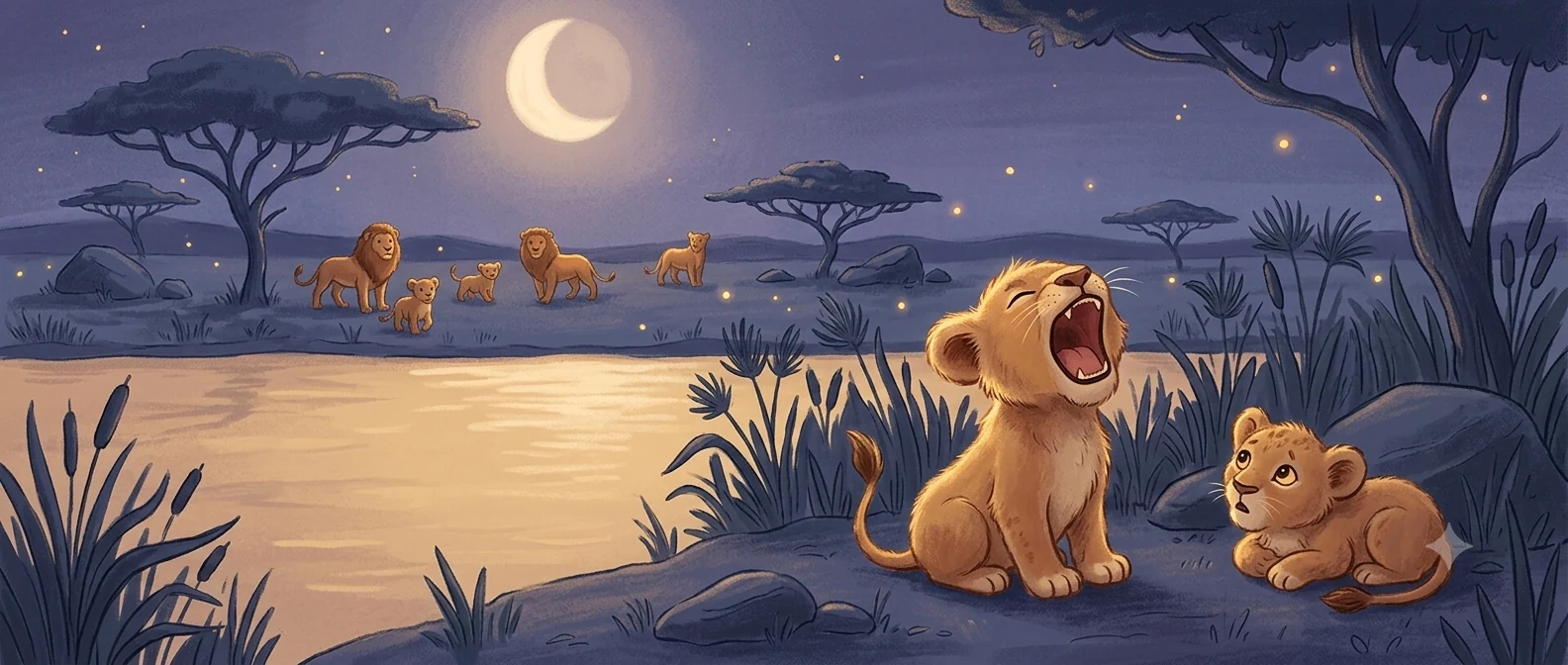
The Lion Cub Who Couldn’t Roar (ages 7–9, 6 minutes) is about Sher, a lion cub who has practised his first roar all season — at the river in the mornings, at his own shadow in the evenings. At the Gathering, in front of the whole watching pride, he plants his paws, takes the biggest breath of his life, and squeaks. One cousin laughs. Sher walks out of the circle and lies down alone by the river in the dark, thinking the thoughts that visit after a squeak: maybe I’m just not a roaring kind of lion.
The story doesn’t rush him back to confidence. It lets him sit with it — right up until his littlest sister needs him, and what comes out of him then is cracked and scraped and, everyone agrees, absolutely a roar. “That was a fine roar,” his mother tells him. “It cracked,” he says. “And the end squeaked.” “Mm,” she says. “They mostly do, the real ones.”
Afterwards, ask one of these — one, not all, and not as a quiz:
- How do you think Sher felt walking away from the Gathering? Have you ever felt like that?
- Why do you think the real roar came when it did?
- What’s the difference between failing at something and being a failure?
That third question is the one worth sitting with longest — it’s the exact distinction a child rarely draws on their own in the moment, and rarely forgets once they’ve drawn it themselves.
If your child is a different age
Failure has a different shape at every age — the library covers the spread:
- Again! (ages 0–3, 2 min) is small enough for a toddler: the tower falls, and falls, and the only real question is whether the hands come back to build it once more.
- The Thirsty Crow and the Tall Jug (ages 4–6, 5 min) is our retelling of the Panchatantra classic — a crow who can’t reach the water no matter how hard she pushes her beak, until pushing harder stops being the plan.
- The Notice Board (ages 10–12, 8 min) is for the preteen who trained all summer and finds their name missing from a list pinned in a school corridor — a quieter, harder-edged failure with no tidy roar-at-the-end fix.
Why none of these ends with a moral
Every story on NestOfValues ends with a Talk About It block — two or three open questions — instead of a stated lesson. Nobody tells Sher “failure makes you stronger.” He works out, in his own time and on his own terms, what a cracked roar is actually worth — and by the next Gathering, he’s the one cheering loudest for the cubs who squeak.
The full handling failure collection is free, original, and sorted by age — no login, no ads, one decision: which story tonight.