The Thank-You Letter
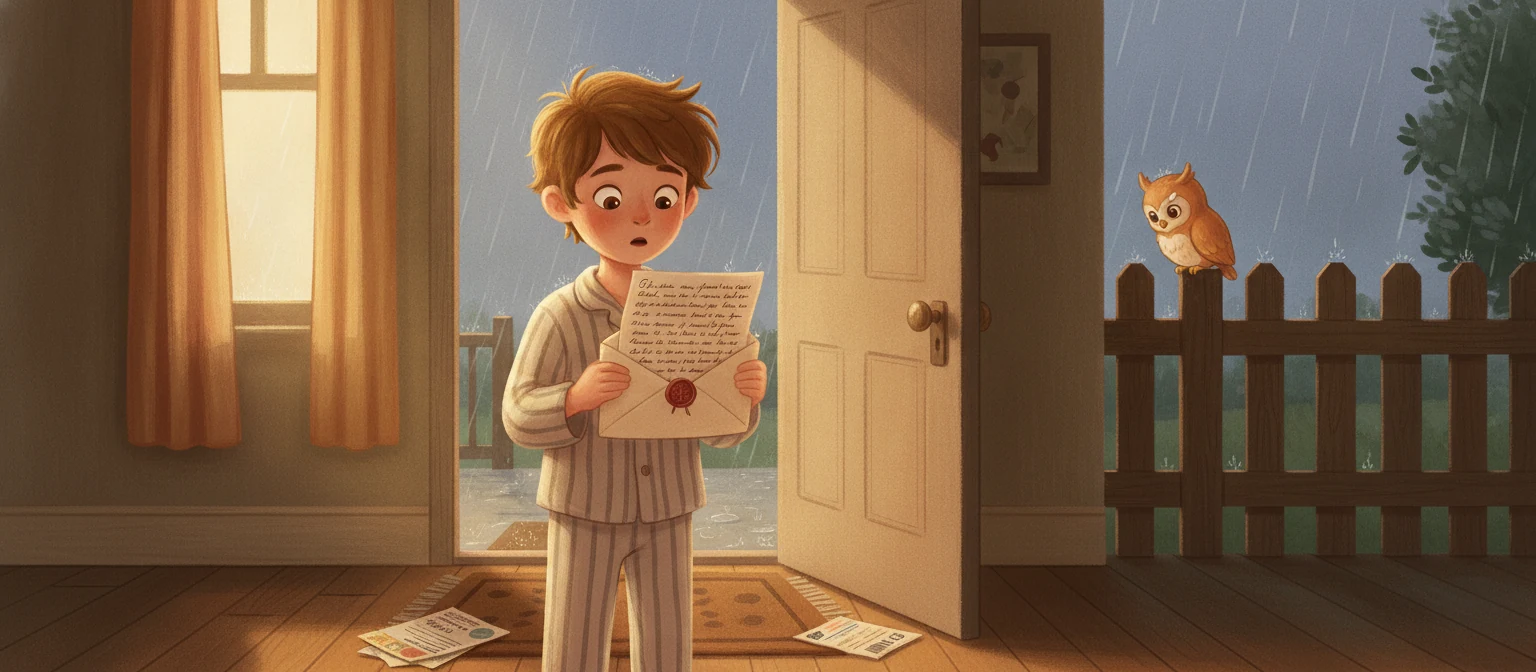
In Sam’s house there was one rule with no known exceptions, and it activated every year on the day after his birthday:
Every present got a thank-you note. Handwritten. Posted.
“Nobody posts LETTERS anymore,” Sam protested annually. “I could just text everyone. It would take one minute.”
“Anyone can be thanked in one minute,” said Mum, laying out the notepaper like surgical equipment. “That’s exactly what’s wrong with it.”
So Sam sat at the kitchen table with ten presents’ worth of thanking to do, and ground through them like homework. Dear Auntie Priya, thank you for the football socks. They are very yellow. Love, Sam. Nine notes, nine variations of the same three sentences, his hand aching by number six.
The tenth was to Great-Uncle Theo.
Great-Uncle Theo was Grandpa’s brother, ancient and far away in a small seaside town, a man Sam had met perhaps four times in his life. Every single year, without fail, a card arrived from him with a ten-pound note inside and a line of beautiful old-fashioned handwriting: For the young man’s fund. Happy birthday. — T.
Sam had already spent the tenner. He looked at the blank notepaper, out of steam, and asked, “What do I even say to him? I don’t know anything about him.”
“So tell him things,” said Mum. “He knows nothing about you either. And Sam — he’s the one thanking-note in the pile with nobody else in the house. Grandpa’s been gone three years. Write him a proper one.”
Sam chewed his pen. Then — mostly to make the chore more interesting — he abandoned the formula. He wrote what the ten pounds had actually become: the exact model of the glow-in-the-dark football he’d bought, and how its first night-game in the garden had ended in next-door’s hedge. He wrote that he played left wing like Grandpa apparently had. He asked, because the page needed filling, two real questions: Did you and Grandpa play football when you were small? Who won?
It took four sides of paper and forty minutes. He posted it and forgot it completely.
The reply came nine days later — a real envelope, addressed in that beautiful fountain-pen hand, thick as a small book.
Dear Sam, it began. Your letter was the first post in months that wasn’t a bill or a leaflet, and I have read it four times…
And then Great-Uncle Theo answered the questions. Oh, how he answered them. Five pages. He and Grandpa had played on the same junior team in 1962 — there was a ruined photograph enclosed to prove it, two grinning boys in enormous shorts. Grandpa played left wing, “all speed, no aim.” There was the story of the cup final and the goal that hit the referee. There was the goal Grandpa scored from near the corner flag that people in that town apparently still mentioned. Five pages of Grandpa, young and quick and laughing — a Grandpa Sam had never once met, delivered by post for the price of a thank-you.
At the bottom: Write again if you like. I’ve more where this came from. — T.
Sam read it twice and took it to Mum, who read it and went quiet in the way grown-ups go quiet when something is worth more than they can say out loud.
“You sent him three sentences of thanks,” she said finally. “Look what he was waiting to give back. That’s the thing about thank-yous, Sam. You think you’re closing a door politely. Sometimes you’re opening one.”
Sam wrote back that weekend — nobody made him — with a report of the rematch against the hedge and three more questions about 1962.
They’re eleven letters deep now. Proper post, both directions; the man’s a fountain of Grandpa and won’t use email. This year’s birthday card from the seaside said For the young man’s fund — and for the stamps. — T., with the ten-pound note and, folded around it, a fixture list from 1962.
The other nine notes still get written every year, three sentences each, under the unbreakable rule.
But Sam doesn’t argue about the rule anymore. He knows now what a thank-you weighs when it lands — and that you can never tell, folding it into the envelope, which one is going to someone who’s been waiting for it.
Talk About It
- Nine notes were a chore and one became something else. What made the tenth one different?
- Great-Uncle Theo said Sam's letter was 'the first post in months that wasn't a bill.' What do you think a thank-you is worth to the person who gets one?
- Who deserves a real thank-you from you — not for a present, but for anything? What would you say?
Did this story land tonight?
One tap helps us write better ones. No login, nothing shared publicly.
Thank you — this genuinely helps. 🌙