The Story He Told Twice
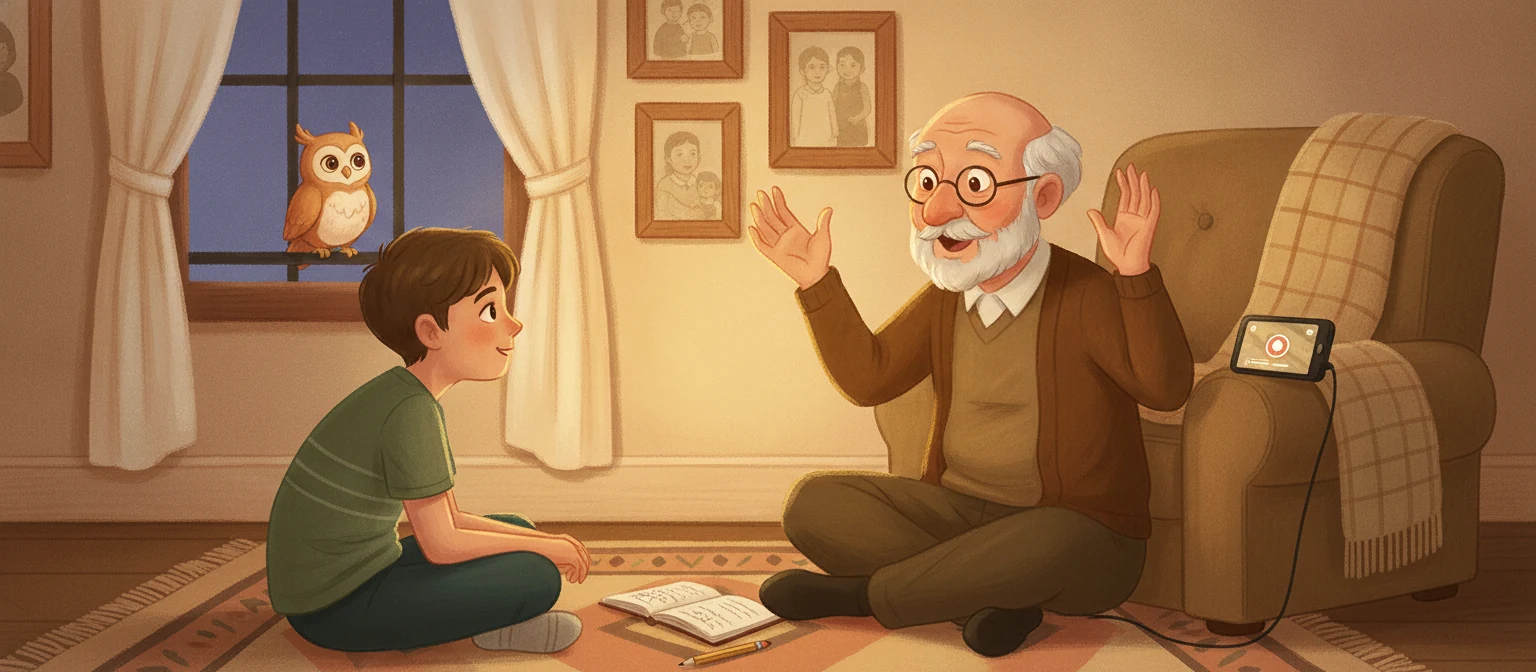
Every house has its repeated stories. In Reyansh’s house, they came from Dada’s armchair, every evening, on a loop.
The list never changed. There was the Flood of ‘78: water up to the second stair, nine days of cooking on the terrace, the neighbour’s goat rescued through a window. There was the Bicycle: bought with eleven months of tuition savings, stolen in a week, found two years later painted a different colour. “And I knew it from the sound of the bell, beta. A bell doesn’t lie.” There was the Transfer Order of 1985, a long battle with railway offices, full of villains Reyansh could name in order. Five or six stories, going round and round forever.
Reyansh was twelve, and he had his ways of surviving them. The slow nod. The “hm” placed at the right moments. Eyes drifting to his phone until Ma’s look arrived. He knew every line the way you know a song you never chose to learn, and sometimes he mouthed the endings silently. A bell doesn’t lie. Once he had even said it out loud at dinner: “Dada, you told us. Sunday. And last month.” Dada stopped mid-story. “Did I? Yes, I suppose.” Then he went quiet, and the table went loud with spoons.
Then Ms. Kashyap assigned the history term project. Living Memory: record an oral history from the oldest person in your family. Minimum forty minutes. Real questions.
Reyansh’s first feeling was relief. Easy project. He had a storyteller in the house who was practically pre-recorded. That Saturday he set his phone on the armrest, opened his notebook, and said, “Dada, tell me about the flood. Properly. From the beginning. It’s for school. I’m recording.”
Two things happened.
The first was Dada himself. At the word recording, the old man sat up differently. Not showing off — the opposite. Careful. Like a witness who had waited years to be called. And he began at a beginning Reyansh had never heard. “You must first understand what the river was to us before it turned. We drank it. We washed in it. We named children after it.”
The second thing was the story itself. It had rooms Reyansh had never been shown. He knew about the nine days on the terrace. He did not know they had cooked for eleven people, because Dada’s mother had taken in a family from a collapsed house downstream. Strangers, for a whole month. He did not know Dada had been fourteen during the flood — almost his own age — and was the one sent swimming to the goat, because he was the lightest. He did not know the second stair still existed in the old village house. Dada had carved a line into it to mark the water. The line was probably there right now, under someone else’s doormat.
“Why did you never tell that part?” Reyansh asked. He had forgotten his notebook completely.
“Nobody ever asked a question,” said Dada, simply. “You cannot fit a whole flood into an after-dinner story, beta. You give people the shortest version that still makes them look up from their plates. When they stop looking up—” he shrugged, calm as a weather report, “you make it shorter.”
Reyansh lay awake with that sentence for a long time. He had always assumed the repeating meant there was nothing more inside. Now he saw it differently. Each retelling was a knock on a door. The knocking had gone unanswered so long that Dada had politely made it quieter and quieter, until it was only a tap.
The project needed forty minutes. Reyansh recorded eleven hours, across a month of Saturdays.
The Bicycle, told properly, held Dada’s whole youth. The tuition students. The exact shop. The policeman who didn’t care, and the one who did. And an ending Reyansh had never once heard: Dada never rode the bicycle again. He sold it the same week he got it back. “The thing I loved was the earning of it. The bell told me even that was gone. A bell doesn’t lie.”
The Transfer Order turned out to be a love story hiding inside a complaint. All that railway trouble was how Dada ended up in the city where he met Dadi. The villains had accidentally been matchmakers. Dada knew it. He had been telling a love story for thirty years to a family that mouthed the endings.
Ms. Kashyap gave the project the department prize. But the real ending is smaller, and it happens every night.
The stories continue. Dada is still Dada. Last Tuesday he began the Flood again at dinner, right on schedule, and Reyansh’s cousins did the slow nod, the “hm”, the drifting eyes.
But now there is a boy at the table who leans in and asks, “Which stair, Dada? Show me how high, with your hand.” A boy who has learned that an old man’s repeated story is not a rerun. It is a door, still being knocked on. And every time he asks, the same small thing happens: Dada sits up, the door opens, and the shortest version grows rooms.
The recordings live on two backup drives and in the family group chat, labelled by year, flood level, and bell.
Eleven hours. It is not everything. But nobody will ever have to guess what the river was, before it turned.
Talk About It
- Reyansh had 'heard' the flood story a hundred times but learned new things when he finally recorded it. What's the difference between hearing and listening?
- Why do you think old people retell their stories? What might each retelling be doing for the teller?
- Whose stories in your family exist only in one person's memory right now? What would it take to keep them?
Did this story land tonight?
One tap helps us write better ones. No login, nothing shared publicly.
Thank you — this genuinely helps. 🌙