The List of Invisible Things
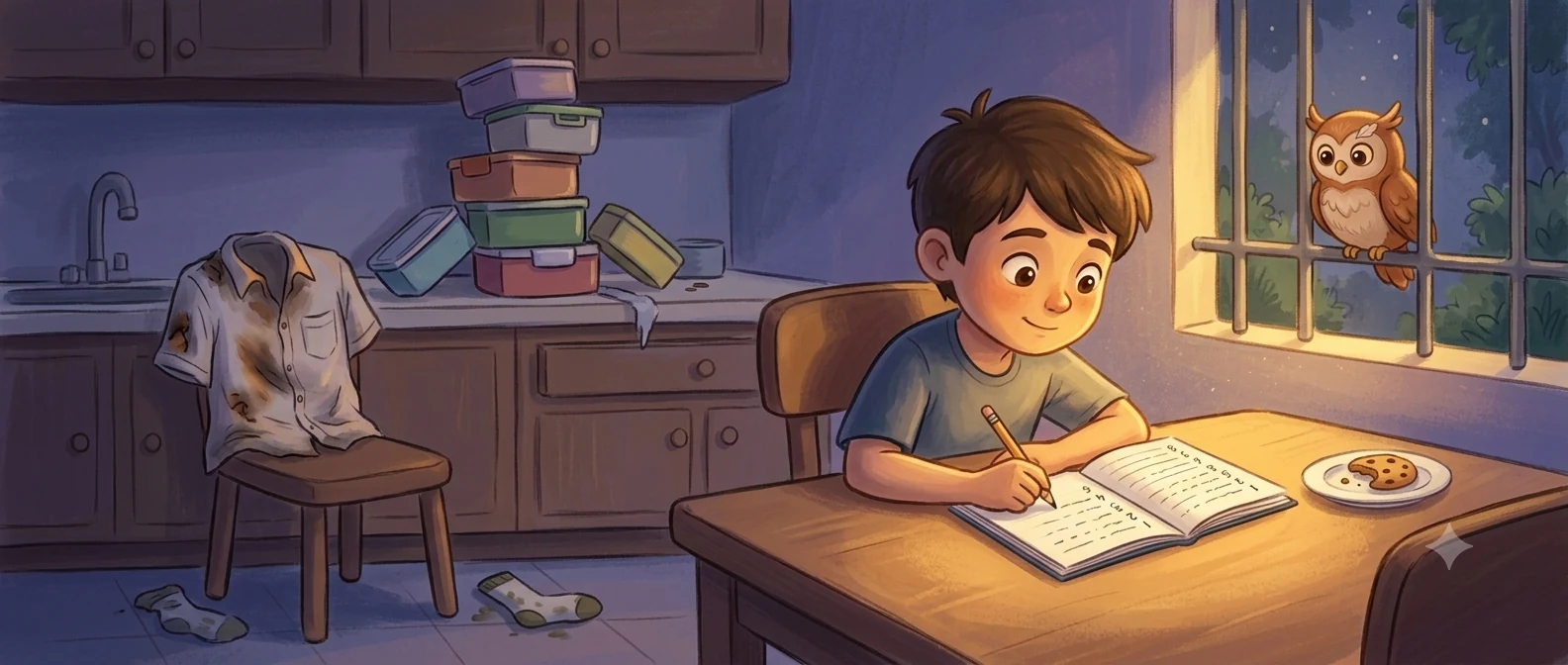
Ma left for Nagpur on a Sunday — two weeks, for Nani’s cataract operation — and the house began to break on Monday.
Not loudly. Nothing exploded. It broke the way a phone with 4% battery breaks. Everything technically present. Nothing quite working.
Arnav’s white school shirt had always simply existed, ironed, in the second drawer. It turned out to arrive there through a process. The process was Ma. Papa ironed one on Monday night with great confidence and burned a brown ghost of the iron into the sleeve. They both stood looking at it like investigators at a crime scene.
Tuesday’s tiffin was — Papa’s word — “experimental.” The water filter had a blinking light, which Ma had apparently understood and acted on for years. It blinked at Arnav and Papa in a language neither of them spoke, until Wednesday’s water tasted of pipe. The dhobi came, went unpaid, and had to be chased down the lane. Arnav’s Thursday PT kit did not appear. It turned out PT kits had never just appeared. They were washed on Tuesdays — specifically Tuesdays, because Wednesday’s sun mattered for drying. Arnav had lived beside this fact for eleven years without once seeing it.
On Friday, the watchman’s daughter came asking about the maths notebooks Ma always saved for her. Arnav stood at the door not knowing what she meant. There was a whole hidden economy running out of this flat. Old notebooks flowed somewhere. Extra rice on some days went somewhere else. Mrs. D’Souza’s plants got watered when her arthritis was bad — that one came out on Saturday, through a hurt look over the balcony rail.
That night, Arnav took his rough notebook, opened a fresh page, and wrote at the top: THINGS MA DOES THAT NOBODY SEES.
He meant to write five or six. It came out to eleven by bedtime.
By the middle of week two, it was thirty-four. The list had changed him in a way he couldn’t undo: he now saw it everywhere. That was the strange power of writing things down. The gas cylinder booking. The exact ratio of his Milo. Knowing which day the good sabziwala came. Being the person who remembered whose birthday it was in the family group — on both sides. Number 27 shook him a little: knows my exam timetable better than I do, starts revision fights three days early on purpose, so the panic happens with time still left. He had always filed those fights under “Ma being annoying.” Refiling them at eleven-thirty at night was uncomfortable in a way he decided to keep.
Papa, it must be said, was doing his honest best. By week two, the two of them had a wobbly system running. But that led to the other discovery, which became number 31: the difference between a house that is managed and a house that is loved is about two hundred small things, and none of them are jobs anyone gave her.
Ma came home on a Sunday evening, tired from the train, happy about Nani’s new eye. Arnav had thought about a speech, or a card. Both felt too small. Worse, they felt like a performance — like a bouquet bought in a hurry at the traffic signal.
So instead, while she was still telling Papa about the surgeon, Arnav quietly made tea. Half a spoon of sugar. Boiled, not dipped. The ginger crushed the way she did it for herself — last of all, after everyone else’s — in the brown cup. Item seven. He had practised twice.
He put it in front of her mid-sentence.
Ma looked at the cup. Looked at him. Something crossed her face that he would spend some years learning to read fully. Surprise. Amusement. And underneath, something like hunger. The hunger of a person who pours out two hundred invisible things a day, for years — and has just watched one, only one, come back with her name on it.
“What’s this?”
“Item seven,” said Arnav, and put the notebook beside the cup.
She read the whole list without a word. He watched her go down the page. Watched her stop at 27. Watched her arrive at 31. Then she laughed once, wetly, wiped her eyes with the heel of her hand, and said the thing that told him she’d understood it exactly:
“The dhobi. You found out about the dhobi.”
She never framed the list. Never mentioned it at dinners. Never used it against him. That was so unlike the usual fate of sentimental family objects that it took him a while to understand. She didn’t need the object. She had been seen, once, in writing. That had already happened, and it couldn’t unhappen.
The list stayed in the rough notebook. But item seven left the page. Sunday evenings, the brown cup, half a spoon, ginger crushed. Hers before anyone’s.
Some thank-yous you say. The better ones, it turns out, you schedule.
Talk About It
- Why had Arnav never noticed any of the things on his list before? What made them suddenly visible?
- Arnav decided a thank-you speech would be 'too small.' Why did doing item seven say more than saying it?
- If you kept a list like Arnav's for one week, whose invisible things do you think would fill it?
Did this story land tonight?
One tap helps us write better ones. No login, nothing shared publicly.
Thank you — this genuinely helps. 🌙