The Notice Board
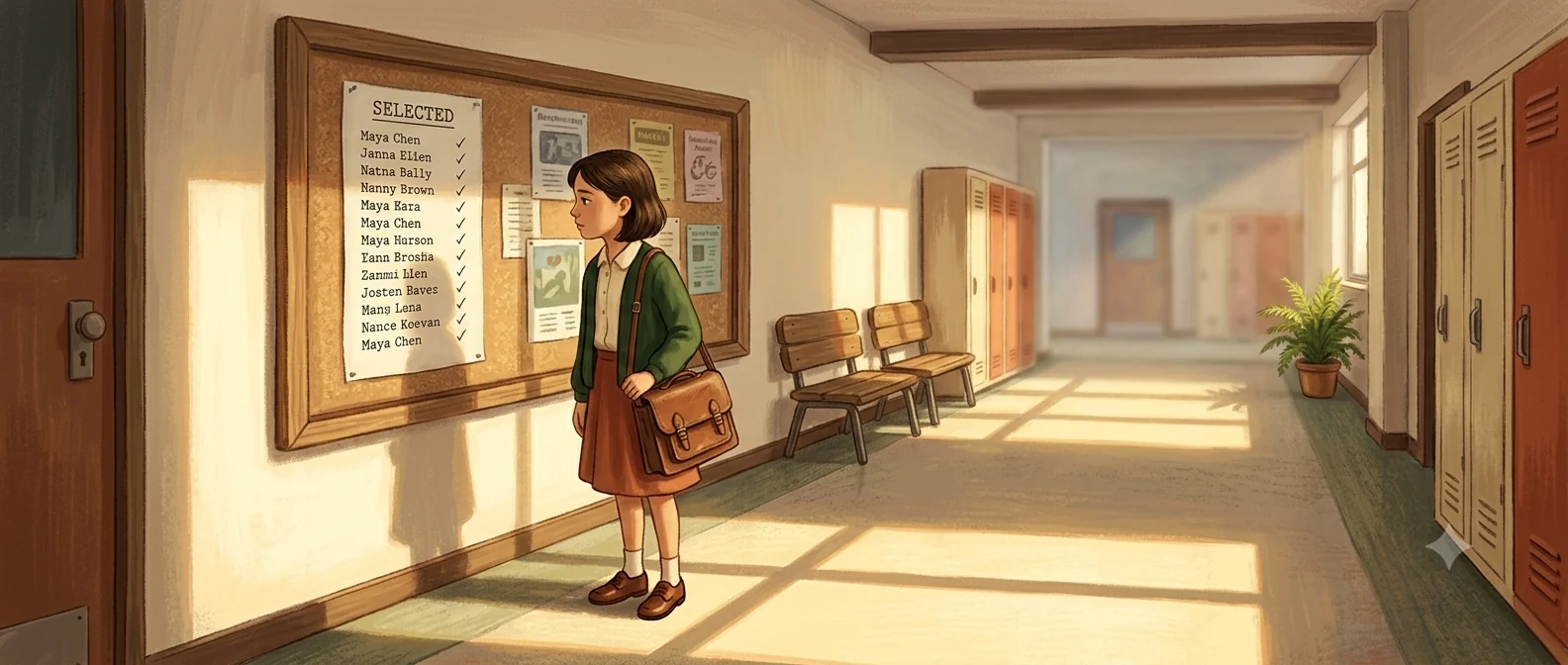
The list went up on a Tuesday, at lunch, on the notice board outside the gym. Typed and signed: School Basketball Team — Girls U-13. The following eleven students…
Tara read it four times. Not because it was long. Reading it again was the only way to keep standing there without understanding it.
Her name was not on it.
She had done everything the summer asked. The 6 a.m. dribbling drills in the society parking lot, with chalk lines for cones. Two hundred free throws a week, counted honestly. She had grown her left-hand layup from an embarrassment into a possibility. All of June. All of July. A girl, a hoop, and a plan — and the plan had come down to eleven typed names, in alphabetical order, none of them hers.
Priya’s name was fourth. Priya, her best friend, who had trained beside her in the parking lot, came sprinting up the corridor with her face already trying to fold its joy small, out of respect. Kindness like that can still land like a slap.
“You’ll get in next—”
“I’m really happy for you,” Tara said. The terrible part was that it was true. Both things were true at once — the gladness and the hurt, sitting in her chest side by side, refusing to cancel out. Nobody warns you about that. She hugged Priya, made her mouth do a smile, and got herself around the corner into the empty stairwell before her eyes filled. She stayed there for one whole bell.
The week that followed had its own weather. She avoided the gym corridor, which took elaborate rerouting. Lunch with the team girls became a place she didn’t belong — practice-schedule talk, new-jersey talk, Priya glancing over mid-sentence, careful. Her mother said, “There’s always next year.” It was true. It didn’t help.
On Friday she went to see Coach D’Mello. Mostly because not knowing why had become worse than the cut itself.
The coach didn’t do the soft face, and Tara was permanently grateful for that. She pulled out the trial sheets and ran her finger down a column, laying it out like an engineer. “Free throws — top three of everyone I saw. Fitness, fine. Game sense, good. You see the pass before it exists. Two things sank you.” She held up two fingers. “Footwork under a real defender. You travel when you’re pressured — three times in the scrimmage. I can’t coach that out of you in one season with eleven other girls to run. And your left hand exists in drills but disappears in traffic.” She slid the sheet across. “You were twelfth or thirteenth out of thirty, Tara. That’s not a no. That’s an almost — and an almost hurts worse than a nowhere-close. You drowned within sight of the shore.”
“So what do I do with a year?”
“Footwork against bodies, not cones. Find real defenders. And make the left hand boring.” The coach looked at her. “Most girls I cut, I never see again. The list tells me who wanted the jersey. Next June tells me who wanted the game.”
Here is what a year actually looks like, since stories usually skip this part. It looks like sixty more Tuesdays. Tara talked her cousin and two colony boys into being her defenders in the parking lot. Real ones — arms, shoves, trash talk. She travelled, and travelled, and then stopped travelling, somewhere around November, without noticing the exact day it happened. The left hand got its two hundred throws a week until it stopped being a project and became just a hand. She watched the school team’s matches from the stands. All of them. It stung in September and only pinched by February. And she learned things watching that she could never have learned playing — where the passes died, and who never protected the ball going left.
Priya still trained with her on Sundays. The friendship had one hard, wordless month in there somewhere. It came out the other side stronger at the mended place, the way some things do.
In June, the list went up on a Tuesday. Twelve names this year — the new coach wanted a full reserve.
Tara was twelfth.
Twelfth. Last name on the paper. First reserve. The seat nearest the door. She stood in front of the notice board while the number tried to tell her one story — barely, scraped in, last — and the summer told the other one, the true one. Eleven girls ahead of her. Thirty behind. And the shore she had once drowned in sight of, now under her feet.
She played four minutes in the first match of the season, when Priya turned her ankle. Scored twice.
Left hand, both.
Talk About It
- Tara's hardest moment wasn't reading the list — it was congratulating Priya. Why is it so hard to be happy for someone and hurt at the same time? Can both be real?
- Coach D'Mello gave Tara a map instead of comfort. Which do you think helps more the day after a failure — and which helps more a month after?
- Tara ended up twelfth on a list of twelve. Why did that feel like more than it sounds like?
Did this story land tonight?
One tap helps us write better ones. No login, nothing shared publicly.
Thank you — this genuinely helps. 🌙