The Slow Ball
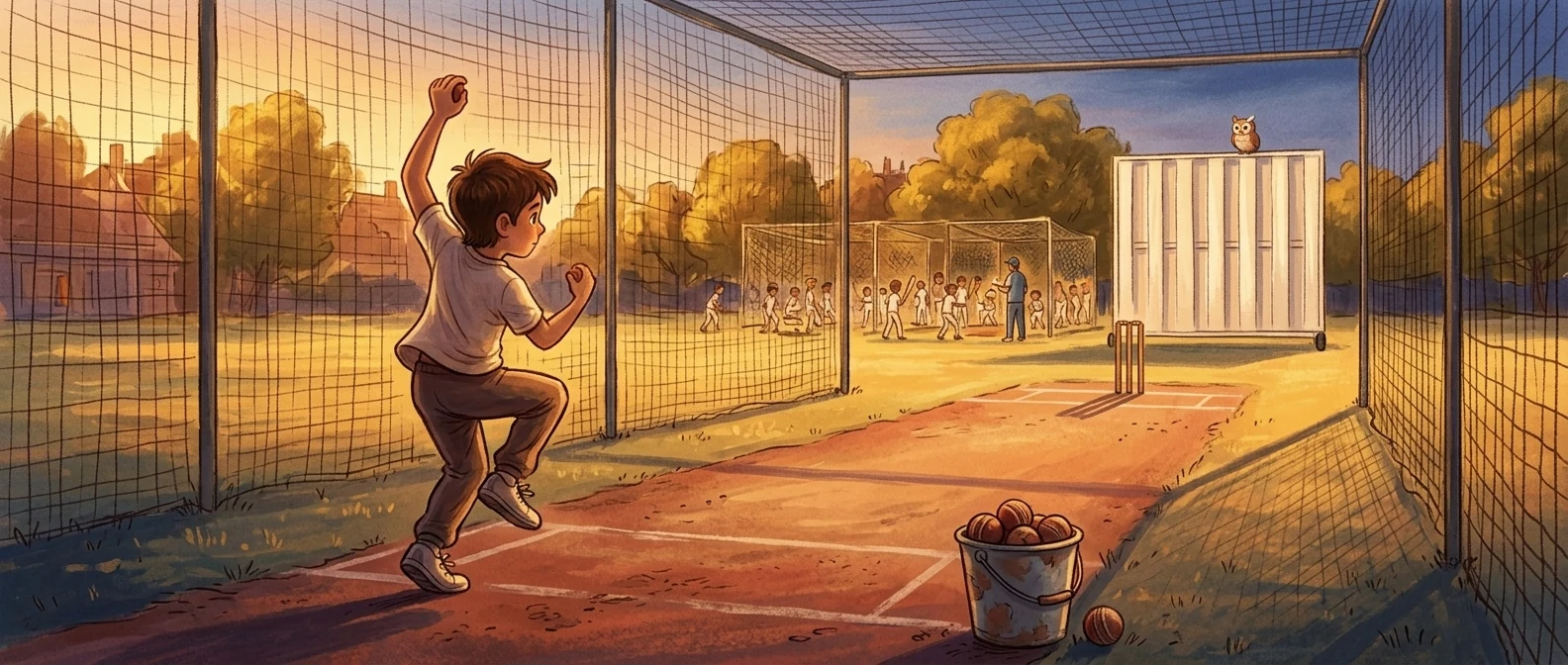
The day Ishan joined the academy, Coach Salvi asked every new boy the same question: “What do you bowl?”
“Leg-spin,” said Ishan. He said it the way you say a secret wish out loud for the first time. Because it was one. He had spent a whole summer watching wrist-spinners on the TV in his uncle’s shop, standing up the whole time, nose almost at the screen. The ball floated up slow and innocent, then turned sideways at the last moment, and the batsman’s shot was already wrong. Ishan had watched that happen and thought: that. Whatever that is, I want to do that.
Coach Salvi looked at him a moment longer than he’d looked at the fast bowlers.
“Show me your wrist.” Ishan flicked an invisible ball. Something in the coach’s face sharpened. “Hm,” he said. Then he pointed down the empty third net, where one stump stood alone on a worn brown patch of turf. “That’s yours.”
Ishan assumed he meant for the day.
He meant for the season.
The drill was this: one leg-break, landing on the patch just wide of the stump, turning back in to knock it over. That was the whole drill. A bucket of old balls, scuffed grey and soft at the seam. The stump. The patch. Bowl, walk down, collect, walk back, bowl. Two nets over, Rohan and the pace boys thundered in. By August they were playing practice matches on the main ground, taking real wickets, shouting real appeals. Ishan bowled at a stick of wood.
“When do I bowl to a batsman?”
“When the stump complains about you three days in a row.”
In the second month, Ishan discovered the truth about the drill. It was not one thing. It was a hundred hidden things. Some days the ball turned but landed short. Some days the length came right and the wrist fell asleep. Leg-spin, he learned, was not one thing his arm did. It was a stack of small ones, and every single one had to arrive in order. The grip. The wrist. The shoulder, the hip, the fourth finger, the seam coming off last. If most of them obeyed and two did not, the ball was rubbish. And Tuesday’s perfect ball promised nothing about Wednesday. Through all of it the stump just stood there, unimpressed, like a teacher who has seen forty years of boys.
In October, Rohan took five wickets in a match against another academy and got clapped off the ground. That evening Ishan stood at the mouth of the third net and hated all of it. The patch. The bucket. The silent stump. He decided, walking home, that he would switch to medium pace. Pace was honest. Pace was now. You ran in, you bowled fast, and things happened in the same week you worked for them.
He came early the next day to say so. He stopped outside the office door, because Coach Salvi was inside, saying his name to the other coach.
“—the new boys? The quick ones are fine. They’ll be club cricketers. The one I’m watching is the leggie.”
“The little one on the single stump? He’s played no matches at all.”
“Because a wrist like that comes along once in five years. And every one I’ve seen ruined was ruined the same way. Matches too early. Captain won’t set the field. Boy gets hit for two sixes. He starts firing it in flat and safe. By fourteen he’s not a leg-spinner anymore. He’s just a boy who used to have a wrist.” A chair creaked. “Fast bowling you can buy in a shop. Leg-spin you have to grow. And growing has one speed.”
Ishan walked to the third net. He did not switch to medium pace.
It did not click that afternoon. It happened in February, and slowly even then. One week, without any ceremony, the stump simply began to lose. Regularly. The ball would leave his hand and he would already know, mid-air, what it was going to do. Drift. Dip. Land. Turn. The eleven parts had stopped being parts.
Coach Salvi watched one Thursday over. He said “Hm” — the same Hm as day one, but heavier — and put him in Saturday’s match.
Ishan’s first over in real cricket went for eleven runs, including one that never bounced at all, which a big kid from Dadar Academy hit over the canteen roof. The walk back to his mark was the longest of his life — past the umpire, past his own shoes, past the flat grass where the ball had landed. Every instinct screamed at him to bowl flat and safe, to just contain. He didn’t. He tossed the next ball up even slower — the brave direction. It drifted in, dipped, bit the turf on the exact patch he had stared at for six months, and knocked out middle stump.
Two wickets that day. Also two more balls over the boundary rope. Ishan looked at the scorebook for a long time afterwards, and did not feel sick.
At the gate afterward, Coach Salvi took a proper season ball out of his bag and put it in Ishan’s hands. Cherry-red. New, with the seam still stiff.
“What’s this for?”
“Year two,” said the coach, already walking away. “Of five.”
Talk About It
- Coach said fast bowling is 'bought' and leg-spin is 'grown.' What do you think grows in a person during the boring middle of learning something?
- Ishan almost quit at the worst possible time — right before it clicked. How can you tell the difference between something not working and something not working yet?
- What's your 'single stump' — the slow, unglamorous practice behind something you want to be great at?
Did this story land tonight?
One tap helps us write better ones. No login, nothing shared publicly.
Thank you — this genuinely helps. 🌙