The Sunny Spot
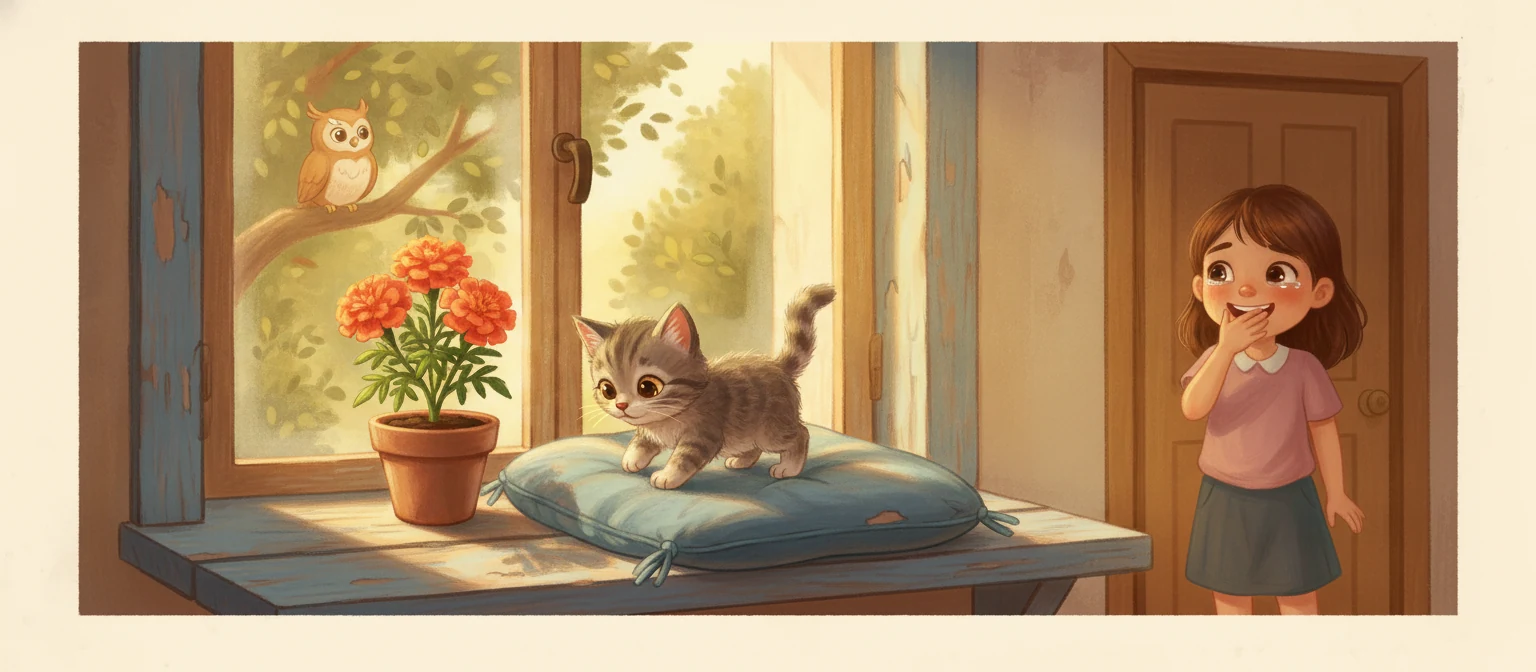
Every house has its geography, and in Elsa’s house, the capital city was the windowsill in the front room — because that’s where the sunny spot lived.
At around three o’clock every afternoon, the sun came past the roof across the street and landed on the sill in one warm golden square. And in that square, every afternoon for as long as Elsa had been alive, lay Mochi. A round grey cat with a crooked ear and a rumbling purr. She soaked up her kingdom, and opened one eye when Elsa came home from school, as if to say: ah, you again — acceptable.
Mochi was seventeen, which is very old for a cat. Elsa knew that. Knowing, it turns out, doesn’t do much.
Mochi died in spring, quietly, at the vet’s, with Mum’s hand on her and Elsa saying goodbye through the kind of crying that soaks your collar. And the family grieved the way families do — the burial under the garden tree, the photos shared, the first strange dinner where nobody’s chair got rubbed against.
Elsa was mostly all right, is the surprising thing. Mostly. School helped. Weekends helped.
Three o’clock did not help.
Because every afternoon, on schedule, the sun still came past the roof and landed on the windowsill in one warm golden square. And it lit up nothing. An empty cushion. The most punctual reminder in the world, arriving daily, of exactly who was missing. Elsa started avoiding the front room after school. Then she started avoiding telling anyone she was avoiding it.
Mum noticed anyway. Mums are their own kind of punctual.
“The sunny spot?” she asked, one afternoon, finding Elsa reading in the kitchen for the ninth day running. Elsa’s eyes went hot immediately, which answered that.
“It’s just — the sun keeps coming,” said Elsa, furious at the sun, at the roof across the street, at three o’clock. “It comes every day and she’s not there and it lands on nothing and it doesn’t even know.”
Mum sat down. “You know what grief is?” she said. “It’s love with nowhere to go. Mochi’s gone. But all that three o’clock love of yours keeps showing up on schedule, with no cat to land on.” She was quiet a moment. “So maybe don’t give it nowhere. Give it somewhere small.”
It was Elsa’s own idea, in the end, what the somewhere should be. That weekend she planted a marigold in a little pot. Orange — because Mochi had been grey, and the spot deserved some colour at last. She set it on the old blue cushion, right where the sun landed.
And three o’clock changed. Not fixed — changed. Now the sun came past the roof and landed on something living. Something that visibly loved the light the way Mochi had, turning its round orange face to follow it. Elsa came back to the front room. Watering the marigold at three became the new small ceremony. Some days it came with tears. Most days it didn’t. And the love had somewhere to go.
The kitten arrived in autumn. Not as a replacement — the family had talked about that word and agreed it wasn’t a real thing. You don’t replace. You make new room. He was small and grey-smudged and frankly ridiculous. His name was Pixel. For his first week, he ignored the front room entirely.
Then, one afternoon in October, Elsa came home from school and stopped dead in the doorway.
The sun was on the sill, golden and punctual. The marigold was turning its face to it.
And beside the pot, stretched out in the warm, lay Pixel. One paw over his nose. Entirely at home. As if the spot had been advertised, and he’d read the notice.
Elsa stood very still, hand over her mouth, feeling two things at exactly the same time, and letting herself feel both, because by now she knew that was allowed:
That’s Mochi’s spot.
And: look — it’s warm again.
Talk About It
- Why was the empty sunny spot harder for Elsa than anything anyone said?
- Mum said grief is 'love with nowhere to go.' Where did Elsa's love slowly find to go?
- The new kitten wasn't a replacement. What's the difference between replacing someone and making room for someone new?
Did this story land tonight?
One tap helps us write better ones. No login, nothing shared publicly.
Thank you — this genuinely helps. 🌙