The Last Photo
The camp was three days in the hills, with waterfalls and a bus that broke down twice on the way up. Sara almost didn’t go, because of Guddu.
Guddu was thirteen — ancient for a dog his size. His white fur had gone yellowish at the ears. He spent most of the day asleep in his corner by the shoe rack, on a folded blanket that used to be a bedsheet. He had slowed down all winter. But the vet said his heart was “managing,” and Ma said, “Beta, he sleeps twenty hours a day. He won’t even notice three of them.” So Sara rubbed his ears goodbye and told him something. She remembered the exact words afterwards. “Back on Friday. Don’t do anything interesting.”
He died on Wednesday afternoon. In his corner, on the blanket, in his sleep. Sara was standing under a waterfall two hundred kilometres away, in her wet shoes, laughing.
They told her at pickup on Friday. Her parents had decided not to tell her over the camp office phone. So the last two days of Guddu’s life had been the two best days of her trip. She had come home sunburned and singing, with a keychain for him in her jacket pocket. A keychain. For a dog. It was shaped like a bone. She’d known it was silly in the shop. He would have sniffed it once and gone back to sleep. She had bought it anyway.
The keychain went into her desk drawer, under the spare batteries and the broken stapler. The drawer stayed shut.
I wasn’t there.
He had died with the house empty till evening, the front door shut, the fan off. Had he looked for her? Dogs have a clock. Everyone knows dogs have a clock — 4:15, school gate, the white face at the window. Wednesday, 4:15. No Sara. Had he waited at the window? In the dark, she built the scene forty different ways, each one worse. He waited. He wondered. He stopped wondering. And where was she? Under a waterfall. That was the charge she read out against herself every night. Not that he died. That he died without her — in the one week of thirteen years she had chosen a trip over his corner by the shoe rack.
She stopped mentioning him. His bowl went into the cupboard behind the pressure cooker, and she did not ask who had put it there. She deleted nothing and looked at nothing. Her phone held six years of Guddu photos, and she scrolled past the white blur of him fast, eyes away. When her parents brought him up gently at the dinner table, she took her plate to the kitchen. Being sad was allowed to show. The verdict she kept to herself.
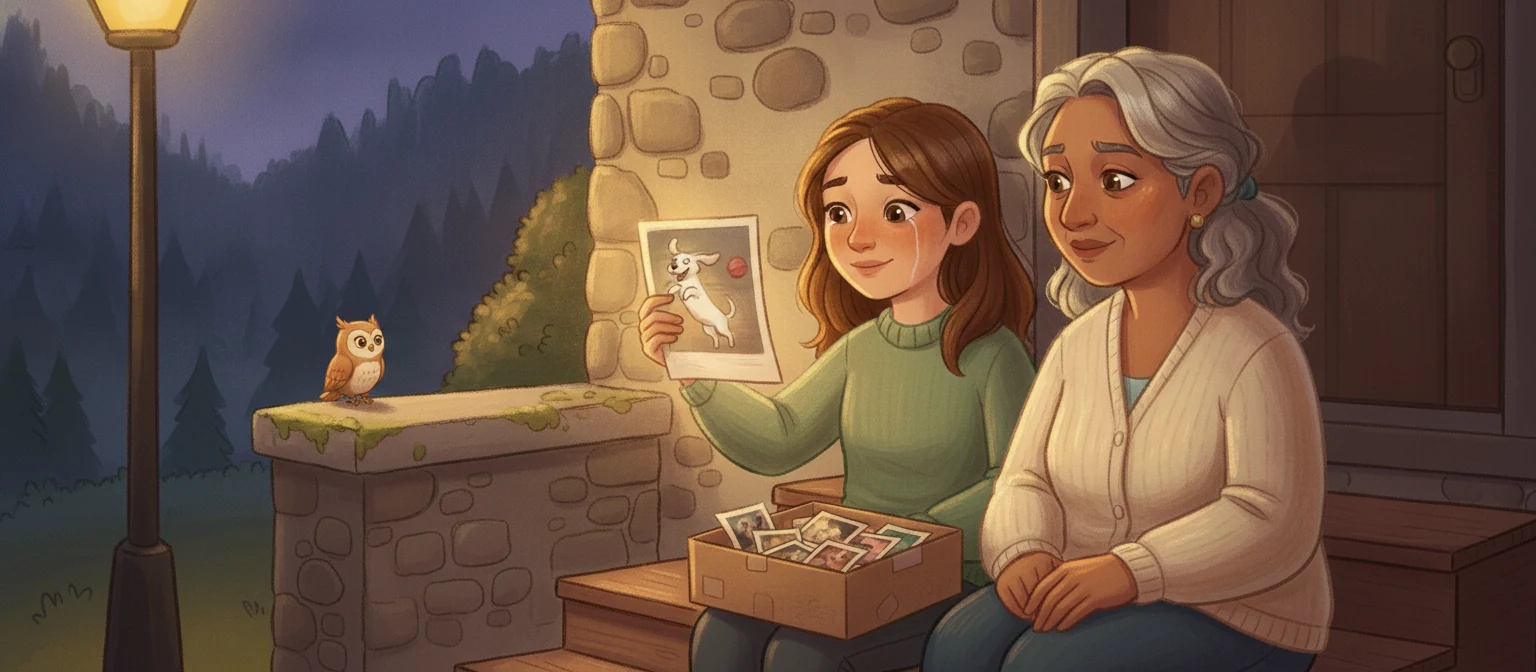
It was Masi, her mother’s sister, who caught the scent of it in August. Masi had lost her own old cat two years before, and she knew the special silence Sara was doing. She turned up one Saturday with a tin of biscuits and a shoebox of printed photographs, from the years when Sara was small and Guddu was young. She sat Sara down on the back steps at dusk, put the box between them, and took off the lid.
Sara looked away from a photo of Guddu mid-leap. Young, airborne, ridiculous, chasing a red ball. And it came out before she could stop it:
“I wasn’t there.”
“Ah,” said Masi, without gasping, which is why children tell aunts things. She put the lid of the box down on the step. “There it is. Go on.”
The whole case came out. Wednesday. The waterfall. 4:15 and the window. The empty house. The keychain in the drawer. Masi listened all the way to the end, like a judge who actually reads the papers. Then she took it seriously.
“Okay. Let’s weigh it your way. On one side: one Wednesday. Three days. Out of — count with me — thirteen years. More than four thousand days. Who fed him half of those days? Who walked him in the rain, complaining the whole way, and went anyway? Who slept on the floor next to him for a week after his surgery? Your mother told me. You were nine.” She tapped the photo of the leap. “Who threw this ball?”
“That’s not—”
“It is exactly. You want to grade thirteen years by the one hour you missed. Tell me. If it were me? If my cat had died while I was at your cousin’s wedding — would you say I failed her? That fifteen years stopped counting?”
“No,” said Sara, instantly. Then she heard it, and stopped, and sat on the step with her hands around her knees.
“Love is measured in the years, Sara. The last hour doesn’t get extra marks. And this part I know from my own guilt, so listen. He did not spend Wednesday missing you. That’s our disease — the rewinding, the rebuilding. Dogs don’t file cases. He was warm. He was home. He was thirteen. He went to sleep in the corner where his whole good life happened.” She nudged the box. “You weren’t missing. You were coming back Friday. As far as that dog ever knew, you were always coming back Friday. And you always came.”
They went through the shoebox until the streetlight came on over the wall. The leap. The puppy photos. The one where toddler Sara is sitting on him like a cushion, holding a spoon. Somewhere in the middle Sara was crying and laughing at the same photo, and Masi said that was the correct dose.
That night, alone, Sara sat on her bed with the phone in both hands and scrolled slowly. All six years. She did not look away once.
The keychain came out of the drawer too. It hangs on the zip of her school bag now, next to her water bottle. A bone-shaped silly thing, a present for a dog who never needed presents — and who never once, in thirteen years, doubted she was coming back.
Talk About It
- Sara kept saying 'I wasn't there.' What was she really accusing herself of — and was it fair, by the standards she'd use for anyone else?
- Masi said love is measured 'in the years, not the last hour.' Why do our minds want to grade the last hour so heavily?
- Why do you think Sara could finally look at the photos again after the conversation on the steps?
Did this story land tonight?
One tap helps us write better ones. No login, nothing shared publicly.
Thank you — this genuinely helps. 🌙