The Biscuit Box
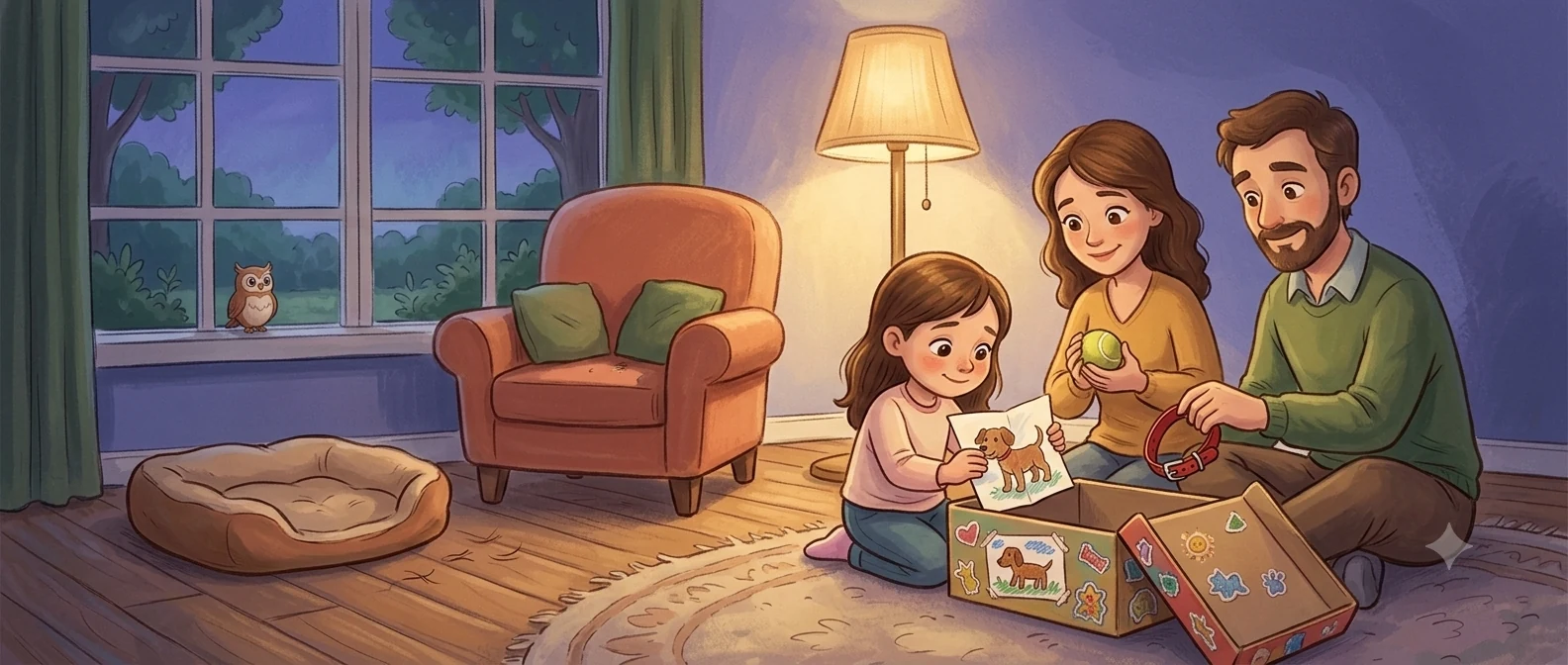
Biscuit was old. He had been old as long as Rosa could remember — a brown, slow, warm old dog whose tail still thumped hello even when the rest of him was too sleepy to get up.
He liked three things best: his cushion by the armchair, the smell of dinner, and Rosa.
One morning, Mama and Papa sat down with Rosa, and their faces were soft and serious at the same time, and Mama said the true words, gently, the way true words should be said:
“Biscuit died last night, love. He was very old, and his body finished working, all peaceful, right there on his cushion. He isn’t hungry or tired or hurting anymore. But he’s gone, and he isn’t coming back. And that is very, very sad.”
It WAS very sad. Rosa cried, and Mama cried, and Papa’s eyes went shiny. Nobody said “don’t cry.” Because at their house, sad about someone you love is allowed to be exactly as big as it is.
The house felt wrong for days. Too quiet. Nobody clicked across the kitchen floor. Nobody thumped a tail at dinner-smell. And the cushion by the armchair sat empty, which was somehow the loudest thing of all.
Then, on Saturday, Papa brought out a shoebox and some paints.
“For Biscuit’s things,” he said. “Not to hide them away. To keep them safe. A remembering box.”
They painted the box brown — Biscuit-brown — with a wobbly bone on the lid. Then, slowly, the family filled it.
In went his red collar, with the tag that jingled.
In went his tennis ball, worn smooth and bald from a thousand throws.
In went Rosa’s drawing of him — extra-thumpy tail, because that was the truest part.
In went a photo of the famous day he stole a whole sock from the laundry and would not give it back. Everyone laughed remembering it — a real laugh, in the middle of a sad week. And Mama said that was exactly right: “That’s what the box is for. The missing and the laughing live in there together.”
The box went on the low shelf, where Rosa could reach it.
And here is how it worked, in the weeks and months after. Sad about someone you love doesn’t go away all at once. It comes back in little waves — at dinner-smell time, or passing the park, or for no reason at all. When a wave came, Rosa would say, “I miss Biscuit,” and somebody would say, “Me too. Box?”
And they’d open it together, and hold the smooth old ball, and tell the sock story one more time. And the wave would turn — from just-missing into missing-and-remembering, which hurts less and warms more.
Because that’s the secret the box knew all along.
Loving someone doesn’t end when they’re gone.
It just changes jobs — from patting and feeding and throwing the ball, to keeping and telling and remembering.
And that job, Rosa’s family agreed, opening the box on Biscuit’s birthday with two biscuits each in his honour, is a job for always.
Talk About It
- What did the family keep in Biscuit's box? What would you put in a box like that?
- Rosa's sad came back sometimes even after a long while. Is that okay? What did her family do when it came?
- Is there someone or some pet you remember? What's your favourite remembering about them?
Did this story land tonight?
One tap helps us write better ones. No login, nothing shared publicly.
Thank you — this genuinely helps. 🌙