The Collar on the Hook
Moti had been in the family two years longer than Kabir.
His parents liked to bring this out at dinner. Moti had met Kabir at the hospital gate. Moti had looked into the cradle, sniffed once, and walked away satisfied.
He was a big brown-and-white dog of no particular breed, with one torn ear, and he had opinions about everything.
He believed the postman was a criminal. He believed the space under Kabir’s study table belonged to him, especially in exam week, when a boy’s feet get cold. And he believed the evening walk had to stop at the gulmohar corner. The tree there dropped its red flowers all over the footpath. Moti read the wall at that corner for one full minute, every single day. The wall’s news never changed. Moti checked it anyway.
By the year this story happened, he was very old. The hair around his muzzle had gone white, and his back legs shook on the stairs. The evening walk got shorter, then slower, then stopped.
“He’s an old man now,” Papa said gently, more than once that year. “You understand?”
Kabir said he understood. Saying it was easy.
It happened in the winter, at home, in his sleep. On the cool floor under the study table, in the spot where a boy’s feet get cold.
The first days were strange. No claws clicking on the floor at food time. No sigh from under the table. The water bowl stayed by the kitchen door, and nobody moved it, and nobody said anything about nobody moving it.
Kabir found that he was angry, and he could not say what at. At the postman, for still coming. At the wall by the gulmohar, for standing there with its news and nobody left to read it.
His little sister cried loudly for two days and then was fine. Kabir did not cry much, and that worried him.
Then, eleven days after, Rohan said something idiotic on the school bus and Kabir laughed. Really laughed. And stopped in the middle of it, like a boy caught stealing.
Eleven days, he thought. And you are laughing.
He told Ma that night at the kitchen table, not looking at her, lining the words up carefully first. Was it wrong that he had laughed? Did it mean he was forgetting?
Ma was quiet for a moment.
“When Moti was young,” she said, “before you were born — he ate a whole tray of laddoos at your Bua’s wedding. The round yellow ones. Twelve of them. Then he sat under the sweets table looking so innocent that everybody blamed the caterer.”
Kabir laughed before he could decide not to.
“There,” Ma said. “Just now. Was that forgetting him?”
After that they did it on purpose. One Moti story at dinner, from whoever had one. The war with the postman, and the afternoon he got hold of the postman’s bag. The twelve laddoos. The monsoon he refused to get wet in, so that somebody had to carry him over every puddle like a king.
Some of the stories still had tears in them. They arrived halfway through, without warning. Nobody stopped for them, and nobody stopped telling.
In the spring the water bowl was washed and put away on a shelf. The collar stayed on the hook by the door — old red cloth, the metal tag worn smooth.
When the next monsoon broke, Kabir took the evening walk again.
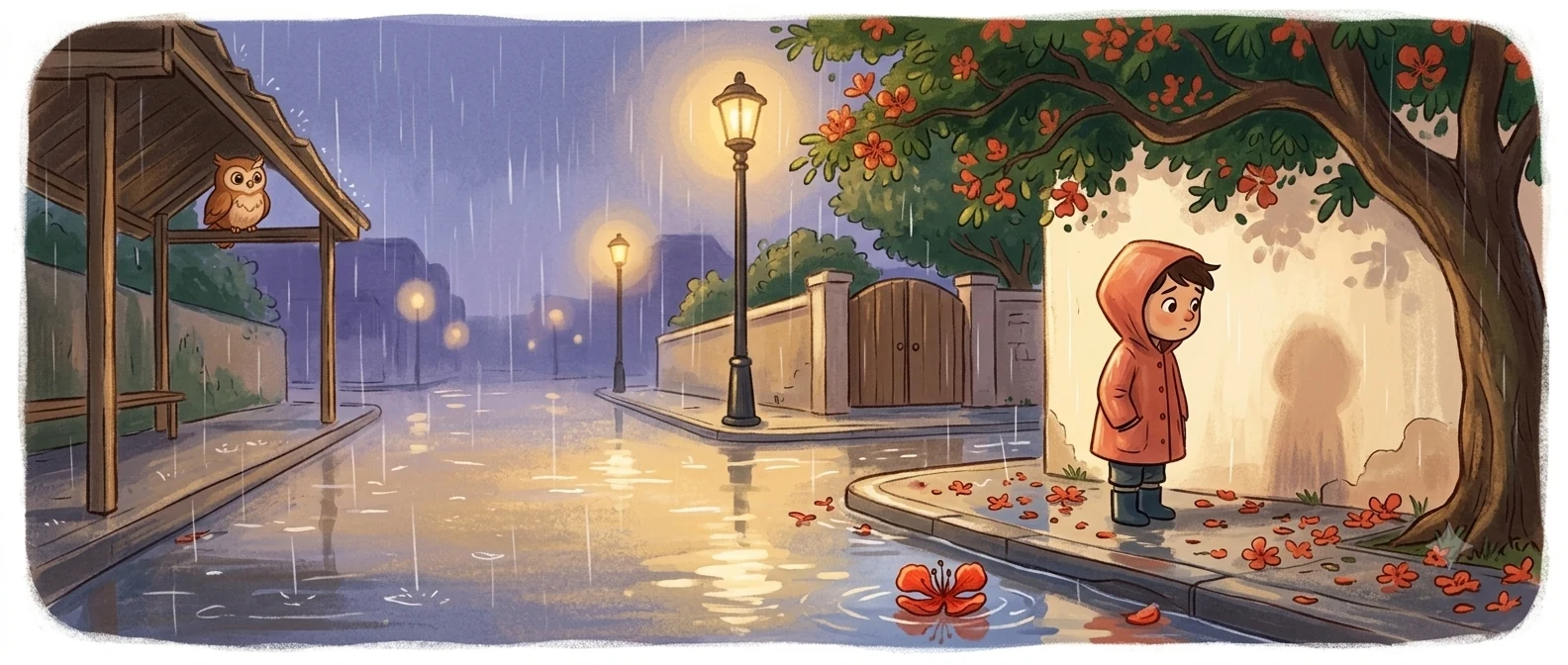
He went the old route. He stopped at the gulmohar corner in the light rain, by the wall, and he stood there for one full minute. Red flowers lay flattened all over the wet footpath. One of them spun past his shoe in the gutter water and was gone.
“Nothing new,” he said, to the corner, and to the rain, and to the empty space beside him. “Same wall. You are not missing anything.”
Then he walked home, past the bus stop, under the dripping trees, up the stairs, and in at the door.
The collar is still on the hook. It is not waiting any more.
Talk About It
- Kabir felt bad the first time he laughed after Moti died. Do you think laughing meant he had forgotten? What else could it mean?
- Why do you think Kabir kept the collar?
- If you could tell someone one favourite memory of a pet or an animal you have known, which one would you pick?
Did this story land tonight?
One tap helps us write better ones. No login, nothing shared publicly.
Thank you — this genuinely helps. 🌙